 and Pseudoeuclidean Spaces
  .
.
3. Lagrangean Conventional Euclidean Spaces
and Pseudoeuclidean Spaces .
Let N denote the number of material particles making a classical closed
system. Time back, Lagrange has noted that kinematics and dynamics of,
say, two material particles A (xA, yA, zA)
and B (xB, yB, zB) having masses
of rest  and
and  may be formally interpreted in a conventional Euclidean space
  in a way as if only one material point having mass
  is moving in that space. Here the only idea is that six coordinates zs
(s=1,2,...,6) of this "united" particle should be defined as follows:
is moving in that space. Here the only idea is that six coordinates zs
(s=1,2,...,6) of this "united" particle should be defined as follows:
 (3.1)
(3.1)
If these coordinates are set off in the directions of six orthogonal
unit vectors  then at
any moment of absolute time t the position of the "united" particle
and its kinetic energy T(t) will be described by expressions
then at
any moment of absolute time t the position of the "united" particle
and its kinetic energy T(t) will be described by expressions
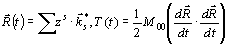 . (3.2)
On the grounds of six-dimensional conventional Euclidean space  having basis unit vectors
  and the coordinates (3.1) of a single material particle M00
it is easy to construct a seven-dimensional pseudoeuclidean vector space
and the coordinates (3.1) of a single material particle M00
it is easy to construct a seven-dimensional pseudoeuclidean vector space  exactly same way how the space
  has been constructed on the basis of a space
  by adding the coordinate t and the unit vector
  .
Now we must only to change all
.
Now we must only to change all  into such
  , when
  and
and  , and then to add
  and coordinate t. The same idea may be generalised to get a pseudoeuclidean
space
and coordinate t. The same idea may be generalised to get a pseudoeuclidean
space  where the only one
material particle is regarded instead of regarding N points in space
where the only one
material particle is regarded instead of regarding N points in space  .
.
In the space  one can
construct different groups of orthogonal transformations of seven coordinates
one can
construct different groups of orthogonal transformations of seven coordinates 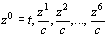 and of co-transformations of unit vectors
  .
In fact, all those groups of transformations will be subgroups of the most
general group of ortogonal transformations in space
.
In fact, all those groups of transformations will be subgroups of the most
general group of ortogonal transformations in space  of the type
  . This group
(D-group) can be represented by matrixis of type
. This group
(D-group) can be represented by matrixis of type 
 ,
where
,
where  generalizes the
former
generalizes the
former  , and
, and  has a block-structure
 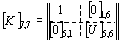 ,
where
,
where  -describe usual
rotation in subspace
-describe usual
rotation in subspace  .
Our objective, though, is to construct such a group (subgroup) of transformations,
which will have not less than two independent numerical or vector invariants.
The author thinks it to be his great achievement that he managed to find
(in D-group) so called g- group of orthogonal
transformations in
.
Our objective, though, is to construct such a group (subgroup) of transformations,
which will have not less than two independent numerical or vector invariants.
The author thinks it to be his great achievement that he managed to find
(in D-group) so called g- group of orthogonal
transformations in  , which
has an additional invariant dAB with the following generalisation
of this method upon the more general case of space
, which
has an additional invariant dAB with the following generalisation
of this method upon the more general case of space  having 2N-3 additional invariants (in the case of N=2 there
is only one additional invariant dAB and this invariant
is absent in the case of N=1, i.e. in the space
having 2N-3 additional invariants (in the case of N=2 there
is only one additional invariant dAB and this invariant
is absent in the case of N=1, i.e. in the space  ).
).
The first (traditional) invariant in the space  is existing in the whole D-group and follows from the property of
the vector
is existing in the whole D-group and follows from the property of
the vector  , which fix
the "united" mass M00 at each moment t
:
, which fix
the "united" mass M00 at each moment t
:
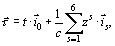
 . (3.3)
By this, in  -subgroup
seven coordinates
-subgroup
seven coordinates  of (3.1)
type are transformed into coordinates
of (3.1)
type are transformed into coordinates  and the unit vectors
  are
co-transformed into the basis
are
co-transformed into the basis  using orthogonal transformations belonging to the abovesaid g
- group, which is represented by above mentioned matrixes
using orthogonal transformations belonging to the abovesaid g
- group, which is represented by above mentioned matrixes  .
These transformations from g -group also consist
of pseudorotations in space
.
These transformations from g -group also consist
of pseudorotations in space  (special block-matrix [V]7,7 ) and of conventional rotations
in subspace
(special block-matrix [V]7,7 ) and of conventional rotations
in subspace  (special ortogonal
block-matrix [U]6,6 ) leaving the first unit vector
(special ortogonal
block-matrix [U]6,6 ) leaving the first unit vector  untouched.
It is shown that from six coordinates  of the type (3.1) one may proceed to six new (more convenient) coordinates
as follows:
of the type (3.1) one may proceed to six new (more convenient) coordinates
as follows: 
 (this is the centre of mass, but in “our” space
  )
and yet three coordinates xAB = xA - xB,
yAB = yA - yB, zAB
= zA - zB. These six new coordinates are
set off along new unit vectors
)
and yet three coordinates xAB = xA - xB,
yAB = yA - yB, zAB
= zA - zB. These six new coordinates are
set off along new unit vectors  and
and  , which are linear
combinations of former unit vectors
, which are linear
combinations of former unit vectors  in
in  :
:
 (3.4)
(3.4)
Above mentioned vectors  and accordingly the expression
  of
the form (3.3) may be presented in the new form:
of
the form (3.3) may be presented in the new form:
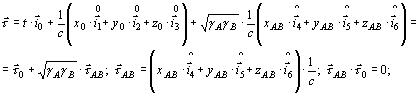 (3.5)
(3.5)
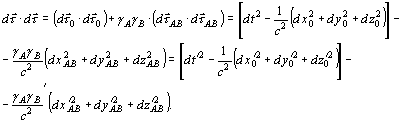 (3.6)
(3.6)
In case of transformations, belonging to g
-group, four unit vectors  are transformed in the subspace
  (from the whole space
  )
into new unit vectors
)
into new unit vectors  ,
using above mentioned matrix
,
using above mentioned matrix  and
and  from the
Pointcare group in the space
from the
Pointcare group in the space  .
But the three vectors
.
But the three vectors  undergoes
into
undergoes
into  by only usual transformation
of conventional rotation, using an orthogonal matrix
by only usual transformation
of conventional rotation, using an orthogonal matrix  from the same Poincare group (pseudoratation matrix
  in -subgroup do not change
both coordinates
in -subgroup do not change
both coordinates  and basis
vectors
and basis
vectors  ). It means that
subspace
). It means that
subspace  (having the unit
vectors
(having the unit
vectors  or
or  )
is an orthogonal supplement to the subspace
)
is an orthogonal supplement to the subspace  ,
i.e.
,
i.e. 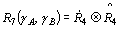 .
.
So we will have (in case of transformation belonging to -subgroup)
an additional vectorial invariant 
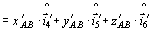 which may be regarded as a function of the invariant argument ?
, which represents the length of an arc drawn by the vector
of the form (3.5) in the whole space
which may be regarded as a function of the invariant argument ?
, which represents the length of an arc drawn by the vector
of the form (3.5) in the whole space  .
It is a natural consequence that a scalar quantity
.
It is a natural consequence that a scalar quantity

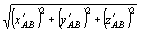
will also be invariant. The quantity dAB is not the
length of the vector  being
just a numerical invariant in space
being
just a numerical invariant in space  ,
but it is a "great luck" that this invariant has happened to resemble the
well-known expression from the space
,
but it is a "great luck" that this invariant has happened to resemble the
well-known expression from the space  geometry. The vector
  from
subspace
from
subspace  consequently
is an invariant too. But of course, the “part”
consequently
is an invariant too. But of course, the “part”  of vector
  is not invariant.
All this gives us a possibility to construct an invariant metric tensor
gss(dAB) as a function from invariant dAB
. This diagonal tensor gss(dAB) may serve
as a tool for arranging a pseudoriemannean space  using a pseudoeuclidean space
  with its invariant vectors
  and
and  of the form (3.4).
If a potential function U describing mutual interaction of two material
particles A and B, has as its argument an invariant function
dAB(? ), for example,
of the form (3.4).
If a potential function U describing mutual interaction of two material
particles A and B, has as its argument an invariant function
dAB(? ), for example, 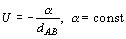 , then as a quadric form
  characterising the metric of the space V7(?A,
?B) we can accept the
expression
characterising the metric of the space V7(?A,
?B) we can accept the
expression
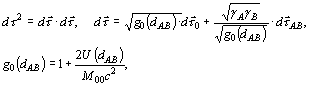 (3.7)
(3.7)
where  are the differentials
of the vectors
are the differentials
of the vectors  of the
form (3.5). Vectors
of the
form (3.5). Vectors  are
realized in the space R7(?
) which is tangent to space V7(?A,
?B) in every moment ?
.
are
realized in the space R7(?
) which is tangent to space V7(?A,
?B) in every moment ?
.
After this we can construct a neorelativistic functional of action which in case of metric (3.7) is defined as an extremum condition (in the pseudoriemannean space V7(?A, ?B) this is the condition of a maximum) for the functional of action S having the form:
 (3.8)
(3.8)
All elements  in expression
(3.8) do not change after any transformation of coordinates (and co-transformation
of the basis), when the transformation belongs to -subgroup
(abovementioned block-matrexes
in expression
(3.8) do not change after any transformation of coordinates (and co-transformation
of the basis), when the transformation belongs to -subgroup
(abovementioned block-matrexes  and
and  ).
).
There are at least three reasons to take the guadric quantic  just the form (3.7):
1) when noninvariant coordinate dt of the vector  tends to differential dt of the classical absolute time t,
then from (3.7) one can obtain an aproximate equality
tends to differential dt of the classical absolute time t,
then from (3.7) one can obtain an aproximate equality 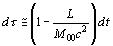 ,
where L is the Lagrange function, and thus the condition of maximum
for functional S will give the same result as the minimum condition
for classical action;
,
where L is the Lagrange function, and thus the condition of maximum
for functional S will give the same result as the minimum condition
for classical action;
2) when 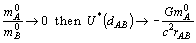 and expression
(3.7) will be close to that of Einstein’s GTR;
and expression
(3.7) will be close to that of Einstein’s GTR;
3) two coefficients before vectors  in (3.6) have a product which not depends on
  ,
and only by this condition the very important future formulae (4.3) and
(4.5) for H and
,
and only by this condition the very important future formulae (4.3) and
(4.5) for H and  can be obtained.
From the geometrical point of view the condition of the first full variation
being equal to zero,  ,
corresponds to the definition of a geodestic line connecting the starting
point A0 with a current point
,
corresponds to the definition of a geodestic line connecting the starting
point A0 with a current point  in pseudo-Riemannean space
  .
From the mechanical point of view seven equalities t = ?0(?
), x0 = ?1(?
), y0 = ?2(?
), z0 = ?3(?
), xAB = ?4(?
), yAB = ?5(?
), zAB = ?6(?
), which realize the maximum value of S , are representing equations
of motion of the two regarded particles A and B, when thier
interaction is governed by a potential function U(dAB)
under the given initial conditions.
.
From the mechanical point of view seven equalities t = ?0(?
), x0 = ?1(?
), y0 = ?2(?
), z0 = ?3(?
), xAB = ?4(?
), yAB = ?5(?
), zAB = ?6(?
), which realize the maximum value of S , are representing equations
of motion of the two regarded particles A and B, when thier
interaction is governed by a potential function U(dAB)
under the given initial conditions.
The expression (3.8) is generalised upon the case of N interacting
material particles. Just this is what invariantly "immerses" mechanics
into geometry, when (in case  )
the transition to a new neorelativistic frame of reference of type
)
the transition to a new neorelativistic frame of reference of type 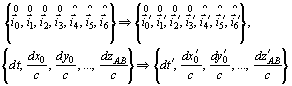
changes nothing in the expression (3.8) and, consequently, does not change anything in those differential equations which are the sequence of extremum conditions for the functional of action S.