Main
page About
author
<<
Chapter1
Chapter2 Chapter3
Chapter4
Chapter5
>>
2. Which Concepts and Ideas of STR Need to Be Perfected?
Classical mechanics is acting (or is geometrically interpreted) in a
three-dimensional conventional Euclidean space  which fully corresponds to physiological ability of thinking creatures
from planet Earth to geometrical imagination. The STR, having rejected
the classical idea of absolute (surgeometrical) time t, has immediately
been "immersed” into the four-dimensional space
which fully corresponds to physiological ability of thinking creatures
from planet Earth to geometrical imagination. The STR, having rejected
the classical idea of absolute (surgeometrical) time t, has immediately
been "immersed” into the four-dimensional space  each point of which is characterised by coordinates
 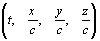 .
Here the constant
.
Here the constant  m/s may
be regarded as a universal (i.e. independent of the choice of a frame of
reference) "transforming constant", which transforms quantities of x,
y, z type, possessing the dimension of length (m) into quantities
m/s may
be regarded as a universal (i.e. independent of the choice of a frame of
reference) "transforming constant", which transforms quantities of x,
y, z type, possessing the dimension of length (m) into quantities 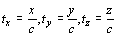 ,
each having the dimension of the first coordinate t. This version
has no principal distinction from a four-dimensional space with four coordinates
x, y, z, ct in use.
,
each having the dimension of the first coordinate t. This version
has no principal distinction from a four-dimensional space with four coordinates
x, y, z, ct in use.
But the four-dimensional world of STR is not a conventional Euclidean
space  (possessing index
k=0) but, actually, it is pseudoeuclidean space possessing negative
index k=3 (or an isomorphic to it space
(possessing index
k=0) but, actually, it is pseudoeuclidean space possessing negative
index k=3 (or an isomorphic to it space  possessing index k=1). This conclusion follows from the fact, that
the only numerical invariant
possessing index k=1). This conclusion follows from the fact, that
the only numerical invariant  (space-time interval) in R4, k=3 is determined by a contravariant
tensor xs, where s=0, 1, 2, 3 (x0=t,
x1=tx, x2=ty, x3=tz)
and by a diagonal metric tensor of the second rank gss
through expression
(space-time interval) in R4, k=3 is determined by a contravariant
tensor xs, where s=0, 1, 2, 3 (x0=t,
x1=tx, x2=ty, x3=tz)
and by a diagonal metric tensor of the second rank gss
through expression
 . (2.1)
Note that in the space  all the three numbers gss have magnitudes 1, and there
exist two independent numerical invariants:
all the three numbers gss have magnitudes 1, and there
exist two independent numerical invariants:
1) the contraction  or the contraction of the type
 ;
;
2) surgeometrical invariant t (absolute time).
But "our" space  is characterised
not only by its being a tensor space but also by its being a vector space
in the sense that in space
is characterised
not only by its being a tensor space but also by its being a vector space
in the sense that in space  there exist vectorial invariants of the
  type. These invariants
  ,
,  ,
... are existing in the space even before we introduced there the concept
of basis unit vectors
,
... are existing in the space even before we introduced there the concept
of basis unit vectors  ,
i.e. even before our introducing there the concept of a tensor of the first
rank.
,
i.e. even before our introducing there the concept of a tensor of the first
rank.
Together with a linear transformation of the three coordinates of the
type

in the vector space  there takes place the analogous co-transformation of the corresponding
unit vectors
there takes place the analogous co-transformation of the corresponding
unit vectors 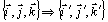 : if the column
of three coordinates is multiplied by the orthogonal matrix of rotation
: if the column
of three coordinates is multiplied by the orthogonal matrix of rotation  then the string of the three unit vectors is multiplied by the inverse
matrix
then the string of the three unit vectors is multiplied by the inverse
matrix  . As a result, nothing
changes in the resulting expression for the vector
. As a result, nothing
changes in the resulting expression for the vector  :
:
 (2.2)
(2.2)
So we ohght to regard vector  in (2.2) as a special invariant contraction of one “numerical tensor”
  and one “basis tensor”
  ,
i.e. the contraction
,
i.e. the contraction  .
.
In this case one must not speak about the transformation only of the
coordinate tensor xs – ys , if the new coordinates  are set off upon the same unit vectors
  . Even more prohibited is to say, for instance, that a two component vector
  in plane
  , regarded as “a
part of the tensor xs - ys, s=1, 2, 3“, when
this “part” is transferred by transformation into "another vector"
, regarded as “a
part of the tensor xs - ys, s=1, 2, 3“, when
this “part” is transferred by transformation into "another vector"  referred to the same unit vectors
  and
and  . Actually, the vector
  is a quite different from the vector
  :
in the system of unit vectors (
:
in the system of unit vectors ( )
it is a two-component one, but it becomes a three-component vector in the
new system of unit vectors (
)
it is a two-component one, but it becomes a three-component vector in the
new system of unit vectors ( ),
so as the contraction (convolution)
),
so as the contraction (convolution)  remains invariant. .
But just these incorrect actions are employed in STR while transforming
all the four components of the tensor 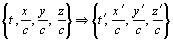 using the Lorentz transformation and dealing afterwards with the so changed
three-component "vector"
using the Lorentz transformation and dealing afterwards with the so changed
three-component "vector" 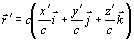 set off upon unchanged unit vectors . This new "vector"
  ,
that depends on the transformation of a four-component tensor
,
that depends on the transformation of a four-component tensor 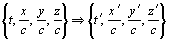 ,
is regarded in a new mooving inertial frame of reference
,
is regarded in a new mooving inertial frame of reference  possessing its own time
  and the axes
  parallel to
the axes Oxyz of the former "immovable" frame of reference K possessing
its own time t.
parallel to
the axes Oxyz of the former "immovable" frame of reference K possessing
its own time t.
The tensor space R4, k=3, in which STR is realised,
may be turned into a vector space R4, k=3 in which vectors  exist even before we introduce the concept of a usual four-component
numerical (coordinate) tensor. To do so one has to generalise the concept
of a scalar product of two arbitrary vectors
exist even before we introduce the concept of a usual four-component
numerical (coordinate) tensor. To do so one has to generalise the concept
of a scalar product of two arbitrary vectors  and
and  from the space R4,
k=3: the scalar product of two vectors
from the space R4,
k=3: the scalar product of two vectors  and
and  is such a symmetrical
and bilinear function
is such a symmetrical
and bilinear function  which to each pair of vector arguments
  and
and  puts into correspondence
the real number s which is not necessarily positive in case of
puts into correspondence
the real number s which is not necessarily positive in case of  =
= .
.
In this pseudoeuclidian vector space R4, k=3
consisting of real fourdimensional vectors with real coordinates, the index
k=3 indicates that there exist three linearly independent fourdimensional
vectors  , such that
  .
This is why in R4,k=3 as a system of basis unit vectors it is
convenient to choose the system of vectors
.
This is why in R4,k=3 as a system of basis unit vectors it is
convenient to choose the system of vectors  such that
  and
and  and with condition
  , when
  .
By this, only real quantities
.
By this, only real quantities (here
(here 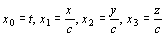 ) are permitted as
multipliers for unit vectors
) are permitted as
multipliers for unit vectors  .
.
Then in R4,k=3 by analogy with (2.2) one obtains invariant
vectors (invariant convolutions) in space R4,k=3 of the form
 , (2.3)
Here  are four new basis
unit orthogonal vectors which are obtained as the result of linear and
homogenous transformation of the four former unit vectors
are four new basis
unit orthogonal vectors which are obtained as the result of linear and
homogenous transformation of the four former unit vectors  .
The coefficients of these four equalities (realizing the transformation)
make some symmetrical matrix
.
The coefficients of these four equalities (realizing the transformation)
make some symmetrical matrix  , which is the reverse matrix to the well known matrix
  , describing the transformation of the four coordinates and using the most
general expressions of Lorentz transformation in the Gerglotz version.
, describing the transformation of the four coordinates and using the most
general expressions of Lorentz transformation in the Gerglotz version.
If  denote an element
of the
denote an element
of the  - matrix
  then new basis
  in (2.3)
we have as a four contractions of type
in (2.3)
we have as a four contractions of type  .
So, define by
.
So, define by  , two 4-columns
from basis vectors
, two 4-columns
from basis vectors 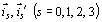 , one
will have
, one
will have 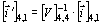 , which denotes
four homogeneous equalities. One can satisfy himself that
, which denotes
four homogeneous equalities. One can satisfy himself that  if
if  and
and  if
if  , but
, but  .
It means that new basis
.
It means that new basis  (contrary to STR!) is not deformed, but only “pseudorotated in
  ”.
And more: the Poincore group is representate by means of matrixes
”.
And more: the Poincore group is representate by means of matrixes 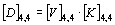 ,
where
,
where 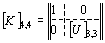 , because for two
matrixes
, because for two
matrixes  we have:
  and
and  .
.
If all the orthogonal transformations of type 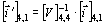 to combine afterwards with conventional rotations of the last three unit
vectors
to combine afterwards with conventional rotations of the last three unit
vectors 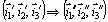 (under the condition
that
(under the condition
that  ) by using the orthogonal
matrix
) by using the orthogonal
matrix  , then the group
of Poincare transformations (all matrixes of [D]4,4 type)
for four basis unit vectors in case when the origin O of this basis
does not change will be obtained. The matrixes [D]4,4
of co-transformations of four coordinates also belong to this group.
, then the group
of Poincare transformations (all matrixes of [D]4,4 type)
for four basis unit vectors in case when the origin O of this basis
does not change will be obtained. The matrixes [D]4,4
of co-transformations of four coordinates also belong to this group.
In the real vector space  as independent on each other there exist three types of "abstract things":
1) points, 2) vectors, 3)real numbers. These "things" are interconnected
by a system of axioms. By this, the coordinates
as independent on each other there exist three types of "abstract things":
1) points, 2) vectors, 3)real numbers. These "things" are interconnected
by a system of axioms. By this, the coordinates 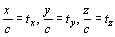 have principally changed their sense comparatively with the space
  ,
because now each of the vectors
,
because now each of the vectors 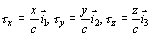 ,
observing that
,
observing that  , where
s = x, y, z , has no length or no modulus. The same may be said
about the vector
, where
s = x, y, z , has no length or no modulus. The same may be said
about the vector  . The
concept of a distance between points A and B, belonging to
. The
concept of a distance between points A and B, belonging to  ,
is valid not for all the points A and B is space
,
is valid not for all the points A and B is space  but only for those, for which the vector

(here  and
and 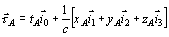 ,
, 
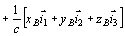 )
possesses the modulus, i.e. if
)
possesses the modulus, i.e. if  .
No other approach to the concept of a distance in the vector space
.
No other approach to the concept of a distance in the vector space  is existing. If
  then one
reaches the cone of isotropy. Each vector belonging to this cone
is orthogonal to itself or it has the zero length.
then one
reaches the cone of isotropy. Each vector belonging to this cone
is orthogonal to itself or it has the zero length.
This is how the metric of  looks like. Naturally, we will consider only those physical directions
of motion in
looks like. Naturally, we will consider only those physical directions
of motion in  , which correspond
to vectors
, which correspond
to vectors  satisfying
the condition
satisfying
the condition  , or to vectors
  if
if  . Let us emphasize:
above mentioned representation of the fourdimensional vector
. Let us emphasize:
above mentioned representation of the fourdimensional vector  is a more general case of contraction (convolution), which gives in space
  ,
a new and more general (vectorial) invariant than (2.1). Only such
invariant – vectors in space
,
a new and more general (vectorial) invariant than (2.1). Only such
invariant – vectors in space  one can name as “vector”.
That is why considering the three-component part of the vector
of the form  in the given
fixed frame of reference
in the given
fixed frame of reference  is permitted only in that sense, that in another frame of reference
  which is pseudorotated in the space
  the same vector
  , will
posses four components. Of course, the negative numerical invariant
, will
posses four components. Of course, the negative numerical invariant  must be observed. Prohibited is, though, to speak about the three-component
vector
must be observed. Prohibited is, though, to speak about the three-component
vector 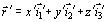 as of the transformed
former three-component vector
as of the transformed
former three-component vector  ,
because the vector
,
because the vector  is
just another vector in both frames of reference, actually being a four-component
vector in the first frame of reference. Quite analogous is the situation
with a one-component vector
is
just another vector in both frames of reference, actually being a four-component
vector in the first frame of reference. Quite analogous is the situation
with a one-component vector  which in the new system will become the same but now a four-component invariant
vector
which in the new system will become the same but now a four-component invariant
vector 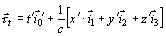 with the numerical
invariant
with the numerical
invariant 
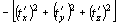 kept.
kept.
On the basis of this we can state that geometrical interpretation of
the Lorentz transformation  in the space
  is not identical
to purely mechanical presentation of this transformation in the space
is not identical
to purely mechanical presentation of this transformation in the space  with its two classical three-dimensional frames of reference K and
K' moving relatively to each other with the velocity
with its two classical three-dimensional frames of reference K and
K' moving relatively to each other with the velocity  and each having their own times t and t'. Yes, indeed, each
of the abovesaid matrixes
and each having their own times t and t'. Yes, indeed, each
of the abovesaid matrixes  or
or  descibing the transformation
  is completely determined if three arbitrary numbers vx, vy,
vz are given under the condition
is completely determined if three arbitrary numbers vx, vy,
vz are given under the condition  ,
but all matrix operations of mutual multiplying of such matrixes
,
but all matrix operations of mutual multiplying of such matrixes  (altogether with all matrixes of pure rotation
  )
cannot be reduced to vectorial algebra in the space
)
cannot be reduced to vectorial algebra in the space  even by adding the concept of different times t and t' in
each system K and K` (New wine should not be poured into
old wine skins). The very idea of three-dimensional system K mooving
in “our” space
even by adding the concept of different times t and t' in
each system K and K` (New wine should not be poured into
old wine skins). The very idea of three-dimensional system K mooving
in “our” space  , is the
“old wine skin” from classical mechanics.
, is the
“old wine skin” from classical mechanics.
This is why we are going to deal with a neorelativistic inertial
frame of reference  which is only pseudorotated (without usual “mooving”!) in relation to another
system
which is only pseudorotated (without usual “mooving”!) in relation to another
system  (pure rotation
of the three last unit vectors
(pure rotation
of the three last unit vectors 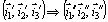 with the vector
  remaining
unchanged may be here included). In this case the sense of a position vector
remaining
unchanged may be here included). In this case the sense of a position vector  fixing the point A in the space
  ,
is that the arrow end of this vector is drawing a four-dimensional space
curve and that the four coordinates
,
is that the arrow end of this vector is drawing a four-dimensional space
curve and that the four coordinates 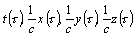 of this vector
  are functions
of the invariant argument t , which denotes
"the time length" of an arc of this curve, laid off from the initial point
are functions
of the invariant argument t , which denotes
"the time length" of an arc of this curve, laid off from the initial point  ,
under the condition
,
under the condition  ,
i.e.
,
i.e.
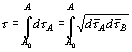 ,
,  (2.4)
(2.4)
If the point A is a free material point then all the four coordinates
are the linear functions of the argument t .
It is very important to realize here as follows: in a geometrical approach
to the space  (and no other
point of view we must have), having eliminated the parameter t
from the four parametrically given functions
(and no other
point of view we must have), having eliminated the parameter t
from the four parametrically given functions  ,
we will get, for instance, three functions x=f1(t), y=f2(t),
z=f3(t) or three other functions
,
we will get, for instance, three functions x=f1(t), y=f2(t),
z=f3(t) or three other functions 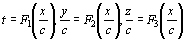 ,
which represent (in space
,
which represent (in space  !)
the path (trajectory) of the point A . Now the information about how
the point A is moving along this path is lost. For example, if all
the three functions x=f1(t), y=f2(t),
z=f3(t) have happened to be linear, then it is not, though,
an evidence of uniform motion of the point A in
!)
the path (trajectory) of the point A . Now the information about how
the point A is moving along this path is lost. For example, if all
the three functions x=f1(t), y=f2(t),
z=f3(t) have happened to be linear, then it is not, though,
an evidence of uniform motion of the point A in  ,
but it only characterises the path in
,
but it only characterises the path in  as a rectilinear one. Along this rectilinear path the point A may perform
non-linear motion when related to the argument t
.
as a rectilinear one. Along this rectilinear path the point A may perform
non-linear motion when related to the argument t
.
So, we have come to the conclusion about the relative character
of the very idea of the uniformity: the motion is uniform but in relation
to what? In relation to t, or in relation to t
? In STR every local time t or  is satisfying the evident conditions
 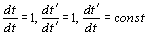 ,
i.e. time t or
,
i.e. time t or  changes “iniformly in relation to itself“. But noninvariant coordinate
t (or
changes “iniformly in relation to itself“. But noninvariant coordinate
t (or  ) of the invariant
vector
) of the invariant
vector  may be changing
nonlinearly in relation to the invariant argument t
. And let us remind that any process
may be changing
nonlinearly in relation to the invariant argument t
. And let us remind that any process  take place as a uniform relatively to itself, because
  .
The idea of “absolutely uniform” time t (changing only its “tempo”
.
The idea of “absolutely uniform” time t (changing only its “tempo”  ),
-this idea is a relic of the classical mechanics.
),
-this idea is a relic of the classical mechanics.
If the point A is moving nonuniformly with respect to argument
t along a rectilinear path  in the space
  then it is
the evidence that in
then it is
the evidence that in  there
is a field interacting with the point A. This motion of the point A must
be “immersed”, though, not into a pseudoeucledean rectilinear space
there
is a field interacting with the point A. This motion of the point A must
be “immersed”, though, not into a pseudoeucledean rectilinear space  but into some pseudoriemannean space V4, for which every
tangent in its point M space
but into some pseudoriemannean space V4, for which every
tangent in its point M space  is a pseudoeucledean one with k=3. Such a space V4
has natural metrics which compensates,or replaces, the existence of a field
in
is a pseudoeucledean one with k=3. Such a space V4
has natural metrics which compensates,or replaces, the existence of a field
in  .
.
And only in that case when all the four coordinates of the point A
are linear functions of t , we may select such
a neorelativistic inertial frame of reference  in which the vector
  is
parallel to
is
parallel to  , i.e.
  and
and  . Nevertheless, it
doesn’t mean that the point A is resting in this frame of reference:
it continues to move along the invariant vector
. Nevertheless, it
doesn’t mean that the point A is resting in this frame of reference:
it continues to move along the invariant vector  exactly as it did earlier when the vector
  possessed nonzero pseudoprojections
 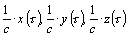 upon the unit vectors
  .
.
This way we have reached the sort of agreement (upon the neo-relativistic
level) between the Friedmann - Hubble idea of the spreading Universe and
the classical idea of the Newton first low. So the free material point
is mooving uniformly (to invariant time  )
along some invariant vector
)
along some invariant vector  in all neorelativistic inertial frames of reference. As one can
see now it would be more correct to speak not about the spreading Universe
but about natural four-dimensional flow of time tin
the space . The flow of
pseudotime t (first coordinat of
in all neorelativistic inertial frames of reference. As one can
see now it would be more correct to speak not about the spreading Universe
but about natural four-dimensional flow of time tin
the space . The flow of
pseudotime t (first coordinat of  )
appears to us to be different in different neorelativistic frames of reference
)
appears to us to be different in different neorelativistic frames of reference  and
and  . This is explained
by the fact, that inhabitants of our planet posses senses, which distort
the real picture of the Universe, because these our senses "reflect" the
three coordinates x = ctx , y = cty , z = =ctz
from space
. This is explained
by the fact, that inhabitants of our planet posses senses, which distort
the real picture of the Universe, because these our senses "reflect" the
three coordinates x = ctx , y = cty , z = =ctz
from space  , upon “our”
basis unit vectors
, upon “our”
basis unit vectors  in
the space
in
the space  , and the coordinate
t is the same way reflected upon our "clock"; at the same time the
invariant magnitude t is left unnoticed as an
extrasensoric one, and it can only theoretically be computed on the grounds
of our direct measurements of each of the four coordinates of the vector
, and the coordinate
t is the same way reflected upon our "clock"; at the same time the
invariant magnitude t is left unnoticed as an
extrasensoric one, and it can only theoretically be computed on the grounds
of our direct measurements of each of the four coordinates of the vector

in every moment t . Of course, it is very
difficult to agree with such “fantastical idea”, that “in reality” (what
is “reality”?) we live in pseudoeuclidean space, but let us try to believe
more the most important sensation of formal logic, then we believe our
usual physiological sensations, because it is a new ordinary sacrifice
in the name of the Great Idea of Relativity. Let us remember that our physiological
sensations had put us in an awkward situation. In the whole history of
science, begining from Euclid, Ptolemaios, Kopernik, Bruno, Galilei, Newton,
Lobachevsky, Einstein, Heisenberg the humanity had this perpetual question:
what is “reality” and what is only a theoretical, mathematical (“wild and
fantastical”) formal scheme. Outstanding academician Leo Landau was shure,
that the reason of crisis in some modern problems in pure physics and mechanics
is just the deficiency of humane fantasy, because real Universe is more
fantastical and more intricate than any our fantasy and imagination.
And something else: when we speak about the velocity of the point A
in the space  , we only
mean a four-coordinate vector
, we only
mean a four-coordinate vector  having components
  . The
magnitude of scalar product
. The
magnitude of scalar product  is always equals to one, and the components of
  are transformed by one of the transformations belonging to Poincare group.
If the point A is a free one and if in some inertial frame of
reference  the three of
its coordinates
the three of
its coordinates  do not
change, then the three numbers
do not
change, then the three numbers 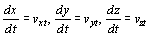 ,
which are obtained as a result of division of the last three components
of the vector
,
which are obtained as a result of division of the last three components
of the vector  (in system
  )
by its first component, fully characterise the transformation matrix
)
by its first component, fully characterise the transformation matrix  transforming the system
 into
the system
into
the system  . But these
three numbers
. But these
three numbers  make neither
a vector nor even a formal tensor, as they are transformed by non-linear
formulae and this is in contradiction with the rules of tensor algebra.
The same case we have in “our” space
make neither
a vector nor even a formal tensor, as they are transformed by non-linear
formulae and this is in contradiction with the rules of tensor algebra.
The same case we have in “our” space  :
three coordinates
:
three coordinates  , of
the vector
, of
the vector  make true tensor
but two “fractions”
make true tensor
but two “fractions” 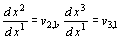 ,
give not a tensor and not a vector, when relatively to usual rotation
,
give not a tensor and not a vector, when relatively to usual rotation  in
in  (because two unit vectors
  in expression
  are not
co-transformed relatively to non-linear transformation of numbers
are not
co-transformed relatively to non-linear transformation of numbers  ).
Naturally, the same three numbers
).
Naturally, the same three numbers  do make a vector in the space
  by a compulsory condition that
  is absolute time. From the point of view of the space
  ,
though, these three numbers
,
though, these three numbers  characterise the direction of the vector
  .
By this, the condition
.
By this, the condition  leads to the condition
  which, actually, is a restriction set upon the choice of the direction
in the space
which, actually, is a restriction set upon the choice of the direction
in the space  , or, in other
words, the vector
, or, in other
words, the vector  must
not coincide with an isotropic vector.
must
not coincide with an isotropic vector.
Consequently, in the space  there exist such directions
  of motion from the point A to the point B for which the length
of the vector
of motion from the point A to the point B for which the length
of the vector  , i.e. the
neorelativistic distance from A to B , tends to zero, though
the noninvariant (in space
, i.e. the
neorelativistic distance from A to B , tends to zero, though
the noninvariant (in space  !)
magnitude
!)
magnitude  may be at the
same time fantastically great. This is how metrics of the space
may be at the
same time fantastically great. This is how metrics of the space  looks like. Let us emphasize once more: the fourdimensional Lorentz’s transformations
in space
looks like. Let us emphasize once more: the fourdimensional Lorentz’s transformations
in space  are in fact formulae
of the analitical geometry in this space; but classical STR
is attempt to use the analitical geometry from
are in fact formulae
of the analitical geometry in this space; but classical STR
is attempt to use the analitical geometry from  for generalization of the kinematics in quite another space
  ;
but in
;
but in  , there exist its
own fourdimensional kinematics, which we use in our neorelativistic mechanics.
, there exist its
own fourdimensional kinematics, which we use in our neorelativistic mechanics.
And, finally, there is the last and maybe the most important question
about the urgent necessity of making the relativistic principle of relativity
more accurate. In STR the definition of this principle sounds approximately
as follows: all the inertial frames of reference (classical three-dimentional
frames of reference in the space  provided by their own local "clocks" are meant here) cannot be told from
one another on the grounds of their physical properties ( no experiment
can distinguish any of them as a preferable one).
provided by their own local "clocks" are meant here) cannot be told from
one another on the grounds of their physical properties ( no experiment
can distinguish any of them as a preferable one).
But the point is that side by side to physical measuring devices in
different inertial frames of reference there exist our theoretical equations
of motion together with their solutions having, for example, the form  ,
in which neither a function dAB nor the argument t
are invariant ones. These solutions, or these functions, we "measure",
or analyze, using a "device" called a human eye, and this device does finds
a difference! Now, is it possible indeed to construct an invariant function,
describing some invariant physical or mechanical process, using noninvariant
magnitudes dAB and t. More of that, for each invariant
vector considered in the space
,
in which neither a function dAB nor the argument t
are invariant ones. These solutions, or these functions, we "measure",
or analyze, using a "device" called a human eye, and this device does finds
a difference! Now, is it possible indeed to construct an invariant function,
describing some invariant physical or mechanical process, using noninvariant
magnitudes dAB and t. More of that, for each invariant
vector considered in the space  there exists only one numerical invariant which can not simultaneously
be a function and an argument of some function as well.
there exists only one numerical invariant which can not simultaneously
be a function and an argument of some function as well.
Let two material particles A and B be connected by an
ideal elastic
"spring" and let them be vibrating in the space  along the vector
  . It is
known that the equations of motion of these two points, derived by using
methods of STR, first in the frame of reference K moving in the
direction perpendicular to
. It is
known that the equations of motion of these two points, derived by using
methods of STR, first in the frame of reference K moving in the
direction perpendicular to  and then in the frame of reference K' moving along
  ,
are different. And here anyone can say: "Let me analyze the both sets of
equations of motion (in system K and in system K'), using
the device called a human eye, and I will get quite a concrete information
about the inertial frames of reference used". This statement is in deep
contradiction with the whole idea of relativity.
,
are different. And here anyone can say: "Let me analyze the both sets of
equations of motion (in system K and in system K'), using
the device called a human eye, and I will get quite a concrete information
about the inertial frames of reference used". This statement is in deep
contradiction with the whole idea of relativity.
Now we mean that the relativistic principle of relativity should not
be declared at the very beginning of this theory but it must logically
flow out from the solution of corresponding equations of motion as a consequence,
i.e. everything must be approximately that way as it was with the classical
Galileian principle of relativity until when physicists have discovered
"forces" depending on velocities.
Such a neorelativistic principle of relativity may be made real only
in the case, when we will utilize a more general method of "immersing”
mechanics into geometry, using more general orthogonal transformations
of coordinates and basis unit vectors in the more general pseudoeuclidean
space  when n>4.
In such space Rn there may exist a number (not less than
two) of independent numerical invariants, giving us a chance to
construct invariant functional relationships between independent invariants,
which will describe real invariant physical processes.
when n>4.
In such space Rn there may exist a number (not less than
two) of independent numerical invariants, giving us a chance to
construct invariant functional relationships between independent invariants,
which will describe real invariant physical processes.
Main
page About
author
<<
Chapter1
Chapter2 Chapter3
Chapter4
Chapter5
>>