 having the form
4. Neorelativistic Laws of Conservation and Quantum Mechanics
From the condition of extremum of the functional (3.8) adjusted to four
cyclic coordinates t(t ), x0(t
), y0(t ), z0(t
) it particularly follows that all the four components Et,
Ex, Ey, Ez, of the
invariant energy vector
having the form
 (4.1)
(4.1)
are unchanged in the given neorelativistic frame of reference  in authonomic subspace
  of the whole space R7(gA,
gB), k = 6. So,
this is how the four laws of conservation look like, and here we have
of the whole space R7(gA,
gB), k = 6. So,
this is how the four laws of conservation look like, and here we have
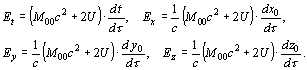 (4.2)
(4.2)
While transition to another neorelativistic frame of reference in subspace  ,
which, actually, is a part of a tangent space R7(
,
which, actually, is a part of a tangent space R7( ),
k = 6 touching at the given magnitude of
),
k = 6 touching at the given magnitude of  the psedoriemannean space V7(gA,
gB), k = 6 at its
curent point
the psedoriemannean space V7(gA,
gB), k = 6 at its
curent point  , the four
components (4.2) are transformed in
, the four
components (4.2) are transformed in  in accordance with the Lorentz formulae. At the same time unit vectors
  are co-transformed in such a way that the invariant vector
  of type (4.1) remains unchanged, as an invariant contraction
  .
.
In the expression for the first constant  ,
appearing in (4.2), one may exclude the expression
,
appearing in (4.2), one may exclude the expression  on the basic of the relationship
  in the form (3.7). (We mean that in every time t
it is
in the form (3.7). (We mean that in every time t
it is  ). Instead of constant
  it is convenient to regard here another constant H relating
to
it is convenient to regard here another constant H relating
to  through a relation
 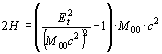 .
(Of course, instead of funcion
.
(Of course, instead of funcion  ,
there exist a lot of anoher such, that
,
there exist a lot of anoher such, that  ,
when
,
when  ; why author takes
exactly this? Analogous question one can ask in case of formulae (3.7).
There exist also a lot of linear expressions of type
; why author takes
exactly this? Analogous question one can ask in case of formulae (3.7).
There exist also a lot of linear expressions of type  ;
why Lagrange takes exactly
;
why Lagrange takes exactly  ).
).
After a series of transformations one gets a following expresion for H:
 (4.3)
(4.3)
where
 (4.4)
(4.4)
Now it follows that the vector  in space
  is obtained from
the artificial threecomponent “vector”
is obtained from
the artificial threecomponent “vector” 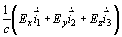 ,
considered in the given fixed frame of reference in subspace
,
considered in the given fixed frame of reference in subspace  ,
by the isomorphic mapping of negative unit vectors
,
by the isomorphic mapping of negative unit vectors  upon "our" usual unit vectors
  in space
  . Same way, the
vector
. Same way, the
vector  is obtained as
a derivative
is obtained as
a derivative  , where
  is defined by (3.5). Here also is used isomorphic mapping of type
 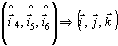 .
.
The right part of the expression for H coincides by its appearance with the classical expression for the sum of kinetic energy T(t) and potential energy U(t), when instead of the invariant relativistic time t the absolute time t is used. This is why we can treat the quantity H as a neorelativistic Hamiltonian function for a closed system of two interacting material particles.
The magnitude H, exactly as in the classical case, does change
while its transition to a new frame of reference because of the change
of a "vector"  . But the
expression for an internal Hamiltonian function Hin,t,
presented in the form
. But the
expression for an internal Hamiltonian function Hin,t,
presented in the form
 , (4.5)
is fully invariant, because it depends on the invariant vector  and on the invariant magnitude dAB(t
) only.
and on the invariant magnitude dAB(t
) only.
From the first of the expressions (4.4) one can conclude that in the
given fixed frame of reference the direction of a canon velocity
of the centre of mass 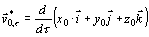 has the same unchanged direction as the canon impulse
  of the system. The direction of "vector"
  remains unchanged in the given frame of reference. But due to there existing
of a variable multiplier appearing to be an invariant function of t
, having the form
remains unchanged in the given frame of reference. But due to there existing
of a variable multiplier appearing to be an invariant function of t
, having the form  , the
modules of the vector
, the
modules of the vector  may periodically change its “length” (we write “lenghte” because vector
 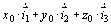 in space
  has no length),
i.e. the "vector"
has no length),
i.e. the "vector"  in fixed
frame of reference will periodically and with some frequency w
either slightly increase or slightly decrease, because the magnitude of
in fixed
frame of reference will periodically and with some frequency w
either slightly increase or slightly decrease, because the magnitude of  is very small when compared with unity.
If instead of the canon velocity  one will consider a pseudovelocity
  then he will have to become convicted that the same impulse
  instead of formula (4.4) may be represented in the form
 (4.6)
(4.6)
because  . The quantity
M in (4.6) has the form
. The quantity
M in (4.6) has the form
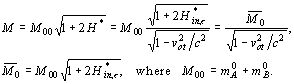 (4.7)
(4.7)
This M should be treated as a neorelativistic dynamic mass of
the isolated system of material particles considered in the given frame
of reference where the centre of masses has the pseudovelocity 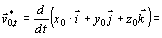
 .
But the magnitude of
.
But the magnitude of  ,
having the form (4.7) with
,
having the form (4.7) with  corresponds here to the invariant defective mass, which depends only on
the invariant internal energy
corresponds here to the invariant defective mass, which depends only on
the invariant internal energy  of the whole system. If
  then the deffective mass
  tends to zero, and this is in agreement with mass annigilation.
If some so called elementary particle in reality is a system of two
or three “more elementary particles”, then this annigilation will correspond
to what in quantum mechanics is called "death of a particle", resulting
the action of the "death and birth" operator. Still, by any infinitesimally
small positive magnitude of e and by 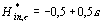 it may happen that the pseudovelocity
  would be as such as
  . Than
on the grounds of (4.7) we will get
. Than
on the grounds of (4.7) we will get  or even M will be more than M00 if
 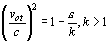 .
That means that the particle will become "a newly born" one.
.
That means that the particle will become "a newly born" one.
Furthermore, if one accepts that in the course of motion of the centre
of mass (of the above described particle-the-system) physically revealed
is not the unchanged pseudovelocity  but just its variable canon velocity
  (i.e. the invariant time tis realy existing
one but t is, so to say, pseudotime) then this phenomena will explain
the reason of appearing of de'Broglie wave.
(i.e. the invariant time tis realy existing
one but t is, so to say, pseudotime) then this phenomena will explain
the reason of appearing of de'Broglie wave.
From the obvious condition for the modules  of the energetic vector
  to be invariant and from the later expressions it follows that
 . (4.8)
The expressions (4.8), (4.6) and (4.7) offer the sufficient generalisation
of the analogous expressions of STR valid, in fact, only for a single material
particle of mass m0. Particularly, in the analogous to
(4.8) expression, offered by STR, an unchanged mass of rest m0
is used instead of the offered by (4.8) defective mass  ,which can be changing in the course of possible interactions with another
"closed system" (considered as an “elementary” particle). Besides that
in the expression (4.8) may occure such situation when under certain conditions
,which can be changing in the course of possible interactions with another
"closed system" (considered as an “elementary” particle). Besides that
in the expression (4.8) may occure such situation when under certain conditions  .
Then it will denote that the direction of the vector
.
Then it will denote that the direction of the vector  in the subspace
  will approach
an isotropic one. In this case four independent variations
will approach
an isotropic one. In this case four independent variations 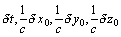 ,
which are employed for varying the functional of action S, become
depending among themselves, because
,
which are employed for varying the functional of action S, become
depending among themselves, because  while
while
 .
.
Then two independent laws of conservation (4.3) and (4.4) will be united
into one law of conservation, thus expressing "energy balance" in case
of "internal" or "external" energy radiation. This law (4.8) in case of  by certain additional hypotheses may be given the form of Plank "law of
radiation", presented in quantum mechanics. These are only some of the
results making a "bridge" between neorelativism and quantum-mechanical
indeterminism.
by certain additional hypotheses may be given the form of Plank "law of
radiation", presented in quantum mechanics. These are only some of the
results making a "bridge" between neorelativism and quantum-mechanical
indeterminism.