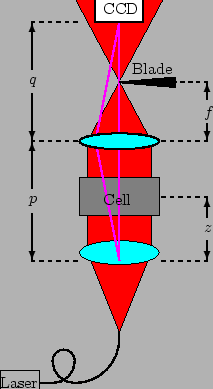
The overall system is sketched in Fig. 4.12.
The range
![$ \left[q_{min},q_{max}\right]$](img271.png) of the fluctuations we
measure is about
of the fluctuations we
measure is about
![$ \left[2\times10^3\mathrm{m}^{-1},2\times10^5\mathrm{m}^{-1}\right]$](img328.png) , that is, the fluctuations range from ten
microns to some millimeters.
By using Eqs. (4.2) and
(4.5), we obtain
, that is, the fluctuations range from ten
microns to some millimeters.
By using Eqs. (4.2) and
(4.5), we obtain
 and
and
 . The cell we used, described in Chapter
9, has an internal diameter of about
. The cell we used, described in Chapter
9, has an internal diameter of about
 .
.
Following Eq. (4.3), we obtain the
magnification:  . We used an achromatic doublet with a
diameter and focal length
. We used an achromatic doublet with a
diameter and focal length
 . To
obtain the required magnification,
. To
obtain the required magnification,
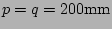 .
Since SNFS is affected by small inhomogeneous
fluctuations of air temperature, we choose to put the collimating lens
and the objective lens as close as possible to the cell, in order to
prevent air movements. This resulted in a negative
.
Since SNFS is affected by small inhomogeneous
fluctuations of air temperature, we choose to put the collimating lens
and the objective lens as close as possible to the cell, in order to
prevent air movements. This resulted in a negative  .
.
The whole optical system is shown in Fig. 4.3.