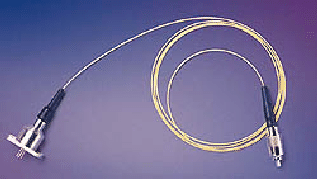
The light source we use is a LED laser, coupled to a single mode
fiber, supplied by Newport. In Tab. 4.1 we show
the data supplied with the LED. Figure 4.4
shows the LED laser and the fiber.
The LED is housed in a Newport 700P temperature controller mount, connected to a temperature controller and a current driver. Since the output wavelenght depends on the temperature, a temperature controller is needed. The LED laser has a built-in monitoring photodiode. The current driver monitors the output power to keep it constant.
A single mode fiber is directly pigtailed to the LED. The other end of
the fiber is terminated by an FC/PC connector. It is held by a
Newport SL50BM, a gimbal mount for the adjustment of the azimuth and
elevation, originally built for mounting mirrors or beam splitters.
The beam output by the fiber is diverging;
we collimate it by sending it through a lens with a focal of
 .
.
The resulting beam has a diameter of about
 . This
diameter is enough for our experiments; in general, it must be
selected as a function of the wavevector range
. This
diameter is enough for our experiments; in general, it must be
selected as a function of the wavevector range
![$ \left[q_{min},q_{max}\right]$](img271.png) we want to measure.
For ONFS and ENFS,
we want to measure.
For ONFS and ENFS,  , the diameter over which the beam intensity is
constant, must be selected in order to fulfill
Eq. (3.64). The best choice is:
, the diameter over which the beam intensity is
constant, must be selected in order to fulfill
Eq. (3.64). The best choice is:
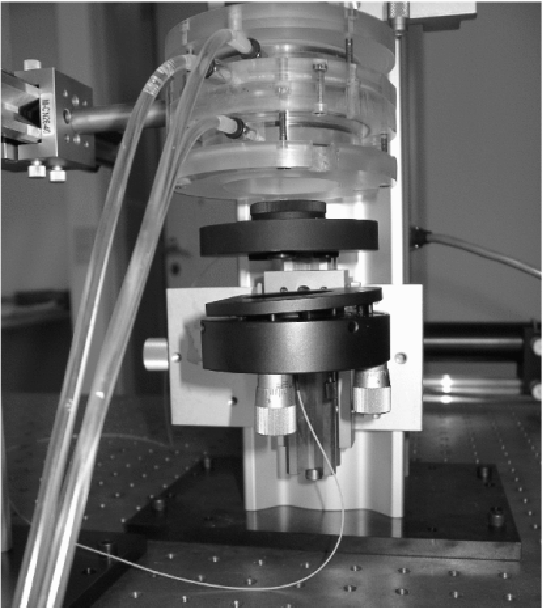
Both the adjustment of the direction of the beam and its collimation are not critical operations. The direction of the beam must be adjusted to hit a lens, centered at the optical axis, half a meter away from the fiber end. The collimation is checked by measuring the beam diameter on a screen, near the lens and one meter away. The collimator is shown in Fig. 4.5.
 |
The LED laser has been used in order to test its performance for industrial applications. The LED laser is much more compact and robust than a gas laser; it can operate immediately after it has been powered on and it does not generate too many heat. For these features it is ideally suited for industrial applications. Moreover, the overall cost of a LED laser device included in an industrial product can be made extremely low, as in the case of CD readers, though a laboratory LED laser equipement can cost as much as a classical gas laser. Moreover, the output of a gas laser must be spatially filtered before being used. A spatial filter is a critical component in an industrial equipement, since it must be extremely stable, and must be adjusted by micrometric actuators controlled by sensors, in order to correct the deformations due to heating and mechanical stresses. On the contrary, the single mode fiber output is more uniform than the output of a spatial filter, and requires no adjustment.


 to
to

 - single mode