CHAPTER THREE: The Fine Arts of Whoring and Drinking,
or,
Activities in Death Before Dishonor
 ne of the most popular social venues in Paris is the Gentleman's Club. A Club may be thought of as a tavern, a gaming-house, a library and a ballroom all rolled into one. Clubs vary in exclusivity and cost, and specialize in particular classes of clientele. Patrons often recognize each other, but often do not share the same camaraderie as comrades-in-arms.
Clubs are the places to see and be seen; often, gentlemen who win a mistress or earn a Mention in Dispatches will hasten to their Club to bask in the adulation of his peers.
Appropriate Secondary Actions (Section 1.4.1.3) at a Club include Carousing (see 3.18.1), Bonne Vivant (3.18.2), Toadying (3.18.4) and Gambling (3.18.3). Repartee and Duels may only occur as the result of Opportunity Actions (see 1.4.1.4).
Joining a club is a Primary Action (see 1.4.1.2) and your character must fulfill the requirements or he will be turned away at the door. If he qualifies, he can attend the club as a regular member and participate in any activities occurring during the week he joins. Joining costs no more than simply paying the monthly dues. Joining a club later in the month does not reduce the amount of dues paid.
Clubs come in many shapes and sizes, and may be found throughout Paris. Each has its own characteristics, as outlined below:
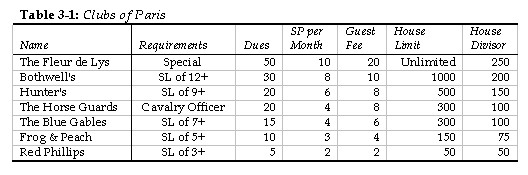
The Fleur de Lys is a high level club which is open to characters of SL 18+, Ministers (including the CPS), military officers of rank Brigadier General and above, and clergyman of rank Bishop or higher. Any event at the Fleur requires arrival in some form of coach, or the character loses 1 SP. One simply does not arrive at Paris's finest establishment on foot.
The Horse Guards is open only to military officers belonging to cavalry regiments.
Membership dues are paid at the end of the month. If your character has not attended his club at any time during a month, you can drop his membership and save some money, but he will not gain any SP from his club. He will have to spend a week to rejoin if he drops his membership. If he is a military man and goes out on campaign, dues are waived while he is out serving King and Country. He will not lose his membership while out on campaign.
Your character will gain a certain amount of SP each month by being a member of a club. He doesn't have to attend the club to earn these SP, just pay the dues.
Each guest your character invites to the club stresses the staff and extra resources are required to uphold the appropriate standards expected to entertain a guest properly. Thus the club will charge the host a nominal fee for each guest invited to the club. The club manager will not bother to check to see if a guest has received multiple invitations. Each host will be charged the guest fee for each guest he invites to the club. Mistresses do not count as guests for this purpose and are included as part of standard membership fees.
These are the statistics for gambling at these establishments. For a complete description and rules concerning their use, see Gambling (3.18.3).
A Club is always available to host parties for its membership. These parties are classed as Special Events (see 3.2, below), and are subject to the following restrictions:
- Only one party per week may be hosted at any given establishment.
- Any number of guests may be invited, but all non-members must have a guest fee paid. It is a good idea to mention any fees in the invitation, if the host does not pay.
If the Special event is held at a club or a character's home, all the rules regarding such establishments apply as well (i. e. guest fees still will be collected).
 pecial Events are social events which are generally either unique or hosted by a player character. By becoming a host -- or even a guest -- at such a gathering, the character is eligible for numerous opportunities for social interaction and status.
Hosting and attending a Special Event is always a Primary Action (see 1.4.1.2). It may also be combined with Secondary Actions (1.4.1.3) such as Toadying (3.18.4), Carousing (3.18.1), Bonne Vivant (3.18.2) or Gambling (Rule 3.18.3), where appropriate.
Events are described by their Class -- that is, the amount of resources placed into its creation (and thereby its formality) -- and its Type. The Type of an event describes the kind of function it will be, whether a fox hunt or a grand ball (always good information to have before dressing for the event).
A special event may be hosted by a character, with the details of the event left to the imagination of the player. Such events can be masquerade balls, fox hunts, boar hunts or whatever you'd like to create. The cost to host such an event depends on how grand an event one would like to put on. Hosting or attending a Special Event is a Primary Action. Consult the following table for details.
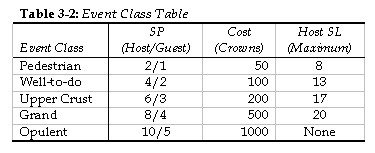
If the host has a social level higher than appropriate for the type of event he is funding, he will lose 1/2 his SL in SP's for his faux pas.
If the event is Grand, there is a 1 in 6 chance that the Royal family will send a representative to the event. If the event is Opulent, it is guaranteed that at least 1 Royal family member will attend. The possibility of a certain member attending can be influenced. A special event with Royal Family attending can result in a Mention in the Royal Lists (see XXX). The host may construct any guest list he would like and may charge admission as he sees fit.
Guests may toady with each other freely, and may carouse if they like (both are Secondary Actions, discussed in 3.18). A Special Event does not always have to be at a club or someone's home, but the GM will only accept locations that make sense for the event. This rule will be the basis for any special events derived in the future. Additional subset rules may be included for particular events. The GM will approve and incorporate the events as they arise and are submitted.
Being seen in the presence of the cream of Parisian society is the aspiration of any gentleman worthy of the title. Cultural events, be they opera or classical plays, are places the elite rub shoulders. Attending a theatrical performance is a Primary Action (for the which, see 1.4.1.2). Acceptable Secondary Actions (1.4.1.3) include Carousing (3.18.1), Bonne Vivant (3.18.2) and Toadying(3.18.4), representing after-theatre parties and the like.
Characters may pay for their own tickets or may pay for a box. A box at the theatre costs 25 crowns and can hold up to 6 people and gain the purchaser 2 SP. A seat costs 5 crowns. These costs are double on the first night. A theatergoer gains SP equal to the net production die roll -7 (never less than 0; see 3.8 for details). The manager gets a free box.
Paris in the seventeenth century was a wild place, by modern standards. Many gentlemen with grudges would not think twice about hiring lower-class goons to heckle the performers on stage and give the manager a coronary.
Players may hire yobs to hiss and boo the production at a cost of 50 crowns. This counts as a Secondary Action (1.4.1.3), usable only with Theatregoing. Each time this is done, 2D6 are rolled and a 12 indicates a riot will occur doing 100-600 crowns worth of damage (to be paid by the manager). If the Royal Family is present, the manager is disgraced (see Section 2.7).
This Special Event consists of the Tournament proper followed by an optional party in the same week at the host's club or home. When a Tournament is selected as an Event, the nature of the tournament should be specified. Horse races, fencing tournaments, tennis, dancing competitions, cock-fighting and the like are all good period ideas for tournaments. The host may provide any guest list he chooses and may set an entrance fee if desired.
The host will provide a prize valued at no less than one half the cost of the Event (i. e., 50cr for Well-to-do, 100cr for Upper Crust, etc). This prize can be in the form of cash, a commemorative medal or anything else the host chooses and is appropriate.
In addition to the amount of Status normally received for hosting an event, the Host will receive an additional 1 SP for each round the tournament takes. The bigger the tournament, the better. The host may participate in the contest as well. The winner of the event will earn as many SP as the host, unless stated otherwise below.
If a party is to be held afterwards, the Host will follow the standard rules for a party at one's home or club, as appropriate (i. e. Guest fees, etc).
The Fencing Tournament, if chosen, is a random pairing, single-elimination competition. The fencers use only the weapon specified by the tournament host. Rounds are fought as if to first blood, but no actual damage is done. The winner of each round advances to the next combat. No Special Moves (2.5.1.2) are allowed in a Tournament. In each round of the contest the loser will receive 1 training level in the weapon used, while the winner will receive a free training roll as if he were at Le Chat.
Participation in a tournament is a Secondary Action (see 1.4.1.3). The winner of the fencing tournament will receive as many SP as the number of bouts the tourney took to get to the final two contestants (as well as one Mention in the Royal Lists). The second place duelist receives a half this amount.
Like the Fencing Tournament, the Marksmanship Tournament is a single-elimination contest, using only the weapon selected by the host of the event (blunderbusses, anyone?). Unlike the Fencing Tournament, however, all of the participants fire the first round simultaneously. The characters who hit the target are advanced to the next round, and the targets are moved further down-range.
Adjudicating the Tournament is simple. All competitors roll 1d10 for their Marksmanship skill. Use Table 3-3 to determine the result, as usual. Any character who misses the target is eliminated.
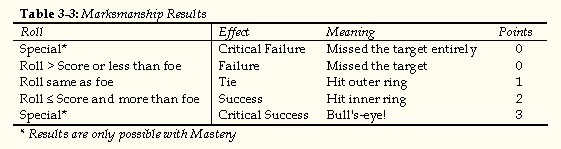
Round Two is done the same way, but at -1 Mastery. If the character has less than one Mastery, his result is downgraded. The third round is at -2 Masteries, and the fourth (if any) is at -3 Masteries. If two or more marksmen are left, total their points from Table 3-3 for all rounds. The highest score wins. In the event of a tie, repeat the fourth round protocol until a clear winner is found.
Those eliminated or losing the match will receive 1 training level in Marksmanship and 1 SP for each round they participated. The winner will get a free training roll as if training at Le Chat. The winner of the match will receive a number of SP equal to (2 � # of rounds).
One of the most venerable gaming institutions of the seventeenth century is the horse race. The Paris Derby is held during the first week of every April, and other (lesser) races are held during the year. The rules and current postings may be found at The Paris Derby page courtesy of John Bowlby.
Church-related ceremonies, whether weddings, baptisms or funerals, are important social events. Unlike other events, however, the church ceremony logically requires the presence of a priest, here called an Officiant. The minimum rank of the officiant and required fees are listed below. If you wish to hire a specific person to officiate, but they are not of the required rank, you must also hire a "consultant" of the appropriate rank. Both officiants must be paid the full fee of the higher-ranking man.
Guests who bring a gift (where deemed appropriate) receive 1 SP per 50 crowns spent (maximum is host SP for event). Certain ceremonies bring extra SP to the participants.
In addition to the usual Status awards for an event of its class, there are additional bonuses, as follows:
The officiant gains SP equal to 1/2 the Groom's SL
- The groom gains Host SP plus 3
- The best man gets Guest SP plus 2
- Groomsmen get Guest SP plus 1
As above, special Status bonuses apply to Baptisms.
- The officiant gains Guest SP plus 2
- The father gets Host SP plus 2
- The godfather gains Guest SP plus 2
Standard SP rules apply. Use the above chart, unmodified.
The bonus SP received for holding these positions assume a certain amount of activity on the part of the participant. For instance, a best man would hold a party and deliver a toast, among other things. A guest to a wedding should bring an appropriate gift, etc. The requirements have not been made explicit in the hopes that players will be creative. The GM is arbiter of whether a player has contributed sufficiently to warrant the extra
SPs.
A Soiree is a party held at a private residence, generally hosted by a PC. These parties use the rules for Class of event, and those listed under Homes and Manors (see 3.5.1).
Each year during the first week of May the Debutante Ball is held. A character may attend this ball (at the cost of his SL in crowns and a Primary Action) just for a dance and a chance to toady. For the maritally inclined, he may attempt to court one of the debutantes with an eye to marry them.
Courting is carried out as for mistresses except the player does not know any of the statistics of the lady. The GM determines her SL by rolling 3D6. Further, a D6 is rolled for each attribute (beauty, wealth, influence), and on a 1 or 2 the lady will have it. If the gentleman's courtship is accepted, he is considered to be automatically engaged to the lady in question, and must marry her within twelve months, as per the normal engagement rules.
A gentleman may seek to improve his appearance at the Ball to have a better chance of being accepted by a debutante (and her family). He may choose to buy expensive clothes at a cost of 6* his SL in Crowns. He may also elect to arrive at the ball in a lavish carriage, as described in 3.5.2. The first of these options adds +1 to his Die Roll, and the second adds a bonus equal to the level of the carriage (3.5.2) to the courtship attempt.
Every occasionally, the King will host a Court Ball. Such an event is invariably considered the pinnacle of the social season. Court Balls are always Opulent, offering the finest wines, culinary delights and sweetmeats.
Such events are not for just anyone, however. Only titled nobles, royal ministers, their wives or mistresses, and anyone invited personally by the King, Queen or Cardinal may attend. Special rules are observed during a Court Ball:
Lords and ladies are expected to be on their very best behavior. Any displays of coarse behavior, drunkenness or vulgarity will see a character banned from any future Court Ball.
Street clothing is assumed to be repugnant to the royal eye. Only the most sumptuous gowns and cunningly-made outfits befit such an occasion, and wearing the same thing twice is simply not done by a person of distinction. One-of-a-kind fashions must be carefully selected from the finest tailors in France. Such creations are developed according to Table 3-3.
The Value is rolled by the GM on the night of the Ball. A "contest" will be held (as a competition) with the winner taking a Class 9 Favor -- the King compliments the character's choice of clothing. The Bonus is the modifier to any Courting roll made by the character (see Table 3-3).
No one arriving on foot or horseback will be allowed to enter the Ball. A Coach must be hired or purchased (see 3.5.2).
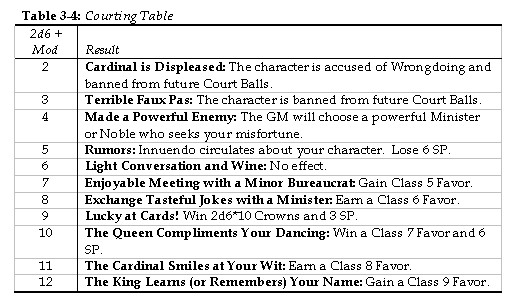
Characters may attempt to hobnob with the Parisian elite while attending a Court Ball. Any character wishing to do so must roll on the table below (add the character's Clothing Bonus to the result of the roll):

 n important measure of a man in DBD is the company he keeps, both male and female. Most characters in DBD will need to avail themselves of the delights and advantages of Female Companionship in order to advance socially, and build their influence. Characters other than clergymen who spend the month in Paris, and who are not seen in the company of women suffer a penalty (due to physical discomfort, psychological discomfort and rumors) to their status. The penalty is a cumulative -1 SP for every consecutive month that the character has been without Female Companionship. Thus, a character who did not acquire Female Companionship in any month during the Spring would lose 1 SP in March, 2 SP in April, and 3 SP in May.
There are two ways for a character to find Female Companionship in DBD. The simplest way is to visit a Bawdyhouse. At a Bawdyhouse, a gentleman will find a selection of fallen women to meet his immediate needs. If a short-term liaison is not to the character's taste, however, his other option is to court a Mistress. Mistresses are women of means -- married to powerful men, heiresses or dowagers -- with the inclination to take a lover. Unlike modern American morality, this arrangement was considered quite normal (particularly considering that the husbands had mistresses of their own).
Mistresses are women of at least some social standing who are available to share the company of interesting gentlemen for love affairs, or even marriage. Mistresses have the following attributes:
- Social Level - Generated originally by the GM by rolling 3d6.
- Beauty - An exceptional attribute, which a Mistress will have if the GM rolls a 1-2 while creating her. While all women may be considered beautiful, this particular mistress is endowed with remarkable charms.
- Wealth - An exceptional attribute, which a Mistress will have if the GM rolls a 1-2 while creating her. Most mistresses are (as stated earlier) women of means, but the Wealthy mistress is independently so.
- Influence - An exceptional attribute, which a Mistress will have is the GM rolls a 1-2 while creating her. Through a web of shrewd social contacts, these mistresses have the ability to bestow favors of influence to their lovers.
- Muse - An exceptional attribute, which a Mistress will have if the GM rolls a 6 on 1d6 during character generation. This woman is a font of inspiration -- all artistic or scientific efforts gain +1 to Quality while the character courts her (see 3.8).
- Marital Status - The GM will roll 2d6 upon creation. A roll of 8+ indicates an unmarried mistress; otherwise, she is already wed. Note that a married mistress will always put her NPC husband aside should her lover propose marriage.
- Seeing - This attribute shows who the Mistress is currently seeing. All Mistresses begin the game as available. The character who is listed as Seeing the mistress at the end of the month is the one who gains benefit from her.
All currently active Mistresses are listed in the Mistress table, along with their attributes. There will never be more than one Mistress in Paris for every two active characters. This may mean that an attached mistress may move to the Provinces.
Characters receive Female Companionship when they successfully court a Mistress, and every month thereafter that they keep her. Courting a Mistress is a Primary Activity. To court a Mistress, a player must visit her during a week and profess his love (which must include gifts at a cost of 3 � her SL). There are several possible outcomes to this action.
- The Character meets another Character on the Mistress' doorstep. In this case an immediate duel is fought, unless one or both of the characters have given explicit orders that they would stand down, or avoid confrontation. The winner of the duel, or the character who did not stand down, may continue the courting attempt normally if the Mistress was not in the company of her current lover. A current lover who stood down loses the SPs normally associated with not accepting a duel with cause. Characters who fought and lost a duel, or who stood down may elect to visit the Bawdyhouse as an Opportunity Action.
- The character attempts to court the mistress, but fails. He receives no Female Companionship, but may elect to visit the Bawdyhouse to soothe his ego.
- The character successfully courts the mistress, and receives Female Companionship for the month. Her "Seeing" status is temporarily changed to indicate that she is currently seeing the character who successfully courted her.
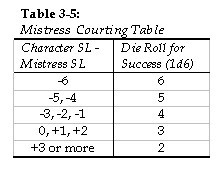 The chance that a Mistress will be successfully courted by a character depends on a number of factors. The table below shows the base chance of a successful courtship, and modifiers which may influence that chance. See Table 3-5:
The following modifiers will influence the success roll, but in all cases a roll of 1 will fail.
- Each multiple of (Mistress' SL � 3) in gifts that the character presents to the Mistress = +1
- Each duel that the suitor won on the Mistress' doorstep this week = +2
- Mistress is currently seeing someone else = -2
- Mistress is currently seeing someone who is at the front = -1 (cumulative with the modifier above)
Once a character has successfully courted a Mistress, his name is entered into the Mistress table under the column heading titled "Seeing". This gives the character several advantages.
First of all, the character may have the Mistress accompany him to Social events, or visits to his club. These events count as Female Companionship for the character, and thus do double duty. Secondly, when a Mistress accompanies a character to a Social Event or Club, she is unavailable to be courted by anyone else. (Though if someone does call on her that week, an immediate duel may take place.) A character who so wishes may have his lackey accompany his Mistress to Church (at a cost of 3� her SL) one week during the month, during which time she will be unavailable to be courted. Finally, a character who is still seeing a Mistress at the end of a month may be able to utilize her influence on his behalf.
If a character attempts to court a mistress who is seeing someone else (or a wife), there is a 1 in 6 chance that he has been indiscreet. This costs the indiscreet character -2 SP, and the character who was seeing (or married to) the mistress -3 SP. In addition, the character who was seeing the Mistress, or who is married to her has cause to duel the indiscreet character. (Both will have cause if one character is married to the Mistress and another is seeing her).
If the courting attempt is successful, no SP loss will accrue to the suitor, but the former boyfriend or current husband will still lose SP and have cause to duel. When a suitor runs into another character on (another character's) Mistress' doorstep, an automatic indiscretion takes place. A character who attempts to court another character's Wife or Mistress may choose to be indiscreet if he wishes, but he will suffer the -2 SP penalty regardless of the success of the courting attempt.
Finally, a character who is already seeing a Mistress may attempt to secretly court another. If he manages to avoid an indiscretion, then nothing happens. If he successfully courts the new Mistress, then his attachment to his current Mistress is immediately severed. If he is indiscreet, he suffers the normal penalties and is immediately dumped by his current Mistress, who will have nothing further to do with him in the future.
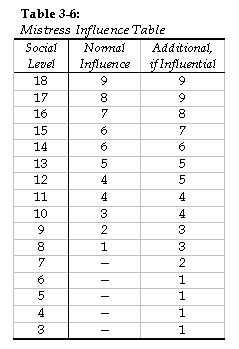 The most valuable asset a Mistress may provide for the character who is seeing her is Influence. Mistresses will provide their Influence to their lover at the beginning of any month where that lover is listed as seeing them on the Mistress table. Mistress' will have an influence level based upon their SL, and Mistresses who are Influential will provide additional Influence in the form of Favors to their lover (see Table 3-6). While the character is currently seeing a Mistress, her Influence will be considered as though it were his, and may be used freely, and regenerate in the same way as his.
Mistresses require funds to operate their households, and their lovers must provide those funds. Normal support for a mistress costs 3 � her SL in crowns each month. If a character is seeing a wealthy mistress, then he need not provide any support at all. In fact if he is of lower SL than she is, the Mistress will provide support for her lover at the rate of 3 � (the difference in their SL) per month.
Characters will also receive status points for having a mistress. A character will always receive 1 SP for having a mistress (2 for a wife). In addition a character will receive SP equal to the difference in SL between them if the Mistress has a higher SL. Finally, the lover of a beautiful mistress will receive an additional +2 SP.
In addition to the cases above where a character is jilted by his mistress or leaves her for another, he may elect to break up with her at the beginning of any month merely by stating so in his orders. A mistress will automatically leave any character who cannot provide her with support. A character may not attempt to court a mistress who has dumped him for non-support, or who he has dumped for whatever reason for at least three months.
A character who has been seeing a Mistress for six months consecutively may propose marriage to her. The attempt is the same as that of an unmodified(except for SL) courting attempt, made as a Secondary Action which must (of course) be done in a week in which the character is with the Mistress. If she accepts, then the couple is considered engaged for up to a year. If the character fails to marry her within a year, the Mistress will break up with him and become unattached.
Marrying a Mistress has several advantages. When a character marries a Mistress, her SL will be raised automatically to his SL (if it was lower). Whenever a married character receives a title, his wife will be elevated to the "New SL" listed in the title table if it was lower. This is the only way which a Mistress' SL may be raised.
Marriage is considered a Special Event, and all the benefits of a lavish ceremony may be had. However, an economically-minded character (read: cheap) may decide to elope. In an elopement, the character and his bride are assumed to be married in a small Provincial village chapel by the local priest.
When a character marries a mistress, he will receive a dowry equal to her SL � 50 crowns (SL � 100 crowns if she is wealthy). Support costs for a wife rise to 4 � her SL, and wealthy wives now require support. That's what the dowry is for.
While marrying a mistress does offer some protection from the attentions of others, it does not guarantee fidelity. A married mistress may still be courted and see other characters, with all of the SP loss associated with an indiscreet affair. When this happens, the husband loses whatever influence his wife would give him, while her lover attains it instead.
A cuckolded husband has one option not available to the lover. If a character has a wife who is being unfaithful, he may elect to send her to live on his estate (if he has one). When this happens, the wife's "seeing" status changes from the name of her lover to "unavailable". This action tends to cause the wife to become vindictive. She will not lend her husband any influence until he recalls her to Paris, and makes 3 successful courting attempts.
Married characters may court mistresses if they wish, with all of the attendant problems of indiscretion etc. While a wife cannot divorce her husband (or vice versa) she will immediately stop seeing him (and lending her influence) if she was seeing him at the time. If she was not seeing anyone when he began his affair, she will become vindictive as above, and her status will revert to available. In order to reconcile with his wife in this case, the character must stop seeing his new mistress and make 3 successful courting attempts. If the wife was the first to become unfaithful, the husband need merely successfully court her once in order to enjoy the benefits of marriage once again.
Finally, when a character is unable or unwilling to support his wife for a period of three months, she may seek an annulment of the marriage. A check will be made each month on a d6, starting with the 4th month. On a roll of a 6, the wife will seeks and receive an annulment of the marriage, and the husband will be disgraced, and suffer a permanent -1 modifier to any future courting rolls. The die roll will be modified by +1 for each month after the 4th, an additional +1 if the wife is seeing someone else, and an additional +2 if the husband is seeing someone else.
Married men in DBD have many advantages over their real-life counterparts. As head of the household, a married PC may decide when (or if) he becomes a father. Simply place this information in your orders as a Free Action, and in nine months a son will be born.
Do remember that Baptisms are also Special Events. This might land Papa some fresh Status at a cost in Crowns, but is also an excellent opportunity for Toadying.
Children have no effect in DBD but one: it is assumed that a woman who is both wife and mother has no time -- and probably no inclination -- to see another suitor. She effectively becomes immune, and is removed from the list of mistresses.
On the other hand, character-fathers caught in indiscretions lose an additional 1 SP, and those whose marriages are annulled lose 10 SP for such caddish behavior in addition to any other penalties.
ttending church is a Primary Action. Donations can be made to generate SP at the rate of 3 � SL crowns per 1 SP, to a maximum of 3 SP, total. Toadying is not allowed at church, and causes for duels are ignored while attending church. Your character may bring his mistress, but she will request appropriate funds to tithe (her SL in tithes). His lackey may escort his Mistress to Church, to provide a modifier against her being wooed away that week, but you must pay your SL � 1, for tithes for the lackey as well. This counts as if your character were with his mistress that week, if someone tries to woo her.
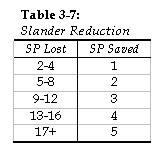 If goons were hired in the same week, they will not attack your character and there is a 2 in 6 chance that the person hiring them will be discovered and suffer as per the goons rule. If an assassin was hired in the same week, the assassin will not attack.
Further if a character is slandered and he attended church, the slander is affected as follows:
This is in effect for the slanderer, as well, if he is caught. Note that these effects are cumulative for each week the character attended church. Therefore if the character was slandered and lost 6 points but attended church 2 weeks he would lose only 2 SP (6 - (2 � 2) = 2). Slander always does a minimum of 1 SP.
 entlemen in Paris are marked by the ownership of property. This ownership marks the difference between the Gentle class and the Commoners. All purchased properties are assumed to be within Paris. The difference between a Residence and an Estate is that the Estate produces income, and is located in the Provinces. While a character may visit, and even stay at an Estate, this effectively removes him from play (being outside of Paris).
Everyone wants to put down roots. A character may purchase property to gain status. Property may be given or sold at any price to another player (who then has to pay and additional 10% of the base cost in redecorating). Property may also be re-sold on the open marker (to an NPC) at 75% of its original value. Buying property is a Primary Action.
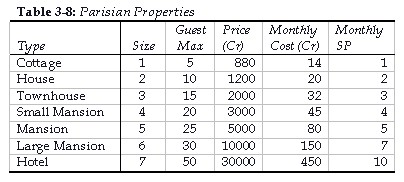
A character may host a private party in his house (as a Special Event) with whatever guest list he desires. The guest list can not exceed the maximum number of guests (mistresses do not count towards this limit) allowed in the establishment. Any order with guests listed in excess of this limit will be rejected and no party held (as the staff quits). The event is handled just the same as a special event as far as costs and SL gain are concerned. Additionally the host receives 1 SP for every 2 guests that show up. The guests receive an additional 1 SP for every 4 guests that show up.
Houses can come with Stables but the cost of the house is increased by 10% and can hold twice as many horses as the house size. If you have already purchased a house and wish to add a stable, then it will cost 25% of the house base cost.
Anyone may own a coach, but none are for hire. The SP award for owning and using a coach is a non-cumulative SP bonus. You order the use of your coach during the pre-monthly phase and will attend every party that month in your coach. This entitles you to the SP bonus listed (regardless of whether you attend 1 or 4 parties), but you will also have to pay the monthly cost. Purchasing a coach is a Free Action.
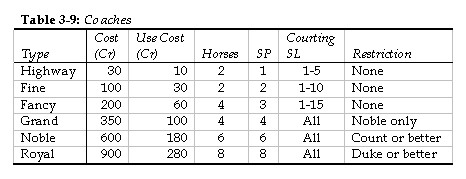
The indicated number of horses also have to be bought and a groom hired to maintain them. Unlike lodgings, the monthly cost for a coach is only paid when your character actually uses his coach. However, if you use a coach in the month you purchase it, you must pay both the initial cost and the monthly cost. Lastly, if you own a coach and wish to purchase a different one, you will receive 1/5 the initial cost of the coach you own toward the purchase of a new one. Purchasing used coaches is tres gauche. If someone buys a coach above his station (see Limits) then all nobles of higher rank have cause to duel this character when they meet, since he is breaking an unwritten code of the nobility.
Any event at the Fleur de Lys requires arrival in some form of coach, or the character loses 1 SP. One simply does not arrive at Paris's finest establishment on foot.
All ladies courted by a gentleman using a coach that month look more favorably on such a suitor, as long as the coach is acceptable to their station (+1 to the courting roll if the mistress's SL is within the range given on the table above).
Horses cost 100 crowns to purchase, and require a groom (2 Crowns per month, no matter the amount of horses) and housing (3 Crowns per month per horse). Buying horses is a Free Action, regardless of the number purchased.
Houses with Stables can house a number of horses equal to the house size free of charge.

 arracks duty is mandatory for all characters of Private or Trooper rank for two weeks each month, and those of Subaltern rank for one week per month. The only exception is by a furlough granted by the company Captain or superior officer.
Barracks Duty is a Primary Action, spent in caring for regimental equipment and animals, laying up provisions and endless drills. Permissible Secondary Actions include Gambling (no divisor, 100 crowns limit) and Carousing (assumed to be after-hours revels at local taverns).
Unlike previous editions of DBD, player characters may not train in weapon skills while performing Barracks Duty. A soldier is expected to know the rudiments of swordsmanship (i.e., "the pointy part goes into the other man"), but extensive training was considered a waste of time on common cannon fodder.
 hree types of investments are available for the wealthy character to gamble upon. These are: Foreign Trade (using a straight risk/profit formula), Arms Investment (speculating on large troop deployments for profit) and Finance Investment (reaping greater rewards during peacetime). Of these, the latter two may be controlled to some extent by the use of Influence (see 3.15.1). Investments are Free Actions, always done in lots of 1000 crowns each.
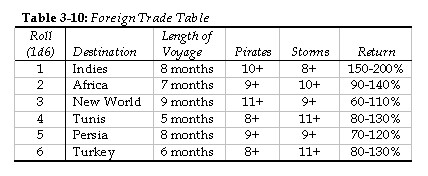 The first is in foreign trade. Each month there is a 1 in 6 chance that the Chancellor may decide to send a merchant fleet to far-flung shores to bring back valuable commodities. The Chancellor will announce such a venture and will invite investors to invest in multiples of 1000cr. The destination is determined on Table 3-10, and characters wishing to invest may do so in the next month. After the amount of time listed under "Length of Voyage" passes, the GM will check to see if the fleet fell prey to either pirates or storms. 2d6 are rolled for each, and if the result is greater or equal to the listed number, than the fleet (and the investment) are lost. If the fleet returns safely to France, then it earns profits as listed under "Return".
Two other types of investment are arms investments and finance investments, which speculate on the scale of the war during the Summer campaign season. Arms investors gain money when more troops are sent, while finance investors have stock in a stable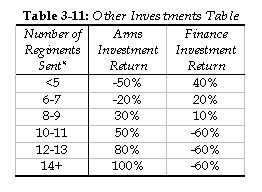 currency and thus lose money when large number of troops are sent. The following table delineates details on these investments. A positive amount is the percentage of his investment the investor receives as a dividend on his investment. A negative amount is the amount the investor must pay in to keep his investment solvent at the initial level, if this amount is not paid within the month the investment is lost in its entirety. Solvent investments may be sold to other players at any time. Investments of this nature can not be refunded until the beginning of a summer campaign season, and the return on funds is calculated at the beginning of each campaign season.
The Quartermaster General may designate one investor in arms as arms supplier for that army. In so doing, that investor receives a return on his investment as if one more brigade had been sent.
The Chancellor of the Exchequer may manipulate funds for the benefit of one player. In so doing, that investor receives a return on his investment as if one less brigade had been sent.
An NPC Quartermaster General of the Army will award preferred arms supplier status to a player on a die roll of 7 on one die. An NPC Chancellor of the Exchequer will manipulate funds on a die roll of 7 on one die. These may be modified by influence. If more than one player receives a 7+ then it goes to the player with the highest roll, with ties being broken by unmodified die rolls.
An NPC Minister of State can be influenced as to how many brigades will be sent on campaign. He can be influenced either to add or subtract brigades from the force deployment, and will add or subtract one brigade on a die roll of 7 on one die. He will add or subtract two brigades on a die roll of 9+. The number of brigades may never go below three or above 8. If the MoS is successfully influenced both to raise and lower the number of brigades, he will do whichever received the highest die roll, and by only one brigade.
entlemen who wish to pursue less Pyrrhic pursuits than combat and warfare may try their hand at the more civilized arts. Chief among these might be Science, Music or Literature. Regardless of what form it takes, each is a creative endeavor requiring common rules (see The Great Work, below).
Regardless of its final form, creative works are performed in discrete steps which must be taken to create a work worthy of attention. The first and most obvious step is to decide upon the subject matter. Will this be a play based on Greek mythology (always a popular choice), or perhaps a coldly scientific treatise designed to cut out long-held superstitions with surgical precision? Even if nothing else is written by the player, the premise should be solid, plausible and entertaining.
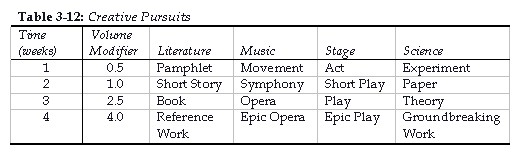
Once the premise is written, Step Two is to select a title for the work. Titles in the Renaissance could be quite lengthy -- feel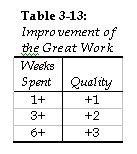 free to make yours as entertaining as possible. Step Three is the actual research and writing done by the character. Depending on the scope of the work, this might take some time, but need not be contiguous (i.e., one week per month, one per quarter, or just every so often). The duration of the project is directly related to its volume (i.e., a brief minuet requires less time to pen than a four-hour opera). Table 3-12 summarizes the minimum time requirements for different works. A player may elect to spend additional time developing the work prior to its publication. A bonus is given to the quality of the piece for each time increment spent (see Table 3-13).
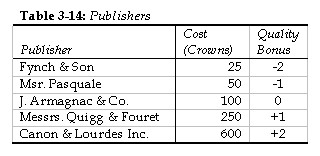 Once the work is complete, a publisher must be found. Finding a publisher is a Primary Action, which may be performed by a lackey. The publisher will determine the type of marketing, and to whom. Smaller publishers tend to cater to the lower classes, while the more prestigious publishing houses appeal to the patrons of the arts. The author (or his backers) must pay the fee to be represented, and hope that representation pays off in recognition and copies sold.
Performances, such as plays, opera and musical works, will have an additional couple of steps -- see Performances (3.8.4, below) for those rules. For written works, the next step is to determine the quality of the finished work. See 3.8.2 and 3.8.3 for details.
Science is not for the weak of mind or small of spirit. Men of Science, being the enlightened ones, tend to heap scorn upon those whose ideas and theories are clearly childish or outrageous. In order to weather these harsh indictments, a Scientist must be stern and strong of will.
Science will rarely earn a man much in the way of money, but fame -- and quite possibly a seat in the Royal Academy of Sciences -- await him who has the firmness of will and the intellectual prowess to succeed.
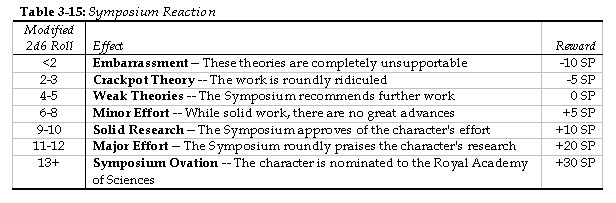
To determine the outcome of a published scientific work, the work must be reviewed by peers in the scientific community. These reviews (each called a
Symposium) are done during the first week of each season (i.e. first weeks of March, June, September and December).
It is not necessary for a scientist to be present at the Symposium for his work to be judged. If he -- or any other published scientist -- wishes to be present, it is as a Primary Action with Toadying as the only available Secondary Action. This event is treated as a Well-to-do Special Event. Numerous scientists from all over France attend the quarterly Symposia to debate topics, present new findings and judge the works of others. The determination of the work's Quality hinges on the following factors:
- Additional time spent writing the thesis (Table 3-13)
- If one's Mistress is a Muse (see 3.3.1)
- The publisher (Table 3-14)
- The reaction of the Symposium (generated on 2d6 -- see Table 3-15)
- The votes of any members of the Royal Academy of Sciences present at the Symposium
Members of the Royal Academy are highly regarded by the Symposium: each vote of an Academy member in favor of a work adds +1 to its Quality, and each vote against it is -1. The only catch is that a character may not vote on his own work.
The SP award is multiplied by the Volume Modifier in Table 3-12.
Example: Jacques has had a brainstorm for original research into the field of Magnetism. His player writes a brief description of Jacques' work, and titles it: "An Essay on the Nature of Magnetism as it Relates to Phlogiston." He spends two weeks in developing and writing his theory (making it a Paper, according to Table 3-12). His player elects to spend an additional week to boost its Quality (+1, per Table 3-13). He then hires J. Armagnac & Co to represent him, paying the customary 100 crowns. So far, his modifiers are +1 for time and +0 for publisher. His Volume Modifier is 1.0. During the next Symposium, Jacques attends and presents his work. No members of the Royal Academy are present, so the 2d6 roll for the Symposium Reaction is modified only with Jacques' own modifiers. The roll is a 9, modified to a 10. According to Table 3-15, the response is Solid Research. Jacques walks away with (10 � 1.0 for Volume Modifier = 10) 10 SPs.
Any pursuit of Literature will have returns both in fame and fortune. The greater the number of copies sold, the greater the returns. Once the publisher is retained, the work is published one month later.
The applicable modifiers to Quality are the following:
- Additional time spent in writing (Table 3-13)
- If one's Mistress is a Muse (see 3.3.1)
- The publisher (see Table 3-14)
- One's Patron (see XXX)
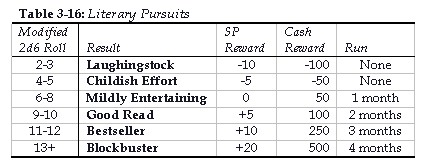 The month following the publication, a Public Reaction roll is made on 2d6. This roll, modified as above, is referenced on the Literary Pursuits Table. Both the SP and Cash rewards are multiplied by the Volume Multiplier in Table 3-12.
Performances include plays, symphonies and opera. In order to be staged, the work must be published though one of the normal publishing houses. A two-week rehearsal prior to opening is mandatory; however, a character-producer may elect to take more time to improve the Quality (see Table 3-13).
A character may produce a play for 500 crowns. A two-week rehearsal must be held the month before the play is scheduled to open. A mistress will take part in the play if asked by her regular lover at the start of rehearsals. If she does participate, she is not available to be courted neither during rehearsals nor during the run of the production, except by the producer of the play. A character other than the producer may only court any mistress participating in the production during non-rehearsal weeks between the first rehearsal week and the end of the run of the production. If she is courted away, her continued participation is at the discretion of her new lover.
The play runs for the whole of the next month with the manager being required to attend the first week. Additionally, he must host an opening-night party at his club in the first week. All those attending the play are entitled to go to the party unless especially barred by the manager. Members of the Royal Family will attend the play on a 6 in 1D6 (but not a bawdy production) and attend the party on a separate roll of a 6 in 1D6.
The Quality of the performance is determined by rolling 2D6 with the following modifiers:
- +1 if a professional producer is retained (cost = 50 crowns)
- Playwright's Mistress is a Muse +1 (see 3.3.1)
- Additional time in rehearsal (see Table 3-13)
- Additional time in writing (see Table 3-13)
- Publisher (see Table 3-14)
- +1 if the show is advertised as bawdy
- +1 for each 100 crowns spent on lavish props (max of +3)
- +1 for every 4 characters attending the show
- +1 for each Beautiful mistress in the show
- +2 if the Queen or Crown Prince attend
- +3 if the King attends
- -1 for each character hiring yobs
If a member of the royal family attends the manager will be presented to him or her (+3 SPs). Attending the theatre is a Primary Activity. The manager will receive 50 crowns times the success level of the play and if the play was successful a Mention in the Royal List (see XXX).
Writing is not the only artistic endeavor that gentlemen may explore in Death Before Dishonor. The seventeenth century was replete with
master artisans of all stripes -- painters, sculptors, architects, sketch
artists and so on. The rules for these arts are similar to, but distinct from,
those for writing.
Works of physical art require varying amounts of time to complete, depending both upon the medium and the scale of the project. Stone
requires more time to sculpt than clay, and the roof of the Sistine Chapel
requires more time to paint than a 10" by 12" canvas. See Table 3-17
for details of these choices. At this stage, the subject matter should be
selected, as well as its style (i.e., Formal, Realistic, Rustic, etc).
Table 3-17 shows three details - Time, Cost and Quality. The Time (measured in weeks) is the minimum time necessary to create the object. More time may be taken, if desired, but less time simply means an unfinished work. The Cost is the minimum cost of the materials and tools for one project.
More money may be spent, if desired, but no benefit is given for doing so.
Quality is the Quality Modifier (see 3.8.5.3).
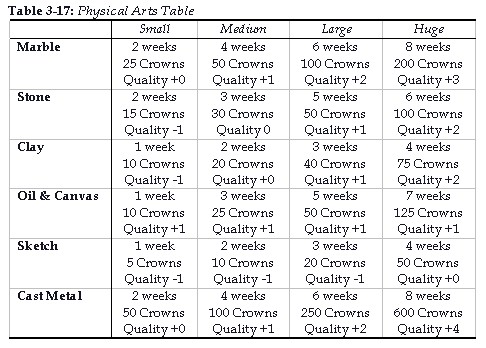
The media and scales available to the gentleman of the arts are as follows:
- Marble - Enduring, beautiful and polishable, Marble is an
expensive material to work with. All marble in DBD is imported from southern England (the famous black Purbeck marble) and Italy (Carrera marble is the most famous).
- Stone - Any durable non-marble rock material (whether
sandstone or granite) falls into this category. Less expensive than marble,
stone lacks the polish and patina of finished marble. Much less expensive, it
also requires less finishing time.
- Clay - Any non-durable, fired material falls into this
category. Clay is easily malleable and suitable for many sculpting purposes. It
was commonly employed for the creation of busts and vases, but any project is
possible.
- Oil & Canvas - The most commonly employed artistic
materials in Europe, oil and canvas are the benchmark for all of the physical
arts. Readily available and inexpensive.
- Sketch - Always done on parchment or paper, sketches may be
done with ink, pencil or charcoal. The materials are among the least expensive
available to the artist; however, in a world which recognized the greatness of
Leonardo da Vinci and Albrecht Durer, it is difficult to impress with sketches.
- Cast Metal - Whether the artist works in brass, silver or
gold, cast metal and foundry arts have become very influential throughout
western Europe. Statuary, jewelry -- even weapon hilts or armor -- may be
considered part of these arts.
- Small - Anything easily portable with one arm.
- Medium - Anything portable with two arms.
- Large - Any man-sized object.
- Huge - Anything horse-sized or larger.
The second stage of physical art is the creative process itself. Table 3-13 shows the minimum time required to produce a piece of art. This time need not be contiguous -- the artist may pursue other goals while in the midst of his art project. Just as for writing, the artist may elect to spend more time on the piece to improve its Quality. The same table (Table 3-13) is used for determining the Quality improvement for the time spent.
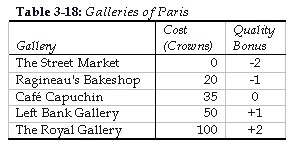 Like a publisher for a writer, artists relay on Galleries to introduce their work to the public. Each Gallery caters to a specific clientele within Paris. Like a publisher, a Gallery is paid a fee to present the work; unlike a publisher, however, a Gallery may also be used as a location to hold a party for the artist, called an Exhibition. Exhibitions are Special Events held by the artist or his patron to introduce the art and artist to the Parisian �lite.
At the time of the Exhibition (or the month following payment to the Gallery, if there is no Exhibition) the final Quality is determined:
- Quality for the Medium and Size of the piece (see Table 3-17)
- Additional time spent on the piece (see Table 3-13)
- If the artist's Mistress is a Muse (see 3.3.1): +1
- The Gallery modifier (see Table 3-18)
- The Patron of the piece (see 3.8.6)
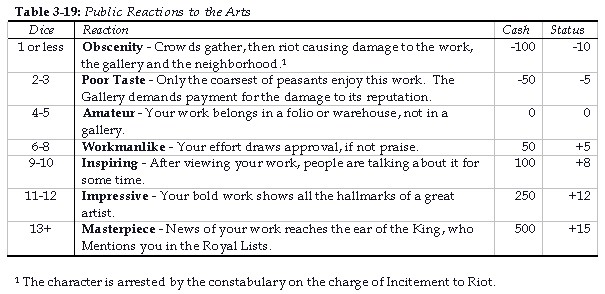
Once the public has seen the work, a Public Reaction roll is made on 2d6, adding all the Quality modifiers. The result is then compared to Table 3-19. Both the Cash and Status columns are multiplied by the Quality Bonus values from Table 3-17 (with a minimum value of 1) for a final sum.
The nobility and the well-heeled often lacked the time or talent for tasteful self-aggrandizement, and so supported artisans who would venerate them in return for financial support. This arrangement, called Patronage, generally took on the air of disinterested largesse, as (after a healthy sum was granted to the gifted artisan) the Patron seemed quite surprised at the generous light in which he was depicted.
Patronage fulfills two needs: the nobleman's scramble for Status in return
for crowns, and the artisan's need for resources to see to his upkeep.
Both aspects will be explored by this rule, along with guidelines for player
character to player character arrangements.
Some generous player characters may seek to bolster their Status supply by retaining a non-player artisan from whom he may commission work. Others may simply seek a short-term boost to Status in return for monetary largesse.
Hiring an NPC artisan is a Primary Action which may be performed by a lackey, if desired. If the character himself hires the NPC, he may combine the Hiring action with the Secondary Actions of Carousing, Bonne Vivant and/or Gambling, all assumed to be at a Tavern where the meeting takes
place.
NPC artisans are hired by reputation, which may or may not reflect his actual skill or dedication. To retain an artisan, the hiring character must specify the types (i.e., Author, Scientist, Playwright, Composer, Sculptor, Painter, Sketch Artist or Foundryman) and pay the sum of 100 crowns per month. This sum accounts for living expenses, studio space and
materials cost. Alternatively, if the character owns property in Paris,
the artisan may be lodged there (in which case the customary payment drops to
a mere 75 crowns per month). Expenses for hiring a publisher or gallery
are not accounted for. The Patron gains +3 Sp per month for having an artisan in his employ.
Once the artisan has been retained, the GM rolls 1d6 two times to generate
the artisan's Talent and Energy. These two statistics define the NPC
artisan, and may be found in Table 3-20. Once generated, these statistics remain constant for this artisan.

Once the artist has been retained, the Patron may commission
work at any time. The player specifies the subject matter and form, and
decides upon the amount of time the artisan will spend on the project.
The artisan will then undertake the effort, spending the number of weeks per
month as mandated by his Energy. When the project is finished, the usual
steps are taken adding the Talent modifier to its Quality along with any
others. The Patron must pay for the publisher or gallery, and, upon
determining the reaction, reaps the full amount of Status that the artisan
would have received. No monetary benefit goes to the Patron.
Many wealthy gentlemen and nobles wish to be elevated and immortalized in works of art, and are willing to pay well for just such services. Finding a Patron is a Primary Action, and is successful on a roll of 5+ on 1d6. Lackeys may not seek NPC Patrons themselves, but may perform legwork to learn of a suitable Patron. Each week the lackey searches, roll 1d6. On a roll of 6+ (+1 if he should have Wit) to learn of a suitable Patron. This information lends a +1 bonus to the Player Character when seeking said Patron.
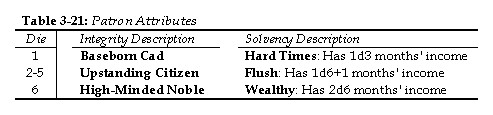 Just as NPC artisans have certain attributes, so do NPC Patrons. These attributes are Integrity and Solvency. Both of these are generated after the contract between the PC and NPC are accepted. Integrity measures the Patron's moral character (for, after all, is the artist painting a picture of a cad or a hero?). Solvency measures the depth of the Patron's pockets -- will the artisan be paid for his work?
The tables are interpreted as follows:
- Baseborn Cad in Hard Times -- The patron expects completed work, but has no intention to pay the full amount.
- Baseborn Cad who is Flush -- The Patron demands three weeks' work per month for the customary fee. If the artist balks, he delays or stops payment.
- Baseborn Cad who is Wealthy -- The Patron contracts for a single week, then drops the artist.
- Upstanding Citizens -- The Patron will contract for whatever he can afford, regardless of Solvency.
- High-Minded Nobles -- The Patron contracts for whatever they can afford and pay a bonus of 100 crowns times the Volume (for written works) or Quality (for physical artworks) modifiers (minimum modifier of 1, for purposes of this calculation). Again, these arrangements are regardless of Solvency.
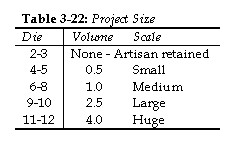 The character-artisan is assigned a project size (from Table 3-22), and may select the form of the piece (i.e., novel, painting, sculpture, etc). The character is then paid the sum of 100 crowns per month for a minimum of two weeks work that month (subject to the Patron's attributes). If the project size is "none", the player is paid the 100 crowns with no obligation to work (Cads, of course, will pay nothing for an idle craftsman).
Once the character-artisan has completed the work, the Patron will pay for the publisher or gallery. Patrons who have fallen on Hard Times will engage Fynch & Son or the Street Market (both -2 Quality Bonus). Flush Patrons will hire J. Armagnac & Co. or Caf� Capuchin (both +0 Quality Bonus) and Wealthy Patrons will use Canon & Lourdes, Inc. or the Royal Gallery (+2 Quality Bonus). The artist will receive all money generated by the project (although any costs are the Patron�s responsibility) and any material benefits (such as MRLs) are likewise the artist�s to enjoy. However, all Status received by the artist is halved. The full amount of Status is accorded to the Patron.
Player characters may act as Patrons or Artisans for other player characters. The details of the arrangement are entirely at the discretion of the players, subject to the following restrictions:
- The agreement must be clearly spelled out by each party in their own orders. Any discrepancy in the terms (payment, etc) will nullify the agreement, releasing both parties.
- The terms may not alter or modify the rules in Section 3.8 regarding the creative process or public showing.
- In order for a Patron to receive Status, a payment of monies must be made to the artisan. Whether it is a token payment or a vast sum is entirely up to the players� agreement.
Player character agreements may be terminated at any time, by either character. If either player terminates, the agreement is automatically nullified. No action may be taken by aggrieved parties, unless both players provide the GM with terms of a contract.
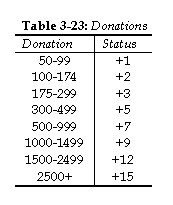 The final form of Patronage is also the simplest. Wealthy characters may elect to donate sums of money to worthy causes, such as relief of the poor, hospitals, charities, orphanages and so on. Property, too, may be donated (its Status return is of course calculated by its cash value).
In order for cash donations to generate Status for the donor, the money must be taken "out of play" (i.e., not to another character). money gifts between characters may make friends, but no Status is accrued by doing so.
To determine the Status reward for a given donation, see Table 3-23. If desired, the donor or his friends may choose to host an Event to mark the donation (such as a party in the new orphanage created by the character, etc). Such events are considered Special Events under rule 3.2.
he essential premise in Death Before Dishonor is a man's ability to advance. The most common means of advancement is by the sword -- by prowess and perseverance the character achieves his goals. However, the Renaissance was made of more than hot-headed bravoes picking fights with each other. Universities and schools were packed with gentlemen who valued education, who preferred Reason to Rashness.
Formal schooling, such as the Seminary, Law School or Military Academy, require a given amount of time to complete the curriculum. This time need not be contiguous, but may be subject to other restrictions (see the appropriate sections for details). Informal schools and academies, such as gymnasiums and fencing schools, have no set curriculum or criteria -- the gentlman may attend as frequently he desires until he has achieved the desired results.
Attending Schools or pursuing studies are all considered Primary Actions, with no allowable Secondary Actions, unless specifically stated otherwise.
Before becoming a Priest, one must first become a Student of Theology (SoT). Anyone can become an SoT at any time, and there is no roll required. Characters may be in the Military and be an SoT at the same time, provided all the character's time requirements are met. An SoT must spend at least 24 weeks in study before ordination (see Table 3-24), and must spend a minimum of one week each month devoted to these studies. The character is exempted form this restriction while at the Front.
If a month passes without at least one week spent in study, the student must begin his studies from the beginning. Fortunately, however, an SoT gains SP for week of study.
Students of Theology must join one of three schools to learn what is necessary to become a Priest. Each of these schools is run by a powerful Order of monastics, and each has its strengths and weaknesses, as can be seen below:
- The Order of St. Dominic, better known as the Dominicans, are a largely mendicant order of clergy. The Order of Preachers was founded in 1216 by St. Dominic de Guzman. He adapted the structure monasticism so that his Friars, vowed to poverty, chastity, and obedience, were nevertheless free to move wherever their preaching was needed. Characters belonging to this Order are encouraged to eschew extravagances.
- The Order of St. Benedict, one of the most ancient orders of monasticism, is better known as the Benedictines. As the oldest of the three Orders, it is also the most conservative in its outlook. While the Rule of St. Benedict (the guidelines by which monastic life is conducted) recommends abstinence and simplicity, the recent Benedictine graduates tend to be among the most worldly men of the cloth.
- The Order of the Society of Jesus, or simply Jesuits, are the most recent Order among the lot. In some circles the Jesuits are considered with a mxture of contempt and fear. Founded by Ignatius of Loyola in 1534, they vowed to live in evangelical poverty. Strangely, however, Jesuit priests and monks have become confidants to Kings and arbiters of trade throughout much of the Known World, even as far away as the fabled Japans.
Students of Theology must select one of these three Schools to begin and complete his training. Each school has a minimum SL for an applicant. Anyone meeting or exceeding this SL is automatically accepted as a student. The "SP/Week" column lists the amount of Status gained by an SoT per week of study. Finally, the "Graduation" column lists the roll required on 1d6 for the student to graduate after the 24 week period. Every additional two weeks of study adds +1 to the die.
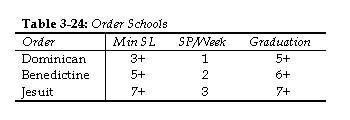
Should a student fail the graduation roll, he must study for two more weeks before rolling again. Additional weeks of study add the usual modifier (+1 per two additional weeks). Once graduated, the character is Ordained as a Priest. See Chapter Five for the details.
After the Seminary, Law School is the most prestigious institution in France. From ancient times, rhetoric and disputation were highly regarded sciences, leading to logic and a return to classical philosophy. Only now, in this Age of Reason, have these arts been eclipsed by Mathematics,Astronomy and Physics.
Training in Law gives a gentleman a direct route to Provincial Appointments, and, by extension, the Royal Government itself. Many non-noble "self-made men" have achieved positions of wealth and influence by this route, which has been at the vanguard of the rivalry between Nobility and Education.
Law School may be entered at any time. Once entered, a minimum of one week each month must be dedicated to legal studies. This counts as a Primary Action with no Secondary Actions allowed. The character graduates after 24 weeks of study. Once graduated, the character is granted the degree of Lawyer, and by traditions style himself "esquire". See Chapter Six for more information.
Some men seem to emerge from the womb with the ability to marshal the midwife and doula into an effective military unit, while others seem to lack this talent. For gentlemen who desire to sharpen their military prowess, the Military Academy offers studies designed to develop those skills.
An officer (Captain and up) may elect to go to the Military Academy for 10 � current MA in crowns for each one-week lesson. After 8 weeks of study (not necessarily contiguously) the character sits an exam. If a d6 rolled is equal to or is greater than the character's current MA, his MA is increased by 1. This places an effective limit on an MA of 6 for Academy training. While it is possible to advance beyond this level, it can only be done with experience.
For each season your character leads troops on campaign (i.e. rolls dice for the unit) as a Major or higher, his Military Ability will increase by one if an 11+ is rolled on 2d6. Military Ability can not increase more than 1 in any single season. This applies to anyone in a command position. See Chapter Four for more details.
 Training in appropriate schools may increase all skill, ability and attribute values. The quality of instruction, and thereby the chances of improvement, depend on the amount of money spent. Each week spent training improves either the skill level or the chances of improving during the next training session.
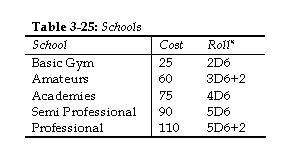
At any school level the appropriate number of die (Table 3-25) are rolled, the number of weeks previously spent training without an increase in skill (if any) are added to the roll, and the result is compared to the current skill level. If the result is higher than the current value, the value increases by one.
In the basic gym, which costs 25 crowns per week, 2D6 will be rolled and if the result is above your character's current value then your character's skill level will increase by one. For each week of failure a cumulative +1 is added to the next attempt at training. Any character may practice at the school level best suited to his ability to pay and desire for better chances to improve.
This rule does not apply to Strength and Constitution training. Strength and Constitution can only be improved in the Basic Gym. Agility is unique still, it can't change as of yet. The available training facilities are shown in the following table.
Example: You want your character to train in Strength, or perhaps ballroom dancing (the skill or attribute doesn't matter as they all work the same) and your character's ability is currently 11. Your character can go to a general school (basic gym) in 1 week, spend 25 crowns and roll 2D6. If the result is higher than 11, then your character's ability is raised to 12. If the roll is not higher than your character's ability (say the roll was 11 or lower), your character can train again in the future. The next time he trains, he takes a week, spends 25 crowns, and rolls 2D6+1 (for the one week training so far). If this is 12 or higher, then your character increases his skill level to 12 and starts the training process at the beginning. If your character goes 4 weeks without increasing his skill, then the 5th week is rolled with 2D6 +4. Sooner or later your character will increase his level of skill. If this isn't fast enough, your character can attend one of the more prestigious schools and get better dice rolls by paying higher fees (except strength and constitution, which can only be trained at the basic gym).
 Each character has five separate skills for melee combat. Each skill defines the character's ability with one class of hand-to-hand weapons. These are: Dagger, Cutlass, Sabre, Rapier and Two-Handed Sword.
The character's initial aptitude with each weapon is determined by his physical attributes, as follows:
- Dagger = 15 - (Agility)
- Cutlass = (Strength + Constitution) /2
- Sabre = (3 + Strength) - Agility
- Rapier = (3 + Constitution) - Agility
- Two-Handed = (Strength) - 1
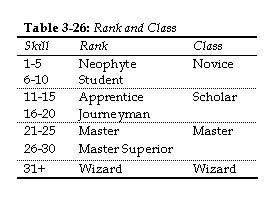
A character may be ranked by the skill he possesses in a given weapon, as shown in Table 3-26:
As a character exceeds 10 points of skill, he gains one Mastery. Thus, as we may see on the table above, Novices have no Masteries, Scholars have one, Masters two and Wizards three.
For each Mastery, we deduct ten from the character's expressed Expertise. Thus, a man with a Sabre skill of 17 has a score of 7 with one Mastery. In game terms, we will write it thus:
(Score) M (# Masteries)
So, our Journeyman of the Sabre may be shown thus: 7M1. Here is another way to look at it:
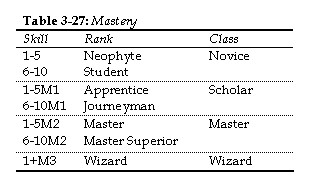
The concept of Mastery is central to the dueling system, and may eventually form the backbone to other game systems as well. The actual use of Mastery will become clear as we look at the combat rules, below.
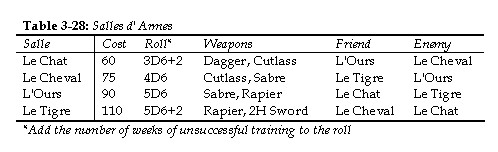
Skills are trained at special schools called "salles", short for salles d'armes. Each salle specializes in different skill combinations. Only these skills may be trained while the student is being taught. Each school also has a secret technique, which the student may learn only under special circumstances.
To make matters even more complex, each salle has friends and rivals among the other salles of Paris. These rivalries act identically and additionally to regimental rivalries. That is, a King's Musketeer who trained at L'Ours may seek a quarrel with either a Cardinal's Guard, a member of Le Tigre or both.
Once a character has begun training at a particular salle, they will remain on that salle's list of members. Member ship lasts until the character voluntarily quits (an opportunity action), or until the character begins training at another salle d'armes.
Should the character elect to switch salles, he must roll a 5+ on 1D6 to be accepted to the new school (-1 if applying to an enemy salle, +1 if applying to a friendly one). Failure to apply means the character may not train that week -- the old school has crossed him off their list, and the new one has not yet accepted him.
Applying to a salle is a free activity, but training is a primary action. For costs and benefits, see Table 3-28.
 iscerning gentlemen of Paris are wise to the fact that, should they allow their baser instincts to surface, especially in a society where most other gentlemen accessorize with three feet of steel upon their hip, violence could easily result. Gentlemen of schooling also recognize the importance of "balancing the humours", another important element of the baser pursuits. Fortunately, the streets of Paris are graced with houses of ill fame, commonly found in the Red Light District (RLD).
Visiting the Red Light District is a Primary Action. Players must write how much money they are taking with them to the RLD. While there, one may do any number of the following things:
- Visiting a Bawdyhouse (Secondary Action) is one way to acquire female companionship at a cost of two times the character's SL in crowns. If the character already has a mistress and she finds out (die roll of 6 on a D6), she will throw him out. Characters gain 1 SP by disporting themselves in this way.
- Gambling (Secondary Action) can also be done at the RLD (see XXX). There is no house limit and no SPs are gained.
- Carousing (Secondary Action) is the same as it is for Clubs, SL in crowns for 1 SP (see XXX)
- Hiring Goons (Secondary Action) to rough up a foe. The goons cost 10 crowns each and do 1D6 endurance damage to the character for each goon hired. They will never do damage bringing the character below 1 endurance. There is a 1 in 6 chance of the character hiring the goons being found out and losing 1D6 SPs because of it.
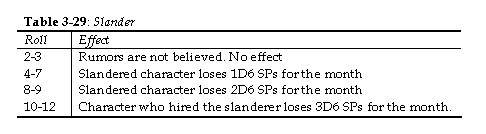
- Slandering (Secondary Action) another character by starting vicious rumors about this person. Slandering costs 20 Crowns. The effects of slandering are as follows in Table 3-29 (During any one trip to the red light district, there is no limit on the number of other characters your character may slander; however, any given character may only be slandered once per visit).
- Hiring Assassins (Secondary Action) You may look for an assassin
At the end of the visit to the red light district, on a die roll of 6 on 1D6 the character is assaulted by footpads and relieved of his money.
 Is there someone particularly troubling to your character that he can't take care of himself? In the darkest alleys of Paris one can find almost anything if he looks hard enough. In particular, one can hire assassins, by looking for them in the red-light district.
To hire an assassin your character must spend a Secondary Action, and on a 6 on a D6 roll he will find an assassin who will do the job. If the result is a 1 then your character will be reported to the Commissioner of Public Safety immediately and brought up on charges. An automatic rumor is generated when your character searches, thereby warning the target to some degree. The contracted hit will be conducted in the next month. A d4 will be rolled to determine in which week the hit will be made.
An assassin costs 100 crowns per SL of the target. The assassin will successfully kill the target on a 4+ on a D6 roll. If a natural 1 is rolled then the assassin just keeps the money and disappears. The assassin will only be caught on a 6 on a D6 roll regardless of success and will reveal the name of the character who hired him.
A lackey will protect your character from an assassin and decrease the probability of success by 1 in 6 (2 in 6 if he has loyalty). If the assassin would have succeeded if not for the lackeys presence, then the lackey is killed as he protects his master. A lackey will increase the odds of the assassin being caught as well by 1 in 6 (2 in 6 if he has wit).
he true gentleman does not soil his hands with menial labor. He is a man of means, able to spend his days in manly pursuits and his evenings in good company. Some gentlemen struggle to make ends meet, however. Even though it is often thought unseemly, for some men work is necessary. Discounting income from the military, clergy or political posts, working is the only way to make an income.
If your character is strapped for money and has no other means to gain it, he can demean himself and actually work to earn some extra funds. While working is a decent way to make some quick cash, it is considered beneath the Parisian dilettante, so there is a SP repercussion. Working gains SL*1D6 crowns for each week worked. Unfortunately, those who engage in work incur -1 SP for the first week worked in a month, -2 SP for the second, -3 for the third, and -4 for the -- so a character who works all month will lose 10 SP's.
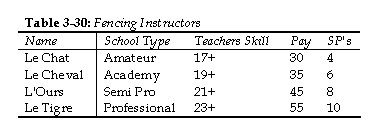 Fencing schools are well established and teaching positions are available for those skilled enough. Instructors must possess a skill appropriate for the school in order to teach there. There are two instructor positions available per school, with acceptance on a 7+, +1 per school difference if he could teach at a higher level school, and -2 if the instructor has not yet won a duel. A level 5 influence is required to modify the roll. Instructor terms are for 1 year, or until the instructor is not available (by being out on campaign). The instructor must spend one week per month "working" at the school, and will receive the pay and SPs shown. If, for any reason, the instructor does not teach at least once during the month, he is dismissed. Each week teaching at the school counts as a week's worth of training at that school. The instructor must specify which weapon he is instructing in a given week and it must meet the Teacher Skill level required for the school. I. e. An instructor at Le Chat has a rapier skill of 20 and saber skill less than 17. He may teach in Rapier and receive a free training, but he may not teach saber. He needs to take lessons himself and pay appropriately.
he streets of Paris are full of cutpurses, thieves and ne'er-do-wells. A man does well to keep his wits about himself at all times, to avoid falling prey to such scum as these. Every so often, however, a man might be tempted to join their ranks, if only for a single evening. For some, it is the simple thrill of the game; for others; a means justified by a particular end.
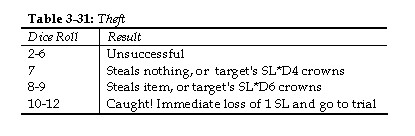 A character can attempt to steal from another character as a Opportunity Action. Both the target and the object must be specified in the orders (i.e., "Steal the signet ring from Porthos"). If no object is specified, it will be assumed to be that person's purse. Once the player is in the presence of he whom they are going to rob, he rolls two dice.
Note that if the target has a lackey, the theft is automatically foiled on a 1 in 6 chance; 2 in 6 if the lackey has Wit. If the theft is foiled, there is a further 1 in 6 chance that the thief is caught; 2 in 6 if the lackey has Wit or Brawn.
character may elect to become a spy for another country or power. Countries and powers who actively seek spies in France are Germany, Spain, England and the Huguenots. A character who elects to become a spy must select the power to whom he sends his reports. This is permanent, as spies may never retire. Becoming a spy is a Primary Action, assumed to be spent outside Paris, away from prying eyes.
The pay is 25 crowns per week spent actively spying (50 if a Major or higher, and 100 a week if a minister). Due to inside knowledge, spies will gain +1 modifier when applying to any Government or Military Appointment, and their MA will be considered to be one higher when determining their Battle Result. Spies will only be paid for weeks spent actively spying.
A spy is discovered if he is tried by the Commissioner of Public Safety for any reason; if he must appear before a Court Martial and found guilty; or if a 12 is rolled on 2D6 during any week spent spying or using the spy-benefits. An uncovered spy may be tried at the discretion of the CPS (an NPC will prosecute on 3+ on 1D6). If you receive a bonus for being a spy then you are considered to have been spying. If you don't want to risk getting caught then don't use the bonus.
 hether called a dogsbody, manservant, valet or batman, a Lackey is a useful tool for the well-to-do gentleman. Able to run errands and protect both his master and his master's goods, a Lackey is also a useful role-playing foil in written communications to the list. Lackeys do have some drawbacks, however. Their activities may prove an embarrassment to their masters, or worse.
As a Primary Action a character may search for a suitable lackey. His search will be successful on a roll of 6+ on 1D6. This roll can be increased by +1 for each 2*SL spent, although an unmodified roll of 1 always fails. Your orders can specify a name for the lackey if found, if you do not provide one, the GM will. Possession of a lackey is worth 1 SP per month and costs 2 times the character's SL (not the lackey's, which is irrelevant) in Crowns.
Like mistresses, lackeys can have special attributes. They are: L (loyalty), B (brawn), W (wit). The lackey has that attribute on the roll of 1-2 on 1D6. Loyalty marks the lackey as being attached to his master for more than just financial reasons; he is an advocate of his master's point of view. Brawn is the atrribute of the physically strong and tough Lackey. Wit is a clear indication that the Lackey has almost the same intellectual capacity as his master.
Lackeys confer the following benefits:
- There is a 1 in 6 chance he will foil goons (he fights alongside his master or warns him of the impending danger in time), this is increased to a 2 in 6 chance if the lackey has B(rawn).
- There is a 1 in 6 chance he will foil an attempted theft against his master (by being in his apartment when the thief comes calling, etc), this is increased to a 2 in 6 chance if the lackey possesses W(its). The lackey also increases the chance that the thief will be caught (see XXX).
- A lackey will protect his master from an assassin and decrease the probability of success by 1 in 6 (2 in 6 if he has L(oyalty)). If the assassin would have succeeded if not for the lackey's presence, then the lackey is killed protecting his master. Additionally, a lackey increases the odds of the assassin being caught by 1 in 6 (2 in 6 if he has W).
- A lackey may perform some weekly actions for the character as specified below in Lackey Activity.
Each month a 2D6 is rolled and on a 12 then the lackey has done some ridiculous thing which causes his master some embarrassment and costs his master 1D6 SP's that month. If his master asked the lackey to do something that caused the lackey to lose SP's then the master is automatically embarrassed.
Lackeys can be dismissed at any time, but dismissing a lackey does not negate the loss of SP's if they cause their master embarrassment. Dismissing a lackey without cause costs the character a one-time loss of 3 SP's. (Rumors spread that the character is destitute or that the lackey performed some indiscretion).
A lackey may be assigned to perform a task that normally takes one week's worth of action. This action does not generate any SP's for his master, and there are some activities that simply require a character's presence and can not be done without them (such as courting a mistress). For example, your lackey may deliver a letter of application to join a regiment for you and thereby save you the week's action.
A lackey may escort his master's mistress to and from Church, but his master will have to pay his mistress' tithes and his SL in tithes for the lackey. This will count as if his master was with his mistress, should someone seek to court her in that week. The lackey may not escort her to a Club, as neither he nor she are members and you cannot invite a guest without attending yourself.
A lackey may act as a Yob at a Performance, this costs nothing, but there is a 1 in 6 chance that he will be recognized in the crowd. If he is noticed, this is an automatic Embarrassment, as above.
A lackey may be sent to hire goons. They will only hire assassins for you if they have both B(rawn) and L(oyalty). Both of these actions increase the chance that they will leave their master's service.
Other characters can bribe a character's lackey to do a one week action for them instead, and this requires a bribe equal to 3*(his masters SL) to even consider it. 1D6 is rolled and on a roll of 6 the lackey will do the task for them. A roll of 1 always fails, and on an unmodified roll of 1, the lackey will report who tried to hire him to his master, which gives his master cause for a duel with the briber. In the case of a failed bribe the money is returned, and it costs the briber nothing. The following modifiers apply to the success roll:
- +1 for each additional 3*(his master's SL) in bribes
- -1 if lackey has W(it) or L(oyalty)
- -1 for each (master's SL in Crowns) gift given to him by his master this month
gentleman needs connections if he is to make his mark on the world. Influence is used to increase the odds of NPC's doing what you want. It can be used to gain money, power and position. Influence can only be used on NPC's, as player characters make their own decisions. You will have some number of influence points available at any given time that can be spent to modify the die rolls used to determine NPC decisions. Once used, these influence points are expended, regardless of the outcome of the roll.
Any activity that can be influenced favorably can also be influenced by others unfavorably. However, not all activity that is influence-able is announced, and if you use influence to attempt to thwart an activity that does not actually occur, then the influence is lost anyway, so make sure you use your influence wisely.
Your SL has a certain influence level associated with it. You might gain additional influence from your mistress (who might have more if she is Influential), and from certain appointments and positions.
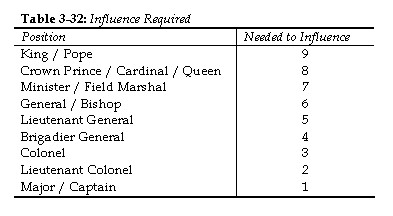 There are two influence numbers to track, your Maximum Influence allowed and your current Influence level. Your maximum Influence Level is the maximum influence that you can bring to bear at one time and is equal to the total sum of all your influences. Your Current Influence level is the number of influence points you have available to spend, and cannot fall below zero, or raise above your maximum influence level.
The table below shows the number of influence points needed to get a die roll modifier of +/- 1 to influence some decision by an NPC, depending on the rank/position of that NPC. Thus to influence a Colonel you will need a current influence level of at least a 3. To gain more than a +/-1 die roll modifier to adjust a decision, you will have to utilize the same number of current influence points. E.g., to gain a +2 to a die roll for a decision made by a NPC Colonel, you can use 6 current influence points, or a +3 modifier costs 9 influence points.
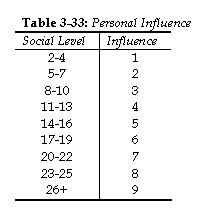 More than one player may bring their influence to bear, and the resulting adjustment to the die roll is the sum of all modifiers from all the players attempting to influence the decision. Players may use their influence on other players' behalf. This is simply done by noting in your orders where you use the influence for and in whose name this happens. This can be important, e.g. when deciding who made a person step down from a position. (Thus if one player uses 6 influence to influence a NPC Colonel decision (+2) and a second player uses three influence (+1) on the first player behalf, then the die roll is modified by +3).
Influence is recovered at a rate equal to 1/3 your maximum influence level at the end of the month. Your current influence level can never exceed your maximum allowed influence level.
Your personal Influence is determined by your SL on the following Table. The influence gained from your mistress is calculated using the same table (and her SL) and if the mistress is Influential then you receive the twice the influence value. For the influence gained by appointments, see the section on appointments.
Sometimes a gentleman is in the right place at the right time, or goes the extra mile for an NPC. A running total of favors owed your character will be kept. Favors can be used the same as influence points. Unlike influence, favors neither refresh, nor expire.
If the influence you have is not enough you may resort to bribing the individual making the decision. You can only purchace a +/- 1 to the dieroll, and the cost is 50 * the number of influence points required to bribe the NPC. The GM will then roll 2d6 and on a 12 you have attempted to bribe an honest NPC, who will immediately reveal you to be the underhanded scoundrel you are and report you to the CPS. If the roll is a 10 or 11, you have attempted to bribe a particularly dishonest NPC and he will just keep the money and the die roll will not be modified.
 haracters may find themselves participating in duels to satisfy their honor. There are two types of duels: those with cause and those without. Duels are usually fought at the end of the month, and do not take up a week's action, but sometimes are immediate (when you court a lady and meet another gentleman with the same idea). Players are to provide the GM with dueling order or suffer the default routine. Defaults are using your best weapon to the death, never surrendering. Winners of duels receive status and satisfaction while losers are humiliated, wounded and sometimes killed. Your orders can be conditional within reason (the GM let you know if it's unreasonable).
There are many reasons for just cause for challenging someone. Some are listed below, but not by any means conclusive. If you can come up with a good enough reason that demands honor be satisfied, I'll allow it as if it were cause.
- When two characters of enemy regiments meet each other there is cause for a duel.
- Committing an indiscretion with another player's mistress.
- Two characters courting the same mistress.
- If a noble meets a non-noble who is four or more social levels above him.
- If two characters apply for the same appointment if the appointment has a limited number of openings.
- Insulting a regimental friend of a character.
- Loss of face to another during Repartee (see 3.18.5)
- Failure to collect on a private loan with terms.
Characters may refuse a duel without loss of SPs if their endurance is less than half. If, however, a character accepts a duel in such a condition, he gains 3 SPs immediately. If a character is able to duel, and the duel is with cause the character may not refuse the duel without a loss of honor (-5 SPs). If there is no cause then turning down a duel has no consequences.
The process of challenging a gentleman to a duel can be very involved. First a slight must have occurred and this is reported in the newsletter for all of Paris to witness. You simply can't make up a reason if no one else has witnessed the event. The offended party then issues the challenge in the next newsletter and states the cause. Finally both parties will meet and duel in the following newsletter. Both parties must write in their game-turn orders that they will wish to duel the other and list the cause or the duel will not occur. Some duels however are fought immediately, like when two characters meet each other at the doorstep of a mistress.
Example:
Month 1: An offense is perpetrated for all of Paris to see, and published in the newsletter.
Month 2: The challenge is posted and the cause listed. Terms and conditions are posted for all of Paris to view.
Month 3: Both gentlemen include orders to duel the other and list the routine for the duel, listing cause if appropriate. The results of the duel will then be revealed.
Combat is conducted through the use of a d10. Each combatant rolls 1d10 and compares it against his Score (remembering that the Score is the Expertise minus 10 for each Mastery). If the roll is equal to or less than the character's Score, he has succeeded. The winner of any given contest is the combatant with the lower roll.
Yes, it's that simple.
Now, let's spice things up a bit. The following table will illustrate what happens under given circumstances:
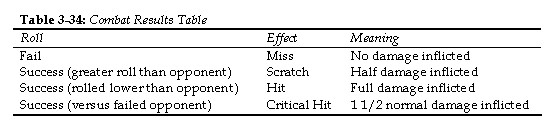
When two combatants with equal Masteries duel, there is no effect. When two unmatched opponents meet each other on the field, he with the higher Mastery has an advantage.
Deduct the lower Mastery level from the higher. The remainder is the degree of advantage possessed by the superior fighter. This advantage is expressed in terms of "bumps".
A bump transforms a Miss to a Scratch, a Scratch to a Hit and a Hit to a Critical Hit. Two levels of bump would make a Miss to a Hit, and a Hit to a Critical Hit.
Three levels difference ensures a Critical Hit with each swing of the sword.
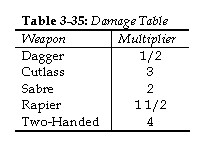 Damage is no longer a function of random die roll. Rather, it is the result of a solid swing to the best of the wielder's ability. The damage inflicted by a weapon is the function of three things: the wielder's Strength attribute, the Damage modifier of the weapon and the quality of the hit (i.e., Scratch, Hit or Critical Hit).
The actual damage suffered by the defender is equal to these three factors multiplied together.
Example: Gilles and Armand have a grudge against each other, and have resolved to carry it to the field of Mars. Armand manages to Scratch Gilles with his Sabre. Gilles will suffer (Armand's Strength [10] x 2 [Sabre] x 1/2 [Scratch]) for a total of ten points of damage.
For the weapons and their damage modifiers, see Table 3-35.
Since the days of the Middle Ages, armor was commonly worn to protect combatants on the field of battle. Even during this new Age of Reason, armor is commonplace despite the growing importance of gunpowder weapons. While armor will never be worn by a gentleman in a duel, there may be circumstances which dictate its use on the field of battle. It is for these such reasons that these rules are designed.
Armor is designed to cover one or more parts of the body. As the Advanced Rules do offer the capacity to perform called shots, these locations are important. Should no called shots be made, all damage is assumed to be to the torso.
Please note that the new Regimental Lists also show the type of armor issued to the troops, if any. All soldiers in the field are assumed to be wearing their regimental armor, unless the player specifies otherwise.
Listed below is the Armor Table:
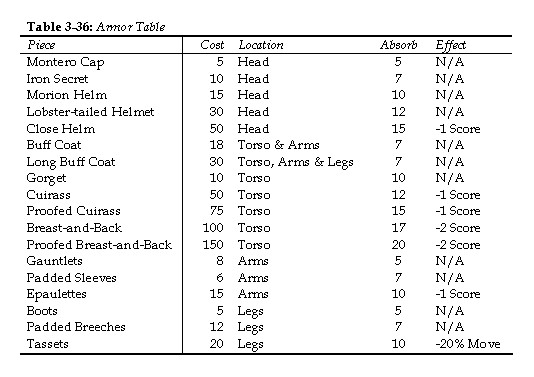
The column labeled "Absorb" shows the amount of damage stopped by the armor. Some armors also have an "Effect," which (due to its weight or bulk) imposes a penalty on the wearer. All costs are in Crowns.
On occasion, it is necessary for a soldier to wear more than one layer of armor. When this happens, the result is not additive, but does enhance the effect of the primary armor.
To determine the actual absorption, add the full value of the strongest armor to (1/2 the value of the next strongest armor) to (1/4 the value of the next) to (1/8 the value of the next) and so on (assuming a character can even move with three or more layers on!).
The person who challenges in a duel may choose to give his opponent the option in weapons. If the challenger does this he must abide by the weapon choice and use the same weapon as his opponent. Doing this gains the challenger +2 SPs.
Status Points are awarded or deducted as follows:
- The winner of a duel gains 1/2 the opponent's SL in SPs or 5 SPs, whichever is higher.
- Both duelists receives -1 SP if they are from the same regiment.
- The winner receives -1 SP if his opponent was from his own regiment.
- The winner gains another 3 SPs if the opponent was from an enemy regiment.
- The challenger gains 2 SPs if he gave his opponent 'choice of weapon' (See above).
- A duelist loses 2 SPs when fighting a regimental enemy not using his regimental weapon (unless he gave the challenged 'choice of weapon' (see above).
- The loser loses 2 SPs if he loses to someone from an enemy regiment.
If a player refuses a challenge which has cause, he loses SPs equal to half his social level.
- If a player challenges with insufficient cause he loses 2 SPs.
- If a player meets an opponent who refuses a challenge with cause he gains 2 SPs.
- Surrendering without being hit loses -3 SPs.
- If a player kills his opponent he gains 2 SPs.
- Not turning up to Duel -SL in SP's.
If you are under half endurance then you may decline the duel without loss of honour, but if you choose to fight anyway, you gain 3 SPs, regardless of the outcome of the duel.
If the duel was a real duel and not just to first blood, then the winner of a duel rolls as if he went to Le Chat to decide if his skill went up or not, if not then he gets his training improved by 1. The loser rolls as if he went to a basic gym (2d6) and if no increase then his training increases a level by 1.
So far, our combat system is pretty complete. The one thing it lacks is flavor. And what brings more flavor to a combat system than a wide selection of special moves?
Combat moves are divided up by two criteria: the number of masteries necessary to learn them, and the number of Expertise points required to purchase them. Yes, that's right: a character must sacrifice Expertise in a given weapon to learn special moves for that weapon. The special move cannot be purchased if the cost would bring the character below the required Mastery level.
Once learned, special moves may be used at any time during a combat sequence. Some are opportunity-based, and will be used whenever the appropriate situation arises.
Rule 2.5.1.3 lists some special moves. Others may be developed in time, but this should offer a pretty good idea about what is possible.
entlemen of Paris are a volatile breed, and upon occasion may be required to pay Nature her due for the offenses they have committed against their own bodies. In other words, by living a hard life, sometimes a character must make some time to recuperate. There are two ways to heal: one may allow Nature to take her course, or one may commit himself to the care of a trained Physick to render the appropriate care.
If a gentleman is in good health he will recover End at the rate of twice his Con each month. Healing occurs at the end of the month after all activities are completed. Thus, if your character duels at the end of the month and he survives, he will recover some End for the next month. If the character is ill then he will only heal at a rate of Con per month, and if the character is seriously ill he won't heal at all without a doctor's care.
A gentleman may seek the assistance of a doctor to help with several situations. Generally, a doctor's aid will greatly enhance healing. However, doctors had a wide range of skill and knowledge during this century, and some of them were downright charletans. The GM will check a doctor's skill when he is first hired by a gentleman. The results of this skill check will be kept secret, but if the gentleman is pleased with the doctor's performance, his player should name the doctor for future reference. If the gentleman seeks to hire that same doctor, the GM uses the previously-generated skill.
A gentleman will most likely seek a doctor's aid for one of two circumstances. First, a gentleman may hire a doctor to tend to him while he recovers from wounds. Second, a doctor can aid mortally wounded gentleman at duels, perhaps saving a life. Hiring a doctor takes no time, and costs 3 � the gentleman's SL per month. To find out how skilled the doctor is, roll 1D6 and consult the chart below:
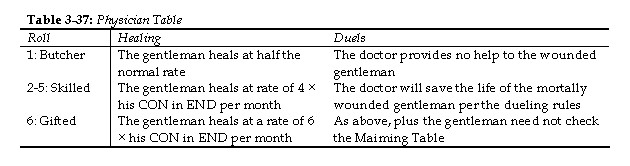
hen in the course of human events it becomes necessary for a man to imbibe vast amounts of alcoholic beverages, it behooves such a man to have access to some rules to do so with some social benefits. These activities share one major similarity, in that none of them are Primary Actions; they are all considered Secondary or Opportunity Actions. As such, all of these activities are to be combined with other actions, such as going to a club.
Your character can drink excessively if he likes to prove to others his drinking prowess. This costs a certain amount (cost is SL � 1 crowns) and is worth 1 SP. Paying for his own drinks and abusing himself in this manner is what earns the SPs not simply drinking at the expense of others. Thus, no SPs are earned if someone else buys your character's drinks. Only your character can fund his own carousing. Please note that carousing may lead to drunk and disorderly behavior (see 3.18.2.1)
Buying a round for the club is very excessive and will earn the character 2 SP for such generosity. It costs the sum of the SL of all characters present, regardless of whether they are drinking or not. This too does not pay for others' carouse, the person spending the money earns the SPs; not the person receiving the drinks. For characters who do drink at the expense of others (assumed to be the case unless the orders specify otherwise), there is a risk of drunk and disorderly behavior (see 3.18.2.1)
Carousing and Bonne Vivant have a slight chance of rendering your character excessively drunk (11+ on 2D6, 10+ if he does both). Drunkenness can result in various events occurring, some good, some bad, as detailed on Table 3-38 (roll 3D6):
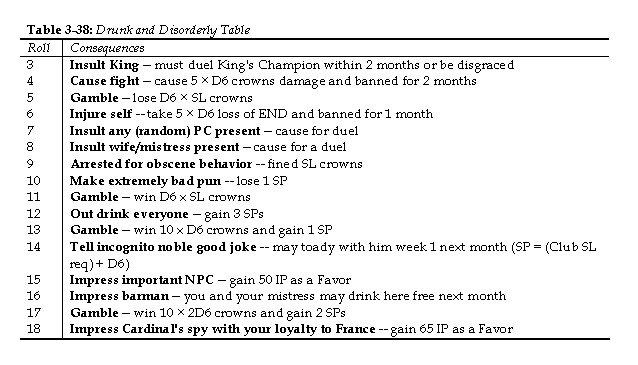
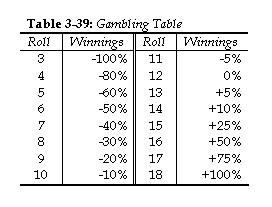 Clubs are a great place to throw money around. A character may place a bet within the house limit to see how Lady Luck treats him. Gambling risks and rewards are financial as well as social. The results are determined as follows: The GM will roll 3D6 and consult the Table 3-39 to calculate winnings or losses. Once the amount won or lost has been determined, gambling SPs are calculated by dividing the number of crowns that the gambler takes home by the house divisor, all fractions rounded down. The monetary odds are in the favor of the house. Nevertheless, a betting man will earn more SPs than he loses over time, while his pocket will feel thinner in the long run.
Example: A member of the Red Phillips bets 50 crowns. If the GM rolls a 3, he loses all his money and earns no SPs. If the GM rolls a 5, he looses 30 crowns, taking home 20, and earns 0 SPs. If the GM rolls a 12, the character goes home with 50 crowns (gaining nothing) but earns 1 SP. The GM would have to roll an 18 for the character to earn 2 SP at the Red Phillips.
Better clubs allow your character to risk more, but have better opportunities for SP generation.
Everyone is judged by the company they keep and the same is true in Paris. Characters gain status by being seen in the company of their social betters, while their betters gain prestige by grooming the up-and-coming gentlemen. Toadying is a two way street and requires both parties to toady to be successful. The higher social level participant will earn SPs according to Table 3-40:
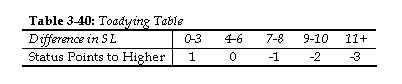 The lower social level participate will earn 1/2 the difference in SL rounded up. If both are of equal Social level then both will earn 1 SP.
Partygoers will earn SPs if they toady together and are within 3 social levels of each other. If they are further apart, but not more than 6 social levels separate them, the higher participant is doing the lower social level participant a favor. If they are further apart than 6 social levels, the higher participant is really allowing the dregs of humanity to interact with him. One must wonder why one does this at all, but sometimes there's a very good reason.
To toady, a character must state whom he is toadying with. It is automatically assumed that the character will allow the other character to toady with him. If the other party puts in orders to toady with your character, the appropriate SPs will be doled out.
Example: Rupert at Social Level 4 goes to a party and has "toady with Geoff" on his character sheet. Geoff is Social Level 7 and writes "toady with Rupert" on his sheet. Rupert then gains (7-4)/2 = 2 SPs and Geoff gains +1 according to the table above. If Geoff didn't put toady to Rupert in his orders, then no toadying would take place and no SPs would be gained or lost.
NPC's (such as the King or Prince) will always allow characters to toady to them.
You must include toady orders if you desire to toady. And you may toady to more than one person. A command to general toady is interpreted to mean "toady to all".
Toadying can only take place at appropriate social gatherings. All such events will be so noted. Assume you may not toady if the rules do not say you can.
There are occasions during which a gentleman may wish to duel with wits rather than steel. It is for these times that Repartee, or verbal fencing, is a vital part of a man's skill. Like Duels (3.16), repartee may be fought under a variety of circumstances and to a variety of ends. "First blood" is a common type of repartee duel, amounting to witty one-line shots until one side is a clear winner. Repartee "to the death" does not end until one side is completely demoralized.
Unlike duels with steel, however, repartee does no damage to an opponent's body; rather, the wounds received are to his self-esteem and social standing. Losing a repartee battle to another, and its concomitant loss of face, is legitimate cause for a duel (section 3.16.1).
Repartee battles are resolved using the Graces skill (GS, see 2.5.1.6). Otherwise, the process is identical. Repartee duels are conducted through the use of a d10. Each combatant rolls 1d10 and compares it against his Graces Score (remembering that the Score is the raw skill minus 10 for each Mastery). If the roll is equal to or less than the character's Score, he has succeeded. The winner of any given contest is the combatant with the lower roll.
Like duels with steel, each level of Mastery one has above one's opponent may "bump" one's result one level on the Repartee Results Table (3-41):
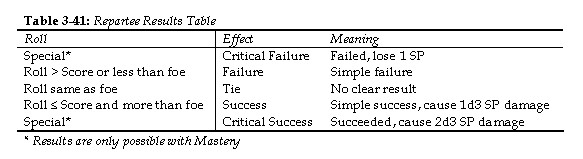
Back
Next