CHAPTER ONE: On a Broad Canvas,
or,
Introduction to Death Before Dishonor
 eath Before Dishonor (DBD) is a game set in seventeenth century France, a time when honor was of paramount importance.
The game master (GM) will create a basic character for you, which you will then flesh out in detail. Once you have your character in order you will have him embark upon a career in the timeless city of Paris.
The character will generally commence with a military or clerical career and try to distinguish himself from his peers, which leads to promotions, titles, appointments and riches.
There are dangers being in the military such as death, dishonor, or being captured on the battlefield.
eath Before Dishonor (DBD) is a game set in seventeenth century France, a time when honor was of paramount importance.
The game master (GM) will create a basic character for you, which you will then flesh out in detail. Once you have your character in order you will have him embark upon a career in the timeless city of Paris.
The character will generally commence with a military or clerical career and try to distinguish himself from his peers, which leads to promotions, titles, appointments and riches.
There are dangers being in the military such as death, dishonor, or being captured on the battlefield.
In Paris, the players can engage in a multitude of actions. Examples of such are dueling, writing treatises, courting lovely ladies, buying property, joining clubs, theatrical productions, parties, military schools and more!
Should you have need for assistance, the following people have offered to help in mentoring and answering questions about playing the game.
Feel free to contact Burt Miller about rules-related questions, or to create a new character.
The game is still accepting players at this time, although that may change at some point in the future.
Another way to keep well informed about administrative details and up-to-date on character press is by using the
DBD e-mail list. The release of newsletters and errata, coordination among players, and general role-playing all happen on the
DBD list. To play DBD, you must first sign up on the list.
You can join it at the following link:

Click
to subscribe to DBD.
The object of the game is to have fun climbing the ladder of success. Success is attained by gaining the top of the Social ladder, which is represented by Social Levels (SL).
Each player controls one character that performs activities designed to gain Status Points (SP).
Accumulation of enough Status Points advances the character's Social Level.
Activities are performed in successive months, each turn representing one month.
You can advance in many ways, but interaction with others is important, either through rivalries or alliances.
Make too many enemies and you'll fall back down the social ladder rather than climb it.
The GM reserves the rights to delete, add, or modify the rules as he sees fit.
Usually this will occur through player feedback. If you have any questions about, or issues with, rule changes, please do not hesitate to bring them to my attention and I will try to help you out.
If you happen to be caught in the middle of a rules change, I will, on a case by case basis, grandfather you into the old rules, at least until things settle out.
However, be aware that all rules changes are meant to make the game more playable or easier to adjudicate.
Adjudication mistakes must be brought to the GM's attention before the next turn's deadline or the mistake will stand.
This is still mostly hand adjudicated and a free service because I enjoy doing it.
Rudeness is cause for expulsion from the game (remember: politeness is the preferred lubricant in social intercourse).
In any game, the number of abbreviations, acronyms and contractions can quickly become overwhelming. Seasoned role-players may be familiar with many of these, but they are listed here for the sake of completion and convenience.
BR - Battle Result
CEND - Current Endurance
CON - Constitution
ConCon - Conspicuous Consumption
CPS - Commissioner of Public Safety
Cr - Crown(s)
DBD - Death Before Dishonor
END - Endurance
GM - Game Master
GS - Graces Skill
HRH - His (or Her) Royal Highness (not to be confused with GM, above
HS - Horsemanship Skill
IC - In Character
IP - Influence Points
MA - Military Ability
MEND - Maximum Endurance
MiD - Mention in Dispatch
MoS - Minister of State
MoW - Minister of War
MRL - Mention in the Royal Lists
MS - Marksmanship Skill
NPC - Non-Player Character
OOC - Out Of Character
PA - Political Ability
RLD - Red Light District
SL - Social Level
SP - Status Point
SS - Swordsmanship Skill
STR - Strength
 he DBD list is a service provided to give characters a chance to share information with all of the players and administrators of
Death Before Dishonor. Here are a few rules and guidelines governing its use.
he DBD list is a service provided to give characters a chance to share information with all of the players and administrators of
Death Before Dishonor. Here are a few rules and guidelines governing its use.
- All information listed on the server is public. Any communications or negotiations you wish to conduct privately should be conducted via the character in question's private email address, available on the register page of the newsletter.
 Only players with active characters in Death Before Dishonor should use the
list. Anyone else should contact Burt Miller for permission to post a message. Keep in mind that Burt does not control this at this time, and that unauthorized persons may post messages to the server.
If you think that this has happened, contact Burt, and he will determine whether the author should be declared persona non grata or banned.
Only players with active characters in Death Before Dishonor should use the
list. Anyone else should contact Burt Miller for permission to post a message. Keep in mind that Burt does not control this at this time, and that unauthorized persons may post messages to the server.
If you think that this has happened, contact Burt, and he will determine whether the author should be declared persona non grata or banned.
- All information posted to the list should be considered rumor, with a reliability equivalent to "I heard it from a Lackey, who heard it from a Lackey...".
Information such as challenges to duel, and invitations to events should also be posted in the newsletter via your orders, or to the appropriate player page.
- Players posting to the list should be careful about whose actions and thoughts they are describing. A player may properly post a message from or about himself, or NPCs he controls such as his Lackey, or Mistress with few exceptions.
In all cases, describing the thoughts of characters that you do not control is forbidden. You must instead describe the character as if they were being observed.
- Describing the actions of powerful NPCs such as the King or the Cardinal is forbidden, unless the actions in question are implied by game events described in the newsletter.
Describing the actions of other important NPCs should be done sparingly if at all, with great care taken to maintain the dignity, neutrality and character of the personage involved.
Descriptions of other player characters thoughts and actions, or those of NPCs that they control is forbidden in most cases, unless the consent of the player involved is granted.
In no circumstances is a post by one player to be attributed to another without express consent.
Players who do so without consent may be banned from the game.
- Players are encouraged to create non-player characters which are not otherwise described in the game as plot devices and props for stories involving their character.
It is acceptable to create characters such as "the Barmaid at The Red Phillips", or "a clergyman met on the road" in order to add color and flavor to whatever yarns they wish to spin about themselves.
They should take care not to have these made up characters engage in libel at another characters expense.
If you wish to do so, your character should do it directly, and face the consequences.
- Messages to the list should be in character. If you need to use your own voice for a message, or part of a message, you should mark the section which contains comments in your voice with the delimiter --OOC--, which stands for Out Of Character.
Communications which are out of character (real person to real person) should always be polite and considerate of the other person's feelings.
Your character may hate "Joe Blow's" character, but please keep in mind that "Joe Blow" is a real person probably much like yourself.
Much more leeway is given to exchanges between characters, but be sure to stay in character, and avoid language which would be offensive in and of itself.
- Have fun. The messages posted to the list allow you to flesh out your character, and really roleplay.
You are encouraged to use your imagination and share it with everyone.
 ach turn represents a month of time and three months equal a season.
Each month is divided into 4 weeks and players provide orders for each of the four weeks of the month.
Actions that take no time are also noted on the order sheet. Players are expected to provide these orders by the due date published in the newsletter or their character risks being sent to the
Front. If two month of game time elapse without any orders or excuse for their absence then your character is removed from the game.
Orders are to be received by E-mail in standard ASCII format. No orders supplied as attachments will be accepted.
ach turn represents a month of time and three months equal a season.
Each month is divided into 4 weeks and players provide orders for each of the four weeks of the month.
Actions that take no time are also noted on the order sheet. Players are expected to provide these orders by the due date published in the newsletter or their character risks being sent to the
Front. If two month of game time elapse without any orders or excuse for their absence then your character is removed from the game.
Orders are to be received by E-mail in standard ASCII format. No orders supplied as attachments will be accepted.
Seasons are important units of time in Death Before Dishonor.
Military actions are always performed over the duration of a single season, and many of the key social and religious events are also bound to a given season.
Below, you will find the months that comprise a given season in DBD.
Winter: December, January, February
Spring: March, April, May
Summer: June, July, August
Fall: September, October, November
 rders cover one month at a
time. Each month, the player "programs" his orders for his character,
and based on them the outcome is determined by the game master. The Orders Page
has links to three kinds of forms. One is for gentlemen residing in the
city of Paris (this will be the most commonly used form). The second deals with orders for gentlemen on campaign (discussed in detail in section
4.9). A third form is used to command one's Lackey (rules for which may be found in section 3.14).
Orders have multiple parts and are comprised of:
rders cover one month at a
time. Each month, the player "programs" his orders for his character,
and based on them the outcome is determined by the game master. The Orders Page
has links to three kinds of forms. One is for gentlemen residing in the
city of Paris (this will be the most commonly used form). The second deals with orders for gentlemen on campaign (discussed in detail in section
4.9). A third form is used to command one's Lackey (rules for which may be found in section 3.14).
Orders have multiple parts and are comprised of:
- Up to three Free Activities
- (4) Primary Activities taking 1 week each
- Up to three Secondary Activities per week
- Dueling orders
- Press to be submitted for the newsletter
1.4.1 Activities
Activities are undertaken to advance a gentleman's fame, fortune or honor.
Generally speaking, the results of such activities are set; however, Fate may also play a role.
Activities are described in one of four categories: Free, Primary, Secondary or Opportunity.
Free actions occur at the beginning of a month's turn, and do not take a week's time.
Up to three Free Actions may be specified for any given month. Examples of free actions include:
- Consulting a Tailor (3.2.8.2),
- Breaking Up with a Mistress (see 3.3.3.4),
- Become a Father (3.3.6),
- Purchase a Coach (3.5.2),
- Buy Horses (3.5.3),
- Investing (see 3.7),
- Donating to Charity (3.8.6.4),
- Apply to a Seminary (3.9.1.1),
- Actively Spying for a Foreign Power (3.13),
- Using Influence or Favors (3.15.1),
- Offering Bribes (3.15.2),
- Fight an "Appointed" Duel (3.16), and
- Hiring a Doctor (see 3.17.2).
Primary actions are those which require a gentleman to dedicate one week's time to the pursuit.
Examples of primary actions include:
- Attending a Club (3.1),
- Attending a Special Event (3.2),
- Courting a Mistress (3.3),
- Going to Church (3.4),
- Buying Property (3.5),
- Barracks Duty (3.6),
- Creating Art (3.8),
- Attend a School or Academy (3.9),
- Visit the Red Light District (3.10),
- Working at a Job (3.11),
- Become a Spy (3.13),
- Seek a Lackey (3.14), and
- Recuperation (3.17).
Secondary actions effectively take no time, but must be combined with a primary action in order to be performed.
Up to three Secondary Actions may be performed for each Primary Action. Common secondary actions might include:
- Hire Yobs (3.2.2.1),
- Participate in a Tournament (3.2.3),
- Participate in a Horse Race (3.2.4),
- Stand up at a Church Ceremony (3.2.5),
- Courting Nobles at a Court Ball (3.2.8.4),
- Seeing a Mistress (3.3.3),
- Proposing Engagement to a Mistress (3.3.4),
- Visiting a Bawdyhouse (3.10),
- Hiring Goons (3.10),
- Slandering a Character (3.10),
- Hiring Assassins (3.10.1),
- Bribing Another Man's Lackey (3.14.5),
- Carousing (3.18.1),
- Bonne Vivant (3.18.2),
- Gambling (3.18.3), and
- Toadying to Others (3.18.4).
Finally, opportunity actions are a special case. They generally depend on preceding events.
A typical opportunity event might be a character who courts a mistress during the first week, then in the second week goes to a club.
He may include orders to bring his mistress, if successful in the preceding courtship.
Duels may also count as an opportunity action, but only under specific circumstances.
These might include the characters who find themselves in the same location at the same time, each with an order to duel the other.
Two characters at the same mistress' doorstep at the same time without stepping down is also a duel of opportunity.
These duels effectively count as secondary actions.
Actions may sometimes be conditional, but only if the conditions are based on activities happening in the same week.
They may not cross weeks.
i. e. I will not keep track of how many SP you have gained in previous weeks of the month to determine what you do in each week.
Each week must be completely resolvable with the information contained in that week's orders.
For example:
Week 1
Try to join KM as captain
If not accepted then try to join CG as captain
Week 2
Court a mistress (step aside if other courtiers are present)
If unavailable then go to the bawdy house and acquire female companionship
Make your if statements clear; otherwise, they run the risk of being ignored and no action being taken.
I will not calculate your SP total for purposes of determining your actions in a given week.
Each player turns in orders that identify what you are doing in each part of the month that you have available to you.
You list as many Actions that don't take time as you like, and you allocate a 1-week action to each week.
Finally, you update your dueling instructions and include any press that you want to appear in the newsletter.
That's all that's needed, but I've seen much more included than necessary.
It can be considered good practice to include as much information about what you think is happening and how it should be resolved so that the Game Master can detect errors and make corrections, or advise better options to pursue.
Here is a simple format you can use:
Conspicuous Consumption Level ___
Actions taking no time List:
1) ________________________________
2) ________________________________
3) ________________________________
Week 1 Action: ________________________________
Week 2 Action: ________________________________
Week 3 Action: ________________________________
Week 4 Action: ________________________________
Dueling orders: ________________________________
Press to be included in Newsletter:
________________________________
________________________________
________________________________
Make up your own form if you like.
 Characters in
Death Before Dishonor are described by numerical statistics, just as in any other game.
These statistics make it possible for the player to assess the character's abilities and potentials within the game world.
One of the GM's biggest responsibilities to the player is the bookkeeping of the character's actions in the game.
Characters in
Death Before Dishonor are described by numerical statistics, just as in any other game.
These statistics make it possible for the player to assess the character's abilities and potentials within the game world.
One of the GM's biggest responsibilities to the player is the bookkeeping of the character's actions in the game.
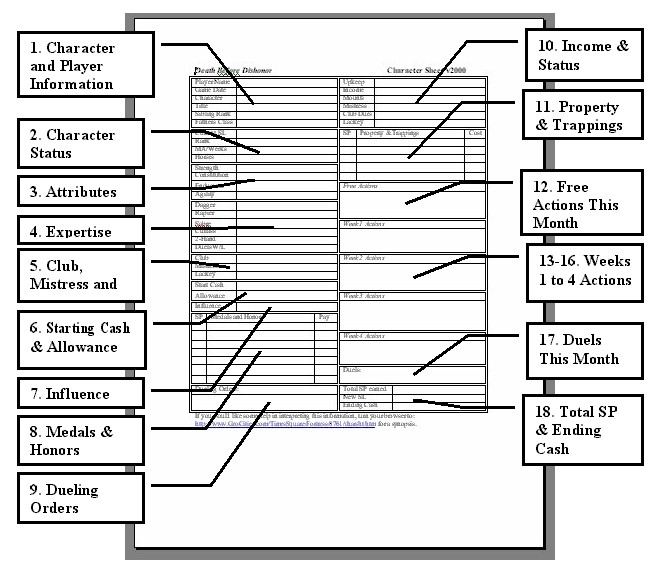
To ease the task, a character sheet was designed. This character sheet is written in a form of "gamer's shorthand," and this section of rules will clear up many of the questions which may arise in the interpretation.
The character sheet is divided into eighteen sections, each detailing a certain element of the character or the turn.
Let's look at each section and how it is used.
The first section (the upper left hand side of the sheet) is basic character and player information.
It tells us a bit about the current status of the character. Below it is the second section, dealing with the character's current status.
It tells us his Social Level, Rank (the highest currently held) and number of horses the character currently owns.
Note the entry labeled "MA/Weeks". This may be read as the character's current Military Ability before the slash, and the number of completed weeks of Military Academy after the slash.
The third section deals with the character's attributes. It is expressed as a number, a slash and a second number.
The number before the slash is the current statistic level. The number after the slash is the current number of unsuccessful weeks of training in that attribute.
Section 3.9 covers Physical and Skill Improvement and the value of this notation may be read there.
The fourth section is for Expertise, and shows the character's current skill level and number of weeks' training.
The "Duels W/L" entry shows the characters won/lost record in duels.
The fifth section is a carry-over entry from the previous month. It shows the character's previous Club, Mistress and Lackey.
This may not be the same at the end of the month. The sixth entry is also a carry-over, showing the character's purse at the beginning of the month as well as the allowance he's entitled to.
The seventh entry lists the numbers and types of Influence the character has at the beginning of the month.
The next section is for Medals and Honors. The first column lists the
SP the character derives from the source, followed by the name of the medal or appointment, followed by any accrued pay from the appointment or award.
The last section in the left column is for Dueling Orders, and lists the current orders used by the GM for your character.
You may change these orders at any time prior to the turn deadline.
The top section on the right side of the character sheet summarizes this turns sources of income and SP.
Each of these are filled out in the following format:
+n SP Item Description (Name) -n cr
This may be read as follows, "A gain of n Status Points for this item at a cost of n crowns".
To illustrate, let's use an actual example: "+2 SP Mistress (CB) -30 cr."
Seeing this, you can then easily tell that this character derives 2 SP per turn from his Mistress, in this case Cherie Baremounde.
It costs the character 30 crowns per month to keep her. This same formula will be used to describe the turn results as well.
The eleventh section, labeled "Property & Trappings," lists income from estates, cost for houses and coaches and so on.
The format is identical to the above. The next five sections are for the character's Free Actions and Weekly Actions, respectively.
They too follow the format described above. Note that if an event is prefaced with a "+n SP" entry, these represent the status points for the class of event you attended (see Special Events, 3.2, for more details).
The next to last section lists (in order) the duels you fight this month.
Lastly, the eighteenth section of the character sheet summarizes the total SP earned for the month, the new SL for the next month and your ending cash (which will be forwarded to the Start Cash entry on your next Character Sheet).
 ress between characters is encouraged.
Interactions can happen in the newsletter for all to see, or privately.
Anonymous press is allowed so long as you remain in character. You may assume the role of NPCs that you control, such as your mistress, or ones that you create, such as the Grey Stalker (a NPC that has made an appearance in the newsletter from time to time).
Do not abuse this privilege, and try to be consistent with previous press releases.
Gossip and rumors may be submitted to the GM for publication but their publication is subject to approval by the GM.
ress between characters is encouraged.
Interactions can happen in the newsletter for all to see, or privately.
Anonymous press is allowed so long as you remain in character. You may assume the role of NPCs that you control, such as your mistress, or ones that you create, such as the Grey Stalker (a NPC that has made an appearance in the newsletter from time to time).
Do not abuse this privilege, and try to be consistent with previous press releases.
Gossip and rumors may be submitted to the GM for publication but their publication is subject to approval by the GM.
Another way to send press that you want broadcast (but not to show up in the newsletter) is to join the
DBD list. Anonymous press may be submitted to the GM for posting to the
list. Please be specific when submitting anonymous press to the list via the GM or it will appear in the newsletter.
Back
Next
© 1999-2004 Crossed Swords Publications