CHAPTER TWO: Soldiers, Scholars and Reprobates,
or,
Characters in Death Before Dishonor
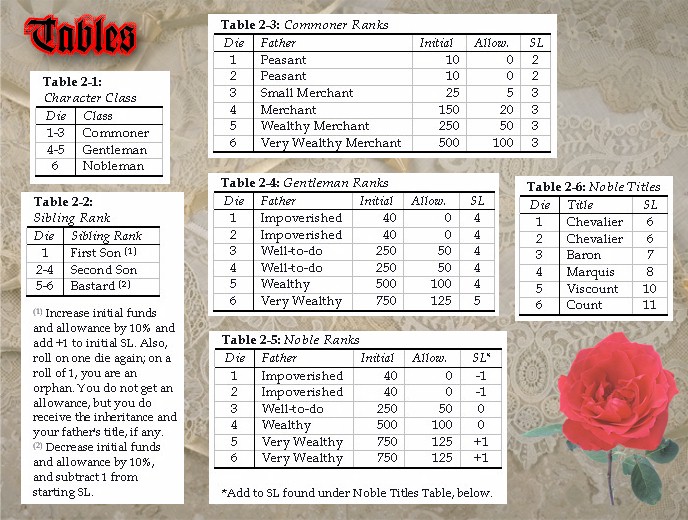
 he statistics for each character will be determined by the GM. Players may join the game at any time. The only requirement from the player is to provide a unique name, specifically a unique last name, and if desired a history. No one is allowed to run more than one character at a time and sharing email accounts is not allowed.
 o person materializes out of thin air without a family or other ties to the world around him. These ties - and the role-playing potential they provide - are a valuable way of sharpening a character's persona. These rules will provide such information.
Please note that if you have a (reasonable) special request, such as a non-French character or someone with a unique background, please let the GM know before the character is generated.
By grand tradition, there are several ways to select a name for your character. One is of course to choose a name which sounds suitably French and seventeenth century. There are many resources for making such selections, and it is always appropriate. A second common alternative is to choose something innately silly, such as Jacques Crudmuffin, or something to that effect.
Of course, we gamers are a witty lot, which has given rise to the third popular means of selecting a character name: puns. Names such as Yves Benait-Badbois (i.e. I've Been a Bad Boy) or Blundarde Hadvaunces (Blundered Advances) make for interesting plays on words. Let your imagination be your guide. One consideration which must be given, though, is that our game is open to those of ages thirteen and above. Please be tasteful in your selection.
Each month, there is a chance that a death will occur in a character's family. Once per month the GM will roll 2d6. If the result is "2", a death has occurred. If a death occurs, roll a d6 and consult Table 2-7:
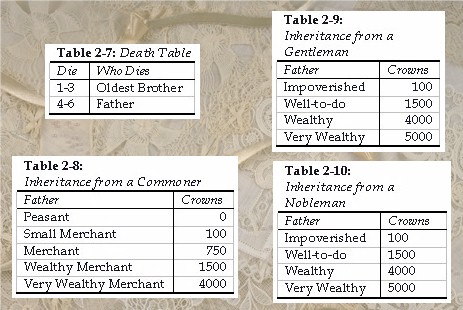
If your character is the eldest son, a roll of 1-3 is ignored; but if he is a second son, he becomes a first son in line for inheritance. Older brothers are considered to have a SL one higher than your current SL and Fathers two higher than your current SL. If the father has died, the character loses any future allowance, but immediately inherits. The value of the inheritance is determined by finding the fathers position on the appropriate Father's Class Inheritance Table, above.
 ho doesn't want status and prestige? A character's Social Level (SL) is a measure of his standing in society. The higher the level, the greater the influence and power of the individual. Accumulating Status Points (SP) increases Social Level.
Characters on campaign are not required to maintain SL, but do need to maintain the SP sources which they wish to keep while on campaign. This means that allowance is still drawn while on campaign and mistresses will only remain with characters that supply them with support during the character's absence. In general, if the resource needs support or is difficult to re-acquire then you should support it during your absence.
The main ways to gain status points are:
- Conspicuous consumption (see 2.6.5)
- Being a member of a Club (see 3.1.2)
- Having or courting a Mistress (see 3.3)
- Owning a residence and/or coach (see 3.5)
- Engaging in Scientific, Artistic or Literary pursuits (see 3.8)
- Winning duels (see 3.16.6)
- Carousing (see 3.18.1)
- Toadying (see 3.18.4)
- Being a member of a regiment, or holding a general staff rank (see 4.3)
- Holding an appointment (see 4.8, 5.5, 6.3 and 6.5)
- Mentions in Dispatches (MiD's): gained at the front (see 4.9)
Earning 3 times the next higher Social Level in Status Points, or more, in a single month results in a Social Level increase. A character may not rise more than one SL in any month. For example, a character at SL 4 would need to obtain 15 SP's to achieve SL 5. In order to maintain his SL, a character must gain as many Status Points as his current Social Level by the end of the month or he will drop down a SL. Status Points are not carried over into subsequent months; although the source of the SP may be utilized in subsequent months.
Parisian society in the seventeenth century may be condensed into three classes: Common, Gentle and Noble. The Common man was of the lower classes, generally known for his coarse humor, rustic appearance and base speech. Commoners could be born to either city or province, could be wealthy or poor; either way, people of distinction avoid association with such rabble. Commoners are born into this class, are assigned to it by virtue of being a bastard son of a Gentleman, or are demoted to it by becoming a Knave.
The second class, known as Gentle, are those who stand between the unwashed masses of the Commons and the rarified and elegant Nobles. Those of gentle birth are known for their poise, education and energy. Theirs is a world of dichotomy -- neither hard work, nor leisure, are unknown to those of gentle birth. To become a Gentleman, one must either be born to it, be an illegitimate son of a Noble, or own land. Therefore, even a man of common origin may enter the gentry by acquiring real estate.
The highest achievable rank in Death Before Dishonor is that of Noble. Noble people are known for their pride (or, in many cases, arrogance) and elegance. Their manners are reputed to be flawless. Becoming noble is the aspiration of many from the lower classes, since with it comes a grant of land in the Provinces, a coat of arms and security for the family's future. Nobility is both easier and harder to achieve than gentility; easier, because there are many routes to it, harder, because politics and influence affect a candidate's chances.
A character's Social Level is more than merely a matter of one's prestige; it is also a matter of one's influence with others. This influence is derived from several sources: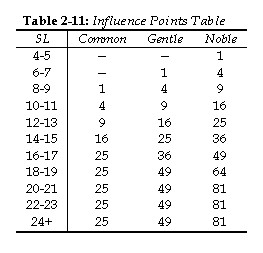
- Your own Social Level (see Table 2-11)
- Your mistress (see 3.3.3.2)
- Appointments (see 4.8, 5.5, 6.3 and 6.5)
- Favors granted by patrons (See XXX)
Influence is described as Influence Points (IP). Influence Points may be thought of as social currency -- once spent, the IP is gone. Each non-player character you may wish to influence has a minimum "cost" to apply a ±1 modifier to your action. Every additional multiple of this amount will provide an additional ±1 to a given die roll.
Influence Points derived from SL -- called Personal IP -- are replenished on the first day of the new season (i. e. December 1, March 1, June 1 and September 1) and do not carry over. This means that a gentleman who does not use his Spring IP will lose them on June 1, but be issued a new one at that time. In this way, Personal IP do not accumulate.
2.4 Characteristics
 character's statistics (or characteristics) largely define his prowess within Death Before Dishonor. What these statistics are, how they function, and how they may be altered is discussed on a case-by-case basis below:
Your character's strength, which determines the amount of damage he inflicts in duels. Initially based on a 3d6 roll. It is important in helping determine a character's Endurance. Strength may be increased by training in a basic gym (see 3.9.4, below). It may be lowered due to long illness or old age.
Your character's basic health; initially based on a 3d6 roll. Constitution may help the character shrug off the effects of alcohol, illness or other deleterious effects. Its effect upon a character's recuperation may be found in 3.17. It, too, is important in determining a character's Endurance. Constitution may be raised by training in a basic gym (see 3.9.4), or may be lowered by illness, age or life-threatening wounds.
Endurance is the amount of damage your character can take before being killed in a duel. Maximum Endurance (MEND) is equal to the product of Strength and Constitution. Current Endurance (CEND) represents initial Endurance reduced by damage taken in duels, which may thereafter be increased back to Maximum Endurance by healing (see 3.17).
 n addition to the character's characteristics, which are measures of his physical abilities, he also possesses skills and abilities. These measure the character's training and innate capability in the following areas: Horsemanship, Marksmanship, Swordsmanship and Graces (as Skills), and Military and Political activities (as Abilities). Skills range from 1 to over 30 in very rare cases, with 9 to 11 being considered average, and all operate in the same manner, as will be described below. Abilities tend to range from 1 to 6, with higher values possible, but rare. The use of Abilities differ from Skills, but similarly to other Abilities.
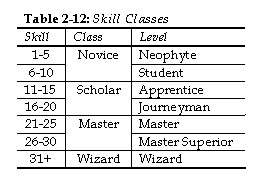 There are four skills in Death Before Dishonor: Horsemanship, Marksmanship, Swordsmanship and Graces. All skills begin as a matter of raw talent, and may, if the player chooses, may be increased by training of the results of events as the game progresses. The minimum of any skill is 1, and the functional maximum limit is 37, with a value of 9 to 11 as the average.
Skills are broken down into Scores and Masteries. Masteries affect the outcome of a skill check by increasing its value (i.e. critical failure to failure, failure to tie, tie to success, success to critical success -- see below). Each full ten points of a character's skill after the first is one level of Mastery. When the Masteries are deducted from a skill, the remaining value is the Score.
Example: Jean-Pierre has a Swordsmanship skill of 10. At this level, he has no Masteries but a score of 10. His friend Armand has a Swordsmanship of 11, which breaks down to one Mastery and a score of 1.
As a character exceeds 10 points of skill, he gains one Mastery. Thus, as we may see on the table above, Novices have no Masteries, Scholars have one, Masters two and Wizards three. For each Mastery, we deduct ten from the character's expressed Expertise. Thus, a man with a Sabre skill of 17 has a score of 7 with one Mastery. In game terms, we will write it thus:
(Score) M (# Masteries)
So, our Journeyman of the Sabre may be shown thus: 7M1. Here is another way to look at it:
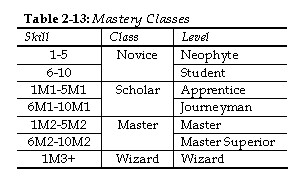
The concept of Mastery is central to the skill system. The actual use of Mastery will become clear as we look at the skill adjudication rules, below.
So far, our combat system is pretty complete. The one thing it lacks is flavor. And what brings more flavor to a combat system than a wide selection of special moves?
Special moves (which may be found under Swordsmaship, 2.5.1.4 and Horsemanship 2.5.1.5) are divided up by two criteria: the number of masteries necessary to learn them, and the number of skill points required to purchase them. Yes, that's right: a character must sacrifice skill in a given arena to learn special moves for that skill. The special move cannot be purchased if the cost would bring the character below the required Mastery level.
Once learned, special moves may be used at any time during the use of that skill. Some are opportunity-based, and will be used whenever the appropriate situation arises. The individual skill descriptions will include a brief list of special moves for that skill.
Skill contests is conducted through the use of a d10. Each "combatant" rolls 1d10 and compares it against his Score (remembering that the Score is the Expertise minus 10 for each Mastery). If the roll is equal to or less than the character's Score, he has succeeded. The winner of any given contest is the combatant with the higher roll (which still must be equal to or less than their Score -- rolling above the Score is an automatic failure).
Yes, it's that simple.
Now, let's spice things up a bit. The following table will illustrate what happens under given circumstances:
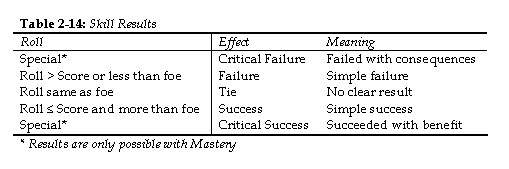
Masteries are used to influence the outcome of any given contest. The character with the greater number of Masteries has a decided advantage over his opponent. For each Mastery a character has over his competitor, he receives one "bump" on the Skill Results Table 2-14 (also see XXX, XXX, XXX, XXX and XXX for specific uses). Each "bump" either improves his result (i.e., from Failure to Tie, Tie to Success, and so on), or diminishes his opponent's result (suggesting a purely defensive stance).
Characters who have multiple Masteries over their opponents gain multiple "bumps". All "bumps" must be used in the same fashion (i.e., all offensive or all defensive). Note that a character with a three Mastery advantage is assured of a Critical Success with every roll of the dice.
One of the premier skills in Death Before Dishonor is, fittingly, one which acts as a measure of a character's skill with bladed weapons. Swordsmanship skill acts as a measure of the character's skill with a blade. In order for a character to use swords to their maximum benefit, he should have Familiarity with a given weapon. A character can only be Familiar with one weapon at a time, and it takes one Primary Action per Mastery to switch Familiarity to another weapon.
Familiarities for SS are: Rapier (r), Dagger (d), Cutlass (c), Sabre (s) or Two-Handed Sword (t). The letter is noted after the character's Masteries. Therefore, a character with a skill of 21 who specializes in rapier will be noted 1M2r.
Swordsmanship is rolled on 3D6. Some common Special Moves include:
Mastery 1 Special Moves:
- Disengage (Cost: 1) Allows the character to escape from combat. Must be ordered by the player.
- Lunge (Cost: 1) An advancing attack. Does 1d6 extra damage to an opponent OR cancels a Disengage. May be ordered, but will be used as an opportunity action if opponent is attempting a Disengage.
- Wrist Cut (Cost: 1) This is a called shot attack to the opponent's sword arm. If successful, there is a 1 in 6 chance he will drop his sword.
- Low Attack (Cost: 1) Another called shot, this time to the legs. Has a 1 in 6 chance of tripping your opponent (causing loss of one attack).
- High Attack (Cost: 2) A called shot to the head. This type of attack has a 1 in 6 chance of disabling the opponent by knocking him cold.
- Wave Hat (Cost: 2) The attacker removes his hat and uses it to distract his opponent. The good news is that the opponent loses his next attack on 1-2 on 1d6 from the distraction. The bad news is this tactic may only be used once per fight -- it ruins the hat.
- Punch (Cost: 1) Does 1d6 damage against an opponent despite armor, and the opponent's next attack is bumped down one category. This is a Dirty Fighting technique.
- Throw Dirt (Cost: 1) This tactic does no damage, but causes the opponent to lose his next attack. This is a Dirty Fighting tactic.
- Throw Dagger (Cost: 1) The attacker flings his dagger at his foe, striking on the roll of 1-2 on 1d6. If the blow hits, it will do (Strength × 3) damage, less any armor. This attack may be combined with a called shot. Dirty Fighting technique.
Mastery 2 Special Moves:
- Fleché (Cost: 2) A charging attack which may be used to prevent a Disengage or a Flee maneuver. Used against a stationary foe, it does (+1/2 x Strength) extra damage.
- Flee (Cost: 2) An advanced form of Disengage, will defeat a Lunge maneuver. If successful, combat ends.
- Riposte (Cost: 2) Maneuver of opportunity. Any time you parry your opponent, you automatically sneak in a quick, low-damage (Strength x 1) attack. Armor has its usual effect.
- Cloak Parry (Cost: 3) This tactic does no damage, but causes the opponent to lose his next attack on 1-2 on 1d6. This move can be used every other combat turn.
- Corps-á-Corps (Cost: 2) When tied with an opponent's roll, the attacker will knock his opponent off his feet. If both combatants have this skill, a second die roll is made and the one with the higher roll becomes the winner.
- Disarm (Cost: 3) A classic move, where the opponent's blade is struck from his hand. Instead of doing damage, a successful attack has a 1-3 on 1d6 chance of tossing the foe's weapon several paces away. This attack must be ordered.
- Throw Sword (Cost: 2) The attacker flings his sword at the enemy. This is usually an act of desperation, as it hits on 1-2 on 1d6, and does (+1 x Strength) in addition to its usual damage.
- Kick (Cost: 2) If successful (1-2 on 1d6) the Kick does 2d6 damage regardless of armor and the opponent loses his next turn. A low blow, easily classified as Dirty Fighting.
Mastery 3 Special Moves:
- Acrobatic Escape (Cost: 3) Provides an escape from the duel, not countered by a Fleché or a Lunge.
- Letter Carving (Cost: 3) Carves the letter of choice into the clothing and/or skin of the opponent. Does no damage, but gives the carver +2 SP for the duel.
- Pommel Pummel (Cost: 3) The attacker uses the pommel of his weapon to knock out the opponent (on a 1 on 1d6). This tactic, if successful, ends the fight, but it is a Dirty Fighting technique.
- Throw Crockery (Cost: 3) Does 3d6 damage regardless of armor, and bumps the opponent's combat results down one category for this turn. This tactic can only be used once, and is obviously Dirty Fighting.
In the era prior to mechanized transportation, a man's ability to judge and command horses was a vital one. The ability to ride great distances, to push an animal to its greatest speed, to control a jump across a stream during a steeple chase -- all of these are part of the Horsemanship skill. As the horse is such a ubiquitous and useful beast, every character has a Horsemanship skill.
For the purposes of Death Before Dishonor, there are no Familiarities for the Horsemanship skill. Saving matters of breeding, there are few differences between one horse and another. There are, however, some Special Moves, and some of these may have restrictions regarding what breed of horse may employ that Move.
The initial Horsemanship Skill is generated by rolling 3D6. Some of the more common Special Moves include the following:
Mastery 1 Special Moves:
- Burst of Speed (Cost: 1) The rider coaxes an extra bit of energy from his mount. There is a 1 in 6 chance that the horse fatigues and slows down the following turn.
- Pivot (Cost: 1) The rider turns his mount quickly, avoiding imminent obstacles on 1-3 on 1D6.
- Hop (Cost: 1) The horse leaps a small obstacle, less than one horse-length in width or one-half in height. This maneuver must be performed at the gallop.
Mastery 2 Special Moves:
- Dressage (Cost: 3) Allows a combat steed to trampled a downed foe. The attack is executed on 1-3 on 1D6 and does 4D6 damage for a Charger, 5D6 for a Courser and 6D6 for a Destrier.
- Wheel (Cost: 2) The rider cajoles his mount to spin in place, knocking footmen to the ground on 1-2 on 1D6. The footman must spend one turn scrambling to his feet in order to attack. Downed footmen are prone to Dressage, if available.
- Leap (Cost: 2) From a gallop, the horse will cross a hurdle no more than one horse-height, or two horse lengths.
As its name implies, Marksmanship deals with a character's facility with ranged weapons, particularly the black-powder firearms of the seventeenth century. Successful uses of the skill allow the marksman to hit the target, although not necessarily the bull's eye. It is important to remember that the weapons in question had smooth bore barrels which imparted no spin to the ball. This made for horribly inaccurate fire, even at short ranges.
Like Swordsmanship, Marksmanship has Familiarities. These include: Arquebus (a), Musket (m), Carbine (c), Pistol (p) and Blunderbuss (b). Like the Familiarities for Swordsmanship, a character can only be Familiar with one weapon at a time, and it takes one Primary Action per Mastery to switch Familiarity to another weapon.
Markmanship skill is rolled on 3D6, and subject to the usual rules for skill improvement. There are no Special Moves for Marksmanship.
One of the most important skills in Parisian society is Graces, sometimes called "etiquette", "eloquence" or even "wit". Just as a man is known by the company he keeps, his facility in social situations is an important measure of his character. All social efforts, whether dancing at a wedding or courting the favor of a high-ranking noble, rely upon the Graces skill.
One of the more interesting uses of Graces is the verbal duel, known as Repartee. In many ways, Repartee is the same as a duel fought with more deadly weapons, but the target is the opponent's self-esteem and social standing. Rules for Repartee may be found under 3.18.5. Depending on the outcome, Repartee may become the cause of a duel or rivalry.
Graces requires no Special Moves. It has three Familiarities: Common (c), Gentle (g) and Noble (n). The character begins with the Familiarity of his birth class (see 2.3.2, above) and must learn his new Familiarity at one Primary Action per Mastery level when he reaches a new class. A character may not take a Familiarity for a class he is not part of -- in other words, a Commoner may not "learn" the Noble Familiarity without first becoming a nobleman. Graces is generated by adding three to the character's Social Level (SL).
Abilities are somewhat different from Skills, both in their function and expression. First of all, Abilities have neither Special Moves nor Familiarities. Secondly, unlike Skills, Abilities are designed to function cumulatively, allowing several characters or NPCs to pool their abilities to determine a final result.
There are only two Abilities in Death Before Dishonor: Military (MA) and Political (PA). Each are generated by the roll of 1D6. It is possible to train Abilities, but the training is generally harder than Skills, and there are more strict limitations. Abilities are more commonly increased by "on-the-job training", by actually making use of them in play.
For details regarding the uses of these Abilities, see Chapters Four and Six.
"Some men are born to lead, others to follow". That maxim is proved by a character's Military Ability. This Ability quantifies your character's facility with military concepts; his score greatly affects your battle results for good or ill. Initially based on 1D6, with higher numbers representing higher skill. Military Ability may be increased by active field command (see XXX) or taking courses at the Military Academy (see 3.9.3).
Some men are bureaucrats, others are statemen, some have no facility with politics at all. How can we tell? Why, by the character's Political Ability score, certainment! When it comes to the ability to persuade others or lead a city, write a legal brief or judge a case, the character's PA is the key element. Generated on 1D6, it is possible (though rare) to exceed an ability greater than 6. Like Military Ability, PA can be advanced by Law School (see 3.9.2) or active participation in politics (see XXX).
In the course of their careers, characters are offered opportunities for improving themselves. Improvements in Social Level, Characteristics, Skills and Abilities are all common activities. Social Level increases come about from participating in events which have a social impact (see 2.3, above). Characteristics, such as Strength of Constitution, may only be raised at a Gymnasium (see 3.9.4). Note that Endurance may never be improved directly -- it is always and automatically increased when either Strength of Constitution is developed.
Skills may be raised in a manner similar to Characteristics. There are, however, more options available to the character who elects to do so. First of all, there are several schools throughout Paris to develop most Skills, from amateur associations to professional schools. The more prestigious the institution, the more expensive it is to attend; however, the higher the prestige of the school, the greater the potential increase. See rules section 3.9 for details on training skills.
 oney
oney makes the world go 'round and everyone needs to spend it, earn it, or borrow it. The monetary unit used for currency is the Crown (Cr). You will earn money through various means and spend it as you please. You will have an allowance from your father (generally your primary income) and a salary if you join the military. You can also earn a salary if you receive an appointment. And, you will gain money as plunder if you go on campaign in the military. You may embezzle funds when holding certain appointments, but there is danger if you are caught. The clergy can tip the plates to earn money. And, if you are strapped for cash you can always borrow from a shylock. Details follow.
Your allowance, if you have one, is collected at the beginning of the month. The only way it can change is if your father or older brother dies. Details are in Section 2.2.2.
If you don't have enough to do everything you want to do, then you can borrow money from other players or from a Shylock. If, during your turn, your character runs short of cash, he will automatically float a loan from a shylock for the minimum amount to remain solvent. No character may end a month in arrears without courting Disgrace (see 2.7).
If you borrow money from another character then you must negotiate the terms, and coordinate the transfer of funds. Both players should have something in their order sheet specifying the transaction, or it will not be conducted.
Shylocks will loan up to the character's SL multiplied by 100 in crowns in lots of 100 crowns at a time. Unfortunately, they charge a one time
ten percent interest and the loan must be paid back within six months. Thus, if you borrow 100 crowns in January, 110 crowns are due by the end of July. Failure to repay a loan sees the character disgraced. Loan payment is due regardless of your character's current activities. If your character goes out on Campaign and his loan comes due, he must still repay the loan or suffer the consequences.
Salaries from military positions or appointments are collected at the end of the month. A gentleman never requests an advance.
If you are really strapped for money you can actually work to earn funds. See Working (3.11) for details and opportunities. Of course, barring some form of elaborate artwork, menial labor hardly befits a gentleman.
A gentleman is known by his comportment, which requires the expenditure of money. Normal support entails food, clothing and cost of living, which everyone must pay. Conspicuous Consumption includes tipping well, meeting friends for dinner and picking up the tab, dressing a little better, eating out at the best restaurants more often and so on. Status points are gained by increasingly lavish behavior (i.e. higher levels of Conspicuous Consumption). The level of Conspicuous Consumption is selected at the beginning of the month, and may not change at any time during that month.
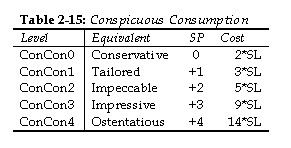
A Conspicuous Consumption of level 0 is always assumed unless otherwise specified.
Support for Mistresses, Lackeys, and other NPC's are tallied at the end of the month. If you have a wealthy mistress as of the end of the month, she will pay you support at the end of the month. All such support is assumed to take place unless you explicitly dismiss the NPC.
 haracters want to avoid becoming disgraced at all costs. Disgraced characters must immediately give up all appointments, may incur a SL penalty and require time to erase the memory of such an ignoble deed.
- If the character is disgraced due to a military matter he must join the Frontier Regiment and serve until Mentioned.
- If the character is disgraced due to a failure to repay a debt he must join the Frontier Regiment until he can repay the debt.
- If the character is disgraced due to ignoring a pregnant mistress he must join the Frontier Regiment for one year from the time of the pregnancy.
If a character returns from the front before his "sentence" is up, he becomes a "Knave". Anyone may challenge a knave on sight without losing SP at all. A knave has a -2 modifier on the modified chance to court a mistress.
A knave will suffer a -2 penalty when applying for any post. Anyone caught toadying with a knave will lose SP equal to the knave's SL.
For purposes of dueling, a knave is treated as regimental enemy to everyone, and everyone may have cause to fight a knave. Further anyone may ignore a knave's challenge without loss of SP.
© 1999-2004 Crossed Swords Publications
