4.1. Functions of Eelgrass in an Estuary
Eelgrass (Zostera marina L.) is a submerged plant that grows exclusively in estuaries and in shallow coastal areas with moderate currents and soft beds. Eelgrass has leaves, stems, and roots. The leaf tips are rounded. Eelgrass is the most common temperate seagrass species. Tremendous variation in size in the length of eelgrass blades can be found from 6 cm to over 300 cm long. The blades connect to the rhizome at the sediment surface with roots extending into the substrate of each rhizome node. A terminal mature shoot occurs at the end of each rhizome, with the young shoots occurring as lateral branches. A sheath at the base of the blade encompasses 3-5 strap-like leaves.
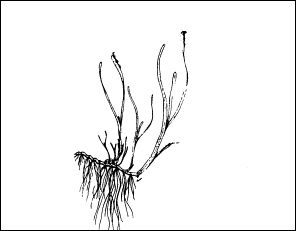
Figure 4-1.Eelgrass, Zostera
marina L.(Fonseca et al., 1998).
Greenish female flowers at the ends of long stems float on the surface of water. The male flowers are clustered on short stems near the base of the plant. As the male flowers grow, they detach from the stem and rise to the surface of water. They release pollen into the water. When the pollen and the female flower meet, they fertilize and produce seeds (Compton, 1999).
Eelgrass habitats are one of the most productive ecosystems. Eelgrass plays several important roles in its environment. Some of them are as follows:
· Eelgrass forms the base of food chain (Botos, 1999)
· Eelgrass grows easily and provides oxygen for the animals in the ecosystem.
· When eelgrass die, the dead leaves increase the organic matter in water providing valuable food for water birds, such as ducks and geese.
· Eelgrass beds serve as shelter for many marine and estuarine creatures. They attract large predatory fish for feeding (Short, 1992).
· Eelgrass meadows act as a filter of estuarine waters, removing both suspended sediments and dissolved nutrients (Short and Short, 1984)
· Eelgrass beds prevent erosion and maintain sediment stability by trapping sediment with its rhizomes (Ward et al., 1998).
· Eelgrass leaves form a three-dimensional baffle in the water, they act as dampers and reduce water motion, alter the current circulation and flow patterns (Grizzle et al., 1996).
4.2. Effects of Eelgrass on Current Flow
Eelgrass strongly affects local current flow and sediment dynamics and reduces current flow within the eelgrass meadow. The momentum extracted by exposed shoots significantly reduces current speeds within the meadow (Harlin et al., 1982, Madsen & Warncke, 1983, Peterson et al., 1984 and Fonseca et al., 1983). The perturbations in flow and sediment transport caused by sea grass meadows may significantly affect the ecology of the resident community. Eckman (1987) suggested that:
· Current flux through the meadow depends directly on the density of eelgrass shoots,
·Rates of recruitment of bivalves onto eelgrass blades vary directly with the shoot density dependent current flux,
·Subsequent growth rates and survival of suspension feeding bivalves vary directly with the shoot density dependent flux of seawater through the meadow.
Fonseca and Kenworthy (1987), in preliminary laboratory studies, suggest that currents affect leaf production of eelgrass. Current velocity, together with wave action, creates hydraulic regimes that influence eelgrass and seedling distribution, which in turn affects the flow field. Thus, when models of are constructed for eelgrass-dominated estuaries, consideration of frictional drag due to the eelgrass may have a significant impact on the model predictions.
4.3. Disturbance Sources of Eelgrass
Eelgrass meadows require high light levels for their growth, which restricts them to shallow coastal areas where human disturbances that damage or kill them is inevitable. The disturbance sources of eelgrass can be listed as follows:
·
Dredging and filling
·
Mooring scars
·
Propeller scars
·
Jet skis
·
Vessel wakes
·
Reduction in water quality (including water clarity)
·
Diseases
·
Physical disruptions from storms and shifting channels
redefine bed distribution and composition.
·
Seasonal disturbances (low tides which expose and
desiccate beds)
·
Catastrophic events like hurricanes
·
Biological disturbance
·
Ice scour, extreme cold
·
Thermal effluents from electric power plants
4.3.1. Wasting Disease (http://www.botany.hawaii.edu/seagrass/wasting.htm)
In 1931, the Wasting Disease is first observed in areas along the northeast coast of North America. The signs were blackish-brown discolorations, loss of leaves and finally the death of the eelgrass. Later, the Wasting Disease was observed in Europe. By 1933, almost all eelgrass in the North Atlantic was affected. All of the eelgrass in most areas of the Atlantic coast disappeared in one year.
Finding some organisms in the dying eelgrass beds lead scientists to assume that the eelgrass destruction was caused by an infection of an epidemic organism. However, later they observed that in Mediterranean and the Pacific coast of North America the eelgrass was unaffected. Some scientists proposed that there was a correlation between shifting periods of droughts and above-average precipitation with the disease.
Another theory is that of increased water temperature. Rasmussen (1977) collected records of water temperature and showed that temperatures in the early 1930’s did not increase on the Pacific coast of North America and in the Mediterranean, while it increased significantly in the North Atlantic. High temperatures weakened plants that then became exposed to a variety of biological organisms.
Several scientists have theorized that in the early 1950s when eelgrass, particularly in the western Atlantic, began to return to available and suitable estuarine areas, the colonizing plants were hardier and more resistant strain.
4.4. Restoration and Mitigation Efforts of Seagrass Habitats
Loss of eelgrass habitat leads to several undesirable and difficult-to-reverse conditions. Shoreline erosion and water column turbidity increases. All important, associated habitat functions will be eliminated (Kikuchi, 1980 and Peterson, 1982). When eelgrass dies, the sediments it helped to stabilize will resuspend into the water column. Resuspended sediment will lower light levels that may not allow eelgrass to recover unless the water clarity is improved within the entire watershed.
Disturbances kill seagrass rapidly while recovery is very slow. The critical role that seagrasses play in many coastal environments, coupled with their extensive losses, have created widespread support for their conservation and restoration. As the human population grows, loss of the seagrass communities continues. When the protection programs fail, active planting seems to be the only option to avoid a permanent loss of these habitats. At present, there have been two types of planting processes going on in order to preserve the present habitats (Fonseca et al., 1998):
· Restoration: In the restoration process, the habitats are being returned to their pre-existing condition.
· Mitigation: In the mitigation process, the functionally equivalent areas are being restored or created to compensate for permitted habitat losses.
Seagrass restoration has been conducted on an experimental scale along all coasts and within all coastal regions of the U.S. However, the mitigation of impacts resulting from permitted activities has been relatively small. The greatest efforts have been in the National Marine Fisheries Service (NMFS) Southeast and Southwest regions. While permits have been reviewed which deal with seagrass habitat, few actions are taken. Site selection and test planting for a 3-acre mitigation in the Piscataqua River (NH) has been the first permit-related mitigation, which NMFS has been involved in making recommendations. This has included not only transplanting but also consideration of alteration of bottom topography to achieve appropriate planting depths for eelgrass (Fonseca et al., 1998).
Eelgrass and the ecosystem it fosters are an important component of the Great Bay Estuary. Short (1992) documented the importance of eelgrass in the Great Bay ecosystem. Eelgrass covers big areas, especially in the Great Bay region. The eelgrass distribution changes seasonally. In Chapters 7, 8 and 9, the frictional effects of eelgrass on the tidal flow in Great Bay will be explored in detail.

![[back]](../images/home.gif)
