1.1. Motivation
Tidal currents and surface elevation changes dominate the physics of shallow estuaries. In cases where tidal range is in the order of the mean depth, the physics is non-linear. As the offshore tide propagates into the estuaries, it can become distorted because of the non-linear processes. The interaction between estuarine geometry and tidal forcing produces the asymmetries between flood and ebb currents. Prediction of flow field is difficult in estuaries due to these distortions introduced by hydrodynamic non-linearities. Kreiss (1957) observed the asymmetry between flood and ebb currents in tidal rivers. He found out that the flood current is stronger in speed but shorter in duration than the ebb flow.
The primary force balance is between friction and the pressure gradient in most shallow tidal embayments (Friedrichs et al., 1992). Swift and Brown (1983) verified this balance observationally throughout the Great Bay Estuary system. Friction can have a major influence on the tide primarily because of the low frequencies and thus long wavelengths involved. Frictional effects increase with decreased depth, increased tidal amplitude, or decreased tidal frequency. The major effect of linear friction on a tidal wave is to reduce its amplitude, shorten its wavelength, and slow it down. Higher frequency tidal constituents are damped more, but the waves representing the lower constituents are slowed more. Pingree and Griffiths (1987) and Amin (1985) have shown that the influence of the bottom friction is such that the damping is proportionally large with small amplitude constituents and small with large amplitude constituents.
In a shallow estuary, there is a frictional effect of one tidal constituent on another. Although M2 greatly dominates over all other constituents, the cumulative effect of these other constituents has a significant effect on M2. Therefore, the ideal calibration would have the model forced by all-important constituents.
It is difficult to include large number of constituents in the model because long simulations are required for harmonic analysis of results. Most of the tidal constituents such as M2, S2, and N2 can be investigated in isolation using numerical models. Previous research suggests that some additional changes in the parameters are essential when the model is driven with an individual constituent.
The bottom friction coefficient can be calculated by fitting the model to amplitude and phase data from the estuary of interest. Model calibration as reported in the literature usually involves adjustment of the friction coefficient at various grid points until the model-produced data matches some measured data from the estuary being modeled.
The increase required in the bottom friction coefficient is very large when a small constituent is considered alone. The cumulative non-linear frictional effect of the tidal constituents left out will increase the frictional momentum loss from M2 and will reduce its amplitude. Without these other constituents included in the model forcing, the bottom friction values are made too large in order to account for this additional M2 amplitude reduction (Parker, 1984).
1.2. Great Bay Estuary, NH
The Great Bay Estuary System, shown in Figure 1-1, is located in the New Hampshire seacoast region. The geomorphology of the estuary is complex. Portsmouth Harbor at the mouth of the estuary and the lower Piscataqua River can be modeled as a channel. The tidal prism in this section of the estuary is the lowest in the system, but the section is dominated by the tidal flow of the entire system (Short, 1992).
The upper Piscataqua River is formed by the convergence of the Cocheco and Salmon Falls Rivers in Dover. In that section, the tidal currents are weaker than the lower Piscataqua. Little Bay is an L-shaped section of the estuary joining the Piscataqua River at Dover Point, to Great Bay at Adams Point. A central deep channel characterizes Little Bay with tidal flats on both sides. Little Bay turns sharply at Fox Point, creating complex flow patterns and a great deal of turbulence. Little Bay is dominated by tidal flow including up- bay effects from Great Bay. The Great Bay is a wide, shallow bay, characterized by tidal flats, a deep main channel and a network of drainage channels. The water surface of Great Bay covers 23km2 at mean high water (MHW) and 11km2 at mean low water (MLW) (Short, 1992). More than 50% of the surface area of Great Bay is exposed as mud flats or eelgrass flats at low tide. River flow varies seasonally with a maximum in spring. Tides dominate over freshwater input throughout the year. Reichard and Celikkol (1978) showed that fresh water input from rivers is around 2% of the tidal prism and there is an approximate equal ground water flow (personal communications with Thomas Ballestero from UNH Civil Engineering Department). As the freshwater input is low in the Great Bay Estuary, tidal currents are more important than density-driven circulation (Swift and Brown, 1983).
In considering tidal flow dynamics, the Great Bay Estuary can be divided into two regimes: the Piscataqua and the Little Bay/Great Bay section. The tidal flow down bay from the narrow channel at Dover Point is more dissipative with a progressive tidal wave character. The flow in the Little Bay/Great Bay section is less dissipative and has a standing wave character (Swift and Brown, 1983).
At the mouth of the estuary near Portsmouth the average tidal range is 2.7m decreasing to 2.0m at Dover Point, increasing slightly to 2.1m at the mouth of Squamscott River (Short, 1992). The phase of the tide lags inward from the ocean. At Dover Point, the tide is 1.3 hours behind Portsmouth Harbor, at Adams Point it is 2.25 hours later and in the Lower Squamscott River it is 2.4 hours behind (Swift and Brown, 1983).
In 1975, National Oceanographic Survey (NOS) measured currents at various stations in the estuary. Maximum current speeds were 0.5m/s in Little Bay/Great Bay section, and were between 0.5m/s and 2.0m/s at stations in the Piscataqua River. Swift and Brown (1983) found that the current speeds were inversely proportional with the channel cross-sectional area.
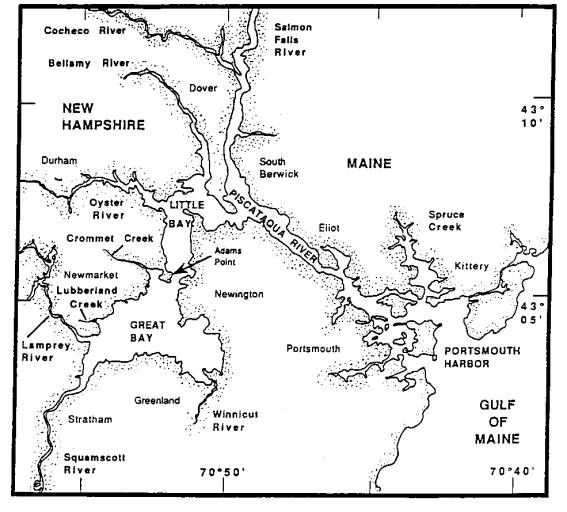
Figure 1-1.
Great Bay Estuary System, NH
(Short, 1992)
1.3. Objectives
There has been a lack in simulating the tidal flow in Great Bay Estuary including wetting/drying phenomenon on the tidal flats, which cover over 50% of the surface area of Great Bay. In this study, in order to resolve the wetting and drying on the tidal flats, the ADAM model (Ip et al., 1998) is chosen, which combines the two-dimensional wave physics with a porous medium beneath the sediment surface to simulate the wetting/drying process of the tidal flats on a fixed, high-resolution mesh.
The objectives of this study are:
· To investigate the effectiveness of ADAM model in simulating the tidal flow in Great Bay with wetting and drying on the tidal flats.
· To calibrate ADAM model by adjusting the bottom friction coefficient for, M2, M2S2, and M2S2N2 tidal forcing, respectively.
· To explore the frictional effects of eelgrass distribution on the flow regime in Great Bay.
1.4. Numerical Methods
The Finite Element Method (FEM) has been used to solve the primitive shallow water equations since the early 1970’s. A significant advantage of the FEM over the Finite Difference Method (FDM) has always been the flexibility provided by the discretization of the domain under study using unstructured polygons, especially when triangles are used. This enables spatial detail to be adjusted according to variations in topographical features or the structure of the computed variables.
In this study, a 2-D, non-linear, time stepping, finite element model, ADAM, is used. ADAM model is developed at Dartmouth College by Dr. Daniel R. Lynch and Dr. Justin T. Ip (see Ip et al. 1998). The ADAM model combines the two-dimensional kinematic wave physics, with a porous medium beneath the sediment surface. The model is sensitive to the bottom friction coefficient distribution.
1.5. Approach
The Great Bay system is forced with three different tidal forcing, M2, M2S2, and M2S2N2 at Little Bay. A depth-related bottom friction coefficient is defined as:
Cd=A-B´h
Where h is the bathymetric depth, A and B are constant coefficients. The bottom friction coefficient increases to its maximum value as depth approaches zero. The bottom friction coefficient distribution is adjusted for each tidal forcing (such as M2, M2S2, and M2S2N2) until the model produced data matched the predicted data from Swift and Brown (1983).
Eelgrass leaves form a three-dimensional baffle in water acting as dampers and reduce water motion. Therefore, eelgrass beds are treated as extra dampers: the bottom friction coefficient over the eelgrass beds is increased to a maximum value of 0.1. This value is then checked with the friction values found from flume tank experiments (Kopp , 1999).
The change in water surface area and the average depth; changes in surface elevation amplitude and phase distributions and the changes in current speed and direction in Great Bay due to the frictional effects of eelgrass are explored.
The details of the steps taken in this study are given in Figure 1-2 with a flow chart.
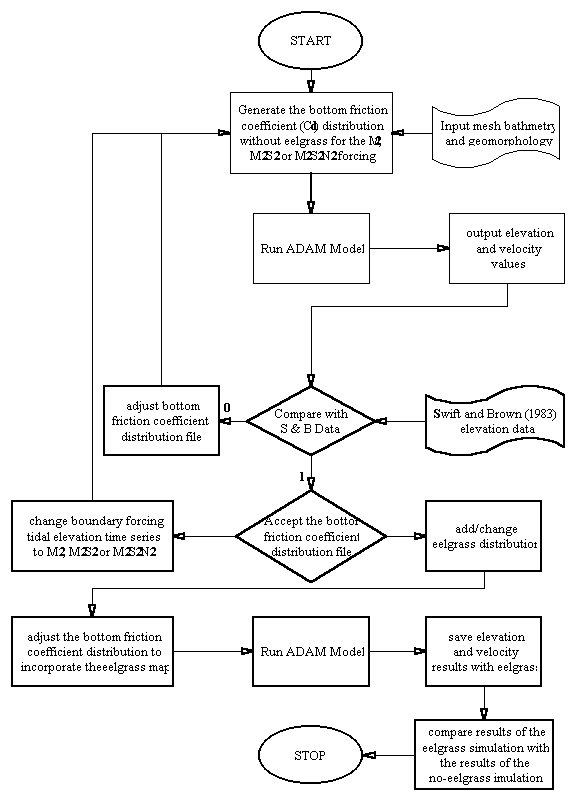
Figure
1-2. Flow chart for the calibration of the ADAM model
with the bottom friction coefficient.
1.6. Overview of Thesis
The thesis is organized as follows:
Chapter 2 explains the historical development of finite element modeling concept. In this chapter, the basics of finite element methods are given. The mesh generation technique and the numeric and geomorphologic properties of the generated meshes are described.
Chapter 3 views the hydrodynamic modeling efforts for the Great Bay Estuary system. The ADAM model is described in detail and the reasons in choosing the ADAM model are given. The governing equations for the kinematic, 2-D, non-linear, ADAM model and the assumptions made in this study are included in this chapter. Details about the porous medium approach are also given.
Chapter 4 introduces one of the most important ecological components in Great Bay, Zostera marina, L. or eelgrass as commonly known. This chapter gives a general idea about seagrasses and their effects on the water quality, sediment movement and the hydrodynamics in shallow embayments. The disturbance sources of seagrasses and the recovery efforts for the eelgrass habitats are also introduced.
Chapter 5 gives information about the field program performed in the summer of 1975 by the University of New Hampshire in cooperation with the National Ocean Survey (NOS). In this chapter, locations of moored current meters and sea level measurement stations are given. Model-produced data is compared with the predictions at these stations in Chapters 6, 7, 8 and 9.
Chapter 6 explains the approach in the adjustment of bottom friction coefficient in a systematic fashion. The gbes16 mesh is introduced and the boundary forcing time series for the M2, M2S2 and M2S2N2 tides are predicted for the gbes16 mesh in this chapter.
In Chapter 7, the M2 tidal flow in Great Bay is explored. The gbes16 mesh introduced in Chapter 6 is used with the September 1990 eelgrass distribution in Great Bay. The change in the surface area and the average-depth, changes in surface elevation amplitude and phase distributions and the changes in current speed and direction in Great Bay due to the frictional effects of eelgrass are discussed in detail in this chapter.
Chapter 8 gives the simulation results for M2S2 tidal forcing. The effect of eelgrass distribution on the M2S2 flow in Great Bay is explored.
Chapter 9 gives the simulation results for M2S2N2 tidal forcing.
Chapter 10 initiates a discussion on the results.
Appendix A describes the Darcian Flow for porous medium.
Appendix B contains information regarding the use of Galerkin method.

![[back]](../images/home.gif)
