APPENDIX A
Darcian Flow:
In the fluid mechanics of
porous media, the place of momentum equations of force balances is occupied by
the numerous experimental observations summarized mathematically as the “Darcy
Law”. The observations were first
reported by Darcy who, based on measurement alone, discovered that the area
averaged fluid velocity through a column of porous material is proportional to
the pressure gradient established along the column. Subsequent experiments
proved that the area-averaged velocity is, in addition, inversely proportional
to the viscosity ( ) of the fluid seeping through the porous material.
So one can write:
 (A-1)
(A-1)
where K is an empirical constant called
permeability. The dimensions of K must be
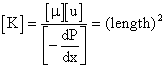 (A-2)
(A-2)
Darcy flow is the
macroscopic manifestation of a highly viscous flow through the pores of the
permeable structure, and  is a length scale
representative of the effective pore diameter. Ergun (1952) proposed
is a length scale
representative of the effective pore diameter. Ergun (1952) proposed
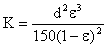 (A-3)
(A-3)
as a correlation for the
measured permeabilities of columns of packed spheres of diameter d and porosity
 .
.
In the presence of a body force per unit volume  the Darcy Law (A-1) becomes
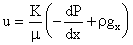 (A-4)
(A-4)
acknowledging the fact that
the flow through the porous column stops when the externally controlled
pressure gradient dP/dx matches the hydrostatic gradient  .
.

![[back]](../images/home.gif)
