APPENDIX B
The Galerkin Method:
For most practical problems, it is impossible to determine the exact solution to the differential equations in terms of known functions, which exactly satisfies the governing equations and the boundary conditions. As an alternative, the FEM seeks an approximate solution; an explicit expression in terms of known functions, which only approximately satisfies the governing equations and the boundary conditions.
The FEM obtains an
approximate solution by using the classical trial-solution procedure. The
trial-solution procedure is composed of three principal operations,
respectively Burnett (1987);
·
Construction
of trial solution,
·
Application
of optimizing criterion,
·
Estimation
of the accuracy.
One has to determine an
approximate solution  , which comes close to the unknown true solution u for a
given problem. The function
, which comes close to the unknown true solution u for a
given problem. The function  will be defined
everywhere in terms of a finite set of mathematical basis functions
will be defined
everywhere in terms of a finite set of mathematical basis functions  whose properties are a priori
well known:
whose properties are a priori
well known:
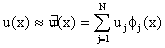 (B-1)
(B-1)
The coefficients  are the primary
unknowns of any problem once the basis has been selected. In any practical
problem, the basis in use will necessarily be finite and incomplete
-i.e. incapable except in lucky cases representing the exact solution
perfectly. Any numerical solution may be viewed as a two-step process. First,
select a basis which is likely to fit the unknown solution for the particular
problem. Second, determine the coefficients
are the primary
unknowns of any problem once the basis has been selected. In any practical
problem, the basis in use will necessarily be finite and incomplete
-i.e. incapable except in lucky cases representing the exact solution
perfectly. Any numerical solution may be viewed as a two-step process. First,
select a basis which is likely to fit the unknown solution for the particular
problem. Second, determine the coefficients  in a reliable way.
Use of a finite or
incomplete basis guarantees that in general a given differential equation
cannot be satisfied everywhere, leaving an imbalance or residual, R, everywhere. Clearly, R depends on the selection of
both the basis  and the coefficient
  . Problem-dependent basis selection is the first step towards
a small residual. Given a finite basis, one must then settle for making R small
in some average way by choosing the coefficients
. Problem-dependent basis selection is the first step towards
a small residual. Given a finite basis, one must then settle for making R small
in some average way by choosing the coefficients  .
.
In the Method of Weighted
Residuals (MWR), in order to determine  , R is required to vanish in a weighted integral sense. In
Cartesian space we have
, R is required to vanish in a weighted integral sense. In
Cartesian space we have
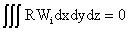 (B-2)
(B-2)
for a set of distinct
weighting functions 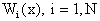 , and the integration performed over the full domain in which
the differential equation governs. We can use the inner product notation,< ,
> to indicate domain (volume) integration and the MWR is stated compactly:
, and the integration performed over the full domain in which
the differential equation governs. We can use the inner product notation,< ,
> to indicate domain (volume) integration and the MWR is stated compactly:
 (B-3)
(B-3)
Equivalently, “R is
orthogonal to Wi “ with N basis functions  selected a priori, a
choice of N independent weighting functions Wi
selected a priori, a
choice of N independent weighting functions Wi will determine the N unknown uj.
Galerkin Method is an MWR in which weighting functions are identical to the basis
functions:
 (B-4)
(B-4)
This is extensively used with finite elements.

![[back]](../images/home.gif)
