Problems part 3 : Fourier series

|
|
|

 .
.![[0,2L]](index3_prob_files/image005.gif) , this can
, this can![f(x)==2[H(x/L)-H(x/L-1)]-1,](index3_prob_files/image007.gif)
 is
the Heaviside function
is
the Heaviside function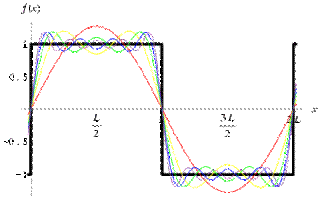
 , the function is
odd, so
, the function is
odd, so  , and
, and 


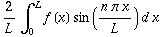

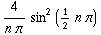
![2/(npi)[1-(-1)^n]](index3_prob_files/image019.gif)
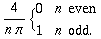
|
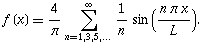
Prob. 2) Find Fourier series of a saw tooth wave described by the following equation |

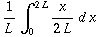
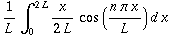
The components of the Fourier series are therefore given by
|
|
|
|
|
|
|
|
|
|
|
|
|
|
|
|
|
|
|
|
|
|
|
|
|
|
|
|
|
|
|
|



![([2npicos(npi)-sin(npi)]sin(npi))/(n^2pi^2)](index3_prob_files/image028.gif)

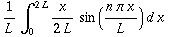


The Fourier series is
therefore given by
|
|
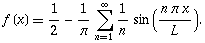
Prob.
3 )
Find Fourier Series of the following function of period 2.
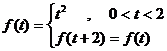
Answer
We have T = 2. Lets find its coefficients :
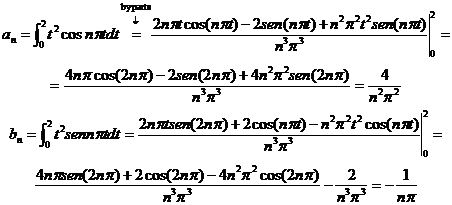
a0 we have to calculate of the following , because
function does not have definition for n = 0.
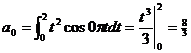
The fourier series is:

Prob 4) Find Fourier series of the following function
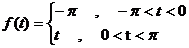
a) Find trigonometric
Fourier series of f(t).
b) Graph in the interval [-4p; 4p].
Answer
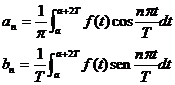
We can extend the period as 2p. We can obtain the coefficients :
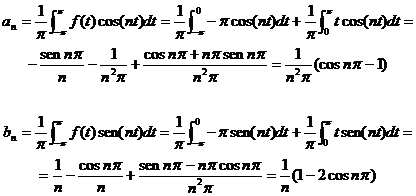
The a0 coefficient
is:

Thus the Fourier series is :

 b) Graph of the function:
The point shown values of
the function in its discontinuity .
Prob. 5) Find the complex Fourier series of the following f(t) = e-at, where -p < a < p. With this series we find  .
.
Answer
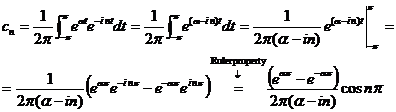
First
we fin its coefficients:
Then:

That function is continuous
for all values . If we evaluate this in 0 is the same that f(0), that is , 1. If we evaluate eint, in
0, we get 1.

Positive terms of in
will cancel , thus we can write the function as :

Go to first part : Principles of Signal and Systems Modeling Concepts
Go to second part : System Modeling and Analysis in the time domain
Go to third part : The Fourier series
Go to fourth part : Laplace Transform