
Part 2: System Modeling and analysis in the time domain.
In the first part we discussed some continuous-time signal models , in this part we will discuss some techniques in time domain.
There are several mathematical procedures for systems in time domain , but we will focus on linear time invariant systems.
We begin our study analyzing the convolution integral which is a powerful tool for analysis of linear , time – invariant systems.
Representation of systems
There are a representation
between input  and
output
and
output  variables of a system



The dependence between input and output variables is related for the following

Convolution integral
The convolution integral has the following form :
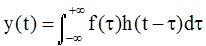
The Evaluation of the Convolution Integral
Consider the system described by the differential equation:

which has an impulse response given by

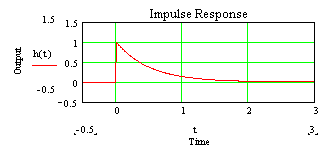
We will use convolution to find the zero input response of this system to the input given by
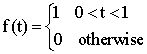
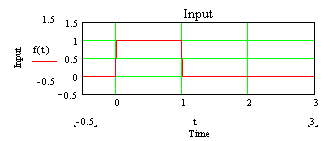
Convolution as sum of
impulse responses
|
For continuity with the page deriving the convolution integral we can approximate the input by a series of impulses... |
|
|
plot the response of the system to each of these impulses... |
|
|
and plot the response as the sum of the individual responses
|
|
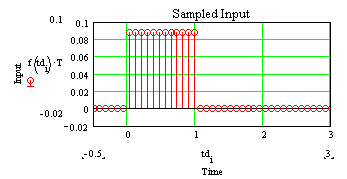
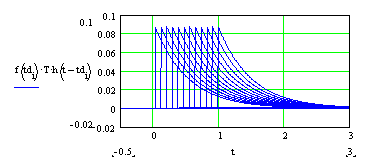
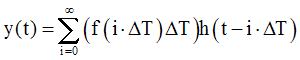
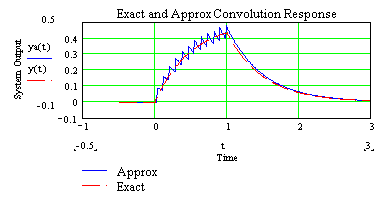
Convolution Integral
Likewise the convolution can be considered from the point of view of the convolution integral.
.
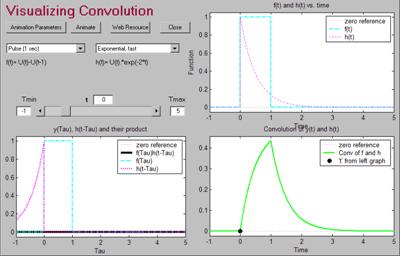
The Mechanics of Using the Convolution Integral
To find the output of the system with impulse response
to the input
we will use the convolution integral
Because the input function has three distinct regions t<0, 0<t<1 and 1<t, we will need to split up the integral into three parts.
Part 1: t<0
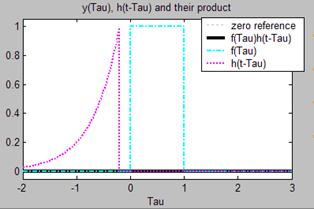
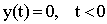
For t<0 the argument of the impulse function (t-t) is always negative. Since h(t-t)=0 for (t-t)<0, the result of the integral is zero for t<0.
This situation is depicted graphically below (t=-0.2):
So the result for the first part of our solution is
Part 2: 0<t<1
For 0<t<1 we need to evaluate the integral only from t=0 to t=t, since f(t)=0 when t<0, and h(t-t)=0 when (t-t)<0 (or, equivalently t<t). So the integral becomes, in effect:
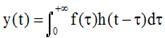
This situation is depicted graphically below (t=0.5):
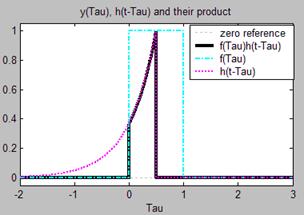
We can now evaluate the integral of the solid black line:
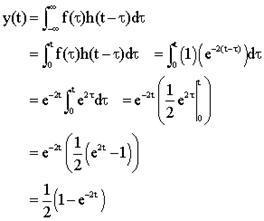
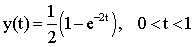
Thus, the result for the second part of the solution is
Part 3: 1<t
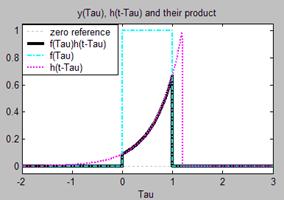
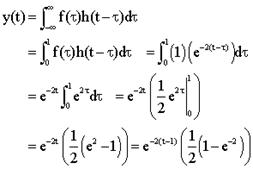
For 1<t we need to evaluate the integral only from t=0 to t=1, since f(t)=0 when t<0 and when t>1. So the integral becomes, in effect:
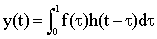
This situation is depicted graphically below (t=1.2):
We can now evaluate the integral:
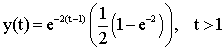
Thus, the result for the third part of the solution is:
The complete answer.
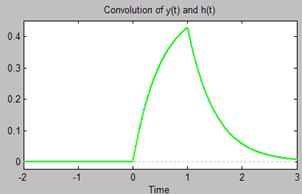
We can get the results for all time by combining the solutions from the three parts.
This result is shown below. Click on the image to see an animation of the convolution operation.
The convolution integral is a completely general method for finding the output of a linear system for any input.
|
Convolution properties |
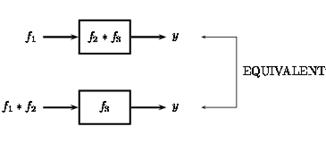
Associativity
theorem 1: Associative Law
f1(t) *(f2(t) *f3(t)) =(f1(t) *f2(t)) *f3(t)
|
Figure 1: Graphical implication of the associative property of convolution. |
Commutativity
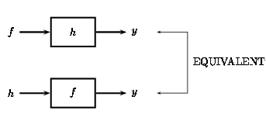
theorem 2: Commutative Law
|
y(t) |
= |
f(t) *h(t) |
|
y(t) |
= |
h(t) *f(t) |
Proof
To prove this equation all we need to do is make a simple change of variables in our convolution integral (or sum),
y(t) =∫−∞∞f(τ) h(t−τ) dτ
By letting τ=t−τ , we can easily show that convolution is commutative:
|
y(t) |
= |
∫−∞∞f(t−τ) h(τ) dτ |
|
y(t) |
= |
∫−∞∞h(τ) f(t−τ) dτ |
f(t) *h(t) =h(t) *f(t)
|
Figure 2: The figure shows that either function can be regarded as the system's input while the other is the impulse response. |
Distribution
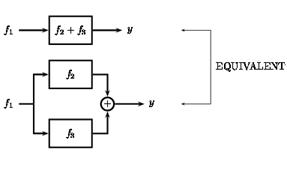
theorem 3: Distributive
Law
f1(t) *(f2(t) +f3(t)) =f1(t) *f2(t) +f1(t) *f3(t)
Proof
The proof of this theorem can be taken directly from the definition of convolution and by using the linearity of the integral.
|
Figure 3 |
Time
Shift
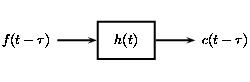
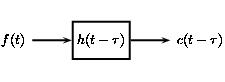
theorem 4: Shift Property
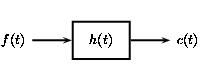
For c(t) =f(t) *h(t) , then
c(t−T) =f(t−T) *h(t)
and
c(t−T) =f(t) *h(t−T)
|
Subfigure 1
Subfigure 2
Subfigure 3 Graphical demonstration of the shift property. |
Convolution
with an Impulse
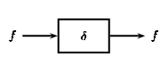
theorem 5: Convolving with Unit Impulse
f(t) *δ(t) =f(t)
Proof
For this proof, we will let δ(t) be the unit impulse located at the origin. Using the definition of convolution we start with the convolution integral
f(t) *δ(t) =∫−∞∞δ(τ) f(t−τ) dτ
From the definition of the unit impulse, we know that δ(τ) =0 whenever τ≠0. We use this fact to reduce the above equation to the following:
|
f(t) *δ(t) |
= |
∫−∞∞δ(τ) f(t) dτ |
|
f(t) *δ(t) |
= |
f(t) ∫−∞∞(δ(τ)) dτ |
The integral of δ(τ) will only have a value when τ=0 (from the definition of the unit impulse), therefore its integral will equal one. Thus we can simplify the equation to our theorem:
f(t) *δ(t) =f(t)
|
Subfigure 1
Subfigure 2 Figure 1: The figures, and equation above, reveal the identity function of the unit impulse. |

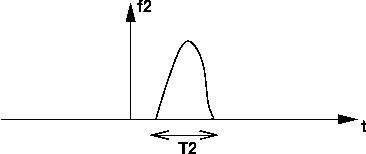
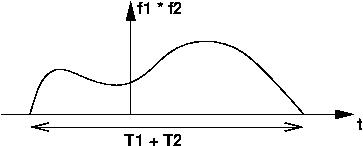
Width
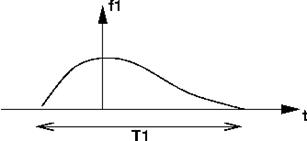
In continuous time, if Duration(f1) =T1 and Duration(f2) =T2 , then
Duration(f1*f2) =T1+T2
|
Subfigure 1
Subfigure 2
Subfigure 3 Figure 1: In continuous-time, the duration of the convolution result equals the sum of the lengths of each of the two signals that are convolved. |
In discrete time, if Duration(f1) =N1 and Duration(f2) =N2 , then
Duration(f1*f2) =N1+N2−1
Causality
If f and h are both causal, then f*h is also causal.
Go to problems for second part
Go to first part : Principles of Signal and Systems Modeling Concepts
Go to third part : The Fourier series
Go to fourth part : Laplace Transform