Four part :
The 
The study of systems involves the solution of differential equations or evaluation of the superposition integral .
These techniques can result in tedious mathematical operations using classical methods however these solutions
can be achieved faster using the Laplace Transform which changes differential equations in algebraic manipulations.
Let’ us define The Laplace Transform :
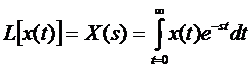
With 
|
Conditions
for the Existence |
|
|
1) |
|
|
2) |
for all |
|
Note
that conditions 1 and 2 are sufficient, but not necessary, for |
|
 is
piecewise continuous on
is
piecewise continuous on  .
. .
That is, there exist real constants
.
That is, there exist real constants  ,
,
 ,
and
,
and  such
that
such
that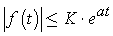
 .
.
 to
exist.
to
exist.The parameter s is assumed to be positive and large enough to ensure that the integral converges ,
we see that s is complex in such case the real part of s must be positive and large enough to ensure convergence.
1) The first Translation theorem
If
L{f(t)}=F(s) then 
2)
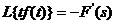
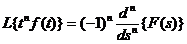
Multiplying by t and tn
If L{f(t)}=F(s) then
3)
Dividing by t
If L{f(t)}=F(s) then
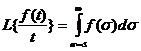 provided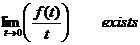
Table of standard transform
|
Standard transform |
|
|
|
|
|
a |
|
|
|
|
|
|
|
|
|
|
|
|
|
|
|
|
|
|
|

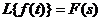


4) Linearity Property
If a and b are constants while f(t) and g(t) are functions of t then
 {a f(t) + b g(t)}
= a{f(t)} + b{g(t)}
{a f(t) + b g(t)}
= a{f(t)} + b{g(t)}
5) Inverse Transform
If L{f(t)}=F(s) then
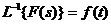
Table of inverse transforms
|
Table of inverse transforms |
|
|
|
|
|
|
a |
|
|
|
|
|
|
|
|
|
|
|
|
|
|
|
|
|
|
|
|
|


5) Laplace transform of derivatives

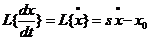
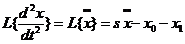
Where x0 = value of x
at t=0 and x1 = value of 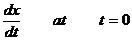
7) Laplace Transforms of Integrals
7.1. If 


 alt="$\{g(t)\}$" v:shapes="_x0000_i1086">
, then
alt="$\{g(t)\}$" v:shapes="_x0000_i1086">
, then  alt=MATH v:shapes="_x0000_i1087">
7.2. For the general integral
 ,
,
Where 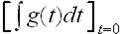 is the value of the integral when
  .
.
8) 
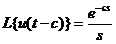
9)  (The second
shift theorem )
(The second
shift theorem )

10) If f(t) is a periodic function of period T we have :

11) Dirac Delta (unit impulse )

Go to problems for the four part
Go to first part : Principles of Signal and Systems Modeling Concepts
Go to second part : System Modeling and Analysis in the time domain
Go to third part : Fourier series