Third part : Fourier Transform and Its Applications

Fourier transform plays an important role in the analysis and design of systems where it is convenient to represent
signals in terms of frequency-domain . Problems involving various forms of oscillations are common in fields
of modern technology and Fourier series enable us to represent a periodic function as an infinite trigonometrical
series in sine and cosine terms.
In communications theory the signal is
usually a voltage, and Fourier theory is essential to understanding how a
signal behaves
when it passes through filters, amplifiers and communications channels. Even
discrete digital
communications which use 0's or 1's to send
information still have frequency contents. This is perhaps
easiest to
grasp in the case of trying to send a single square pulse down a channel.
The field of communications spans a range
of applications from high-level network management down to sending
individual bits down
a channel. The Fourier transform is usually associated with these low level
aspects of communications
Before to define Fourier series we have some important definitions:
Periodic
Function :
A function  is said to be periodic
if its function value repeat at regular intervals
is said to be periodic
if its function value repeat at regular intervals
of the independent variable.
x(t+T0)= x(t) -∞ < t < ∞ .
Integral of periodic functions: We have some important properties involving sines , cosines and its combinations
where the
integration is over a single period from  to
to  :
:
a)
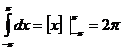
b) 
c) 
d) 
e) 
f) 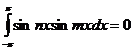
Trigonometric Fourier series representation of Periodic Signals .
A periodic signal can be represented in the following general form :


This can be written compactly in the following form :

Now we have to find a0 , an and bn .
Integrating the series term by
term over one period of  , we obtain :
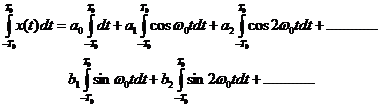
According integral of periodic function properties all terms where sines and cosines are included are zero thus:
|
|
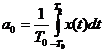
Which represent the average value of the waveform .
The other constants of the general
series we find multiplying that series by

And integrating over a period of .


The integration of the first term
is zero , multiplying each term of the series in
parentheses by and
integrate term by term we have :

We have some interesting properties of integrals involving products of sines and cosines .
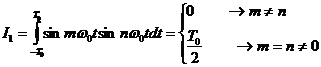
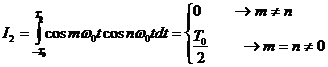

Where  is a period of the
fundamental and m , n are integers.
is a period of the
fundamental and m , n are integers.
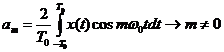
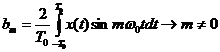
Using properties shown above we can obtain the other constants :
|
|
|
The complex Exponential representation of
Fourier Series
Another form of the Fourier series that involves complex exponential functions can be obtained by substituting the complex exponential
forms of  and
and  :
:
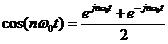
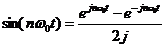
We can represent as :

|
|

This is the complex exponential form of the Fourier series.
If we now define  thus the conjugate of
cn is
thus the conjugate of
cn is 
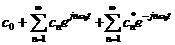
We can write this sum as:
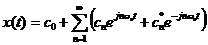
= 
For notation convenience we denote
 by
by  .
.
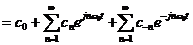
An n ranges from 1 to ∞ so –n ranges from -1 to -∞
|
|
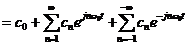
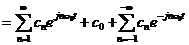

where
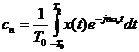
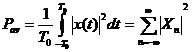
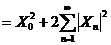
Parseval’s
Theorem
In part 1.
we defined the
average power of a periodic waveform as
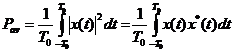
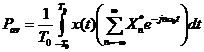
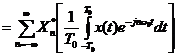
We recognize that into brackets as Xn , thus it can be written as :
|
|
Fourier transform theorems
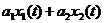
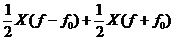
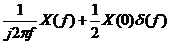
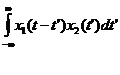
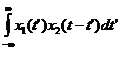
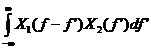
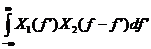
The following table show some important theorems which make easier calculus of Fourier series.
|
Name of Theorem |
||
|
1) Superposition (a1 and a2 are constants ) |
|
|
|
2) Time delay |
|
|
|
3) Scale change |
|
|
|
4) Frequency translation |
|
|
|
5) Modulation |
|
|
|
6) Differentiation |
|
|
|
7) Integration |
|
|
|
8) Convolution |
|
|
|
9) Multiplication |
|
|







Go to first part : Principles of Signal and Systems Modeling Concepts
Go to second part : System Modeling and Analysis in the time domain
Go to fourth part : Laplace Transform