PROBLEMS

1) a)
A sample-data signal derived by taking samples of a continuous-time signal ,  , is often represented
in terms of an infinite sequence
, is often represented
in terms of an infinite sequence
of rectangular pulse signals by multiplication. That is ,
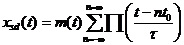
If 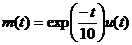 ,
,  , and
, and  , sketch
  for
for 
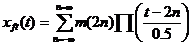
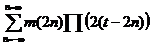
b) Flat-top sample representation of a signal is sometimes preferred over the above schema . In this case , the sample representation of a
continuous-time signal is given by

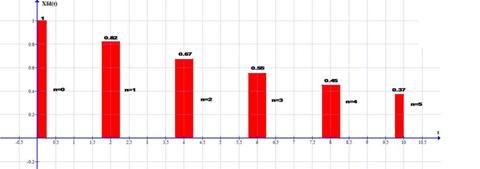
Sketch this sample-data representation for the same signal and parameters as
given in part (a) .
Answer:
Part (a)
First working with  replacing its values
we have
replacing its values
we have  =
=
According equation (1-2) we have :

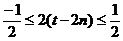 à
à 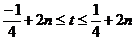 we know that n varies
from -
we know that n varies
from - to given some values :
If n= -2 thus 
If n= -1 thus 
If n= 0 thus 
If n= 1 thus 
If n= 2 thus 
If n= 3 thus 
If n= 4 thus 
If n= 5 thus 
With this values we can graph
The second graph of is defines for all
values of  , otherwise is zero
but according limits of t the interval is
, otherwise is zero
but according limits of t the interval is
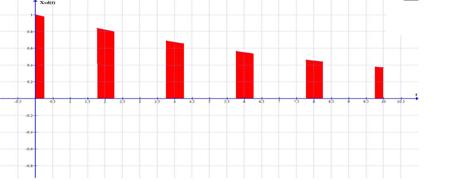
Multiplying point by point and we have
If , , and , sketch for
Part (b)

If , , and , sketch for
 =
=

|
Values of n |
|
|
|
n=-2 |
1.49 |
|
|
n=-1 |
1.22 |
|
|
n=0 |
1 |
|
|
n=1 |
0.82 |
|
|
n=2 |
0.67 |
|
|
n=3 |
0.55 |
|
|
n=4 |
0.45 |
|
|
n=5 |
0.37 |
|


(*) we stop when n=5 because the upper limit of t =10.
Multiplying point by point  and
and  we have:
2) Sketch the following signals.
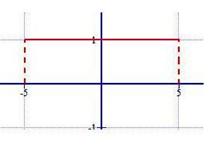 a)
a)

We know that 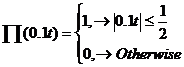
->  ->
-> 
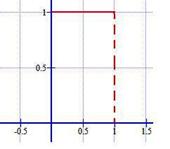 b)
b) 
We know that 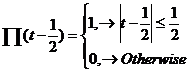
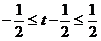 ->
-> 
3) What are the fundamental periods of the signals given below ?. (assume unit of seconds)
a)




Or


We know that 
Thus :


b)



Thus 
c) 


Thus 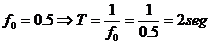
4) Show that :
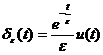 has properties of
a delta function in the limit as
has properties of
a delta function in the limit as 
Applying hoppital theorem we have :
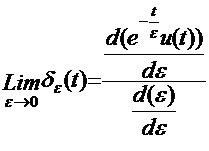
 =
= 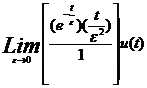 =
= 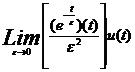 Applying hoppital
again:
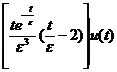
Applying hoppital
again:
=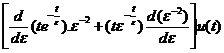 =
= 
=
5) Show that  has the properties of
a unit impulse function as
has the properties of
a unit impulse function as 
Answer :
We know that : 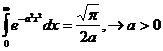 ……..(*) and
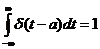 ……(**)
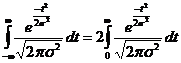 because this
function is even
because this
function is even
Applying (* ) we have :
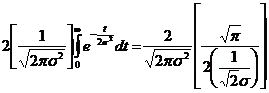 =
=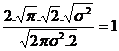
We see that this function have the
same properties of equation (**) that is an unit impulse function 
6)Evaluate the following integrals :
a) 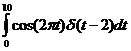
We know that : 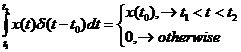
Thus  and
and 

= 1
b) 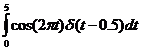 applying the same
property of part a we have :
applying the same
property of part a we have :
 and
and 
=-1
Go to first part : Principles of Signal and Systems Modeling Concepts
Go to second part : System Modeling and Analysis in the time domain
Go to third part : The Fourier series
Go to fourth part : Laplace Transform