 Marinduque was said to have been named after the mythical
characters Marina and Garduke. According to a legend, the heart-shaped island
was formed as a result of a tragic love affair between Marina and Garduke.
Marina's father objected to the love affair of his daughter with Garduke that he
ordered the beheading of the latter. This forced the couple to sail out to
sea and drown themselves. The island that surged from the waters became
Marinduque.
Marinduque was said to have been named after the mythical
characters Marina and Garduke. According to a legend, the heart-shaped island
was formed as a result of a tragic love affair between Marina and Garduke.
Marina's father objected to the love affair of his daughter with Garduke that he
ordered the beheading of the latter. This forced the couple to sail out to
sea and drown themselves. The island that surged from the waters became
Marinduque.
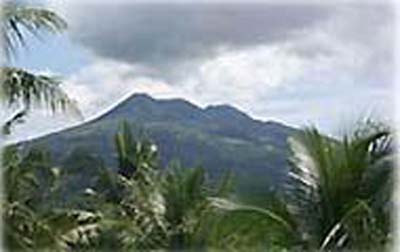
 Another version says that the original name of the island was Malandik that was
derived from its highest peak, Mt. Malindig. The Spaniards could hardly
pronounce Malandik, thus they called the island Marinduc.
Another version says that the original name of the island was Malandik that was
derived from its highest peak, Mt. Malindig. The Spaniards could hardly
pronounce Malandik, thus they called the island Marinduc.
In the 1500s,
Marinduque was part of Batangas (formerly Balayan). Early
in the 1600s, it became part of Mindoro. Finally in 1901, the American
colonizers constituted the island into a separate province.
Tthe island was again declared under Tayabas, the present day Quezon.
It was on February 21, 1920 that the island was returned to its status as the
province of Marinduque by virtue of Act No. 2880 passed by the Philippine
Commonwealth. It was subdivided into six (6) municipalities: Boac, Buenavista, Gasan,
Mogpog, Sta Cruz and Torrijos.
Boac was derived from Visayan word b'ak, equivalent
to the Tagalog term "biak", meaning broken into pieces.
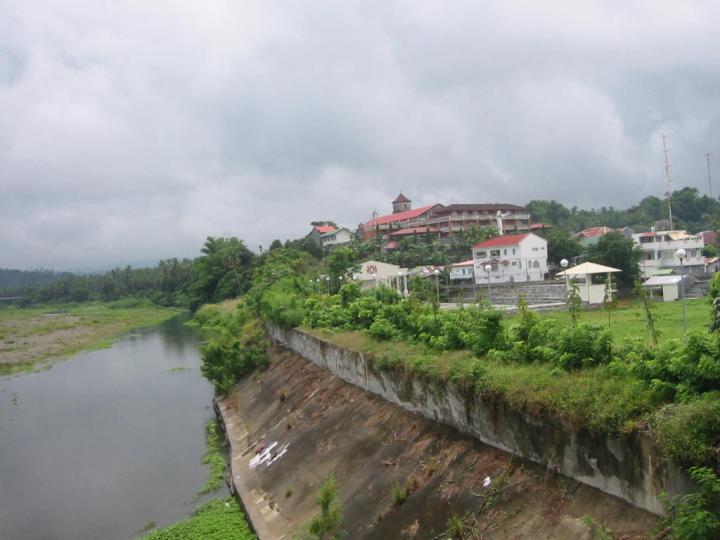
Boac has a big river that divides the settlement into two.
It may also mean a break on the access roads to the town due to "Bundok ng
Santol".
Buenavista was formerly called "Sabang". A priest named Father
Clemente Ignacio, who admired the view of Tres Reyes Islands from the coastal
town, may have given the name Buenavista (Good View) when it
was declared a "visita" of Gasan in 1870.
Gasan was derived from the Tagalog word "gasang", a term for
corals or broken pieces of corals and seashells which was believed to be
abundant along the seashore of Gasan.
Sta Cruz was the first known settlement in the eastern
section of the province. According to legend, a mirage in the form of a cross
was seen in that place, hence, the name Sta. Cruz de Napo.
Jesuit missionaries were responsible for the Christianization of the island's
inhabitants. In the early 1600s, the Jesuits built the towns of Boac,
Gasan and Santa Cruz.
 Marinduque was constantly under threat from Moro attacks so that watchtowers were
built to warn the Christian population and prepare for their defense against the
Moro armada. As a thanksgiving to the miraculous Virgin of Biglang-Awa,
the fortress-church of Boac was built in 1792.
Marinduque was constantly under threat from Moro attacks so that watchtowers were
built to warn the Christian population and prepare for their defense against the
Moro armada. As a thanksgiving to the miraculous Virgin of Biglang-Awa,
the fortress-church of Boac was built in 1792.
Mining prospectors discovered large copper deposits in 1956 and in the late
1960s, the island became home to one of the largest mining operations in
the country. In March 1996, mine tailings from a holding pool leaked into
the Boac River, destroying fishing resources in the river as well as in the
coastal areas surrounding the river mouth. This was one of the worst
ecological disasters in the country which eventually forced the closure of the
copper mine in the province.