
***
In a newspaper article printed in the OKINAWA TIMES, Master Shimabuku was interviewed about the US servicemen training in his dojo. The article is below.
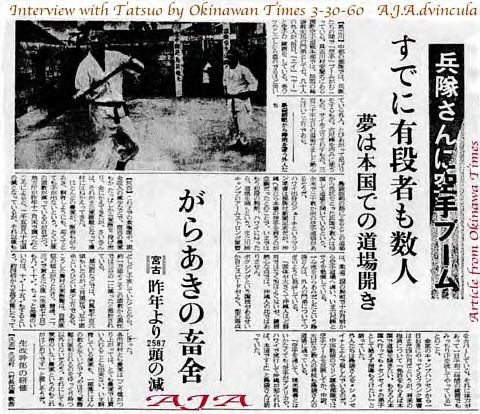
OKINAWA TIMES, Saturday, April 30, 1960
Karate Boom among Soldiers
-Several Already Have Dan-Ranking
-Dream is to Open Dojo in Own Country
(Photo Caption: Foreigners learning Bojutsu from Shimabuku
Shihan)
[Gushikawa - There is a karate boom among the soldiers
stationed in the central region [of Okinawa - JS. There
are 70-80 foreigners studying under Mr. Shimabuku Tatsuo,
the instructor of the International Karatedo Headquarters,
training hard with yells of "EI" and "YA". Some foreigners
strike the makiwara until their fists bleed. Some jump up
in the air and kick with their feet. Some wield the 6-foot
staff skillfully. Some swing sai around. They train
enthusiastically in the 330 square meter dojo.
According to Shimabuku Shihan, several foreigners received
their teaching licenses from this dojo and opened their
own dojo upon returning to their homeland. There are
apparently over 30 karate dojo in the USA.
Sergeant Jake of the Marines is a military newspaper
reporter originally from Hawaii, but his dream was to
learn karate if he ever came to Okinawa. Now, he holds a
Shodan rank, and plans to open a dojo upon his return to
Hawaii. Sergeant Armstrong from the Kawasaki Camp holds a
Nidan in Judo, and joined the karate dojo 10 months ago.
He is presently studying the use of the bo and the sai.
Mr. Shimabuku, who is the founder of Isshinryu, evaluates
his foreign students as follows:
"Their bodies are large and they are not as skill full as
Okinawans, and their kata is not very good, but they are
much more enthusiastic about the training than their
Okinawan counterparts.
Perhaps due to the popularity of boxing in their
country, their eyes and speed is very good, which helps to
cover their weakness in kata. They are physically strong,
and train an average of 2 hours a day, soaked in sweat."
Sergeant Frank, who comes every other day from Camp Hansen
in Kin, has only been studying for 4 months now, but his
future dream is to "receive my teaching license and open a
dojo in my country. However, I would still like to
continue receiving instruction as a student of Sensei."
The foreigners affectionately call Mr. Shimabuku
"Shensei."
Perhaps as a reflection of the karate boom among the
Marines stationed in central Okinawa, several officers are
also training at Mr. Shimabuku's dojo.
"Even if we cannot promote friendship between Okinawa and
America through karate, my true hope is that if karate
becomes popular in the USA and Hawaii, then Okinawa would
also become more well understood," said Mr. Shimabuku.]
It was Master Shimabuku's wish that Okinawa is understood through karate. This is one of the reasons why the Isshin-kai & Tomo No Kai was created. To understand karate one must try to understand the reason for karate, and this is found in the Okinawan people themselves and their culture.
Visit these links to find out more about Okinawan culture:
November 3, 1995 CNN wrote an article titled "Okinawa's culture not well know by outsiders." The man interviewed in the article represents their forgiving and peaceful nature. This is an excerpt from the article:
The hands of old fishermen have had their share of labor, not in the fields, but out in the open sea. They are the fishermen of Yomitan Village in Okinawa. Their dark and rugged faces show the signs of some wear and tear over the years but for these veterans of the sea, fishing is what they know and what they love.
"I'm proud to be a fisherman because I feel I'm part of nature," said a fisherman.
"It's nice to be on the boat every day and see familiar faces. It's good for my health too," smiled another man.
The enjoyment helps take the sting out of days when the catch is disappointing. On a good day, these fisherman can catch nearly a ton of fish.
Sixty-eight year old Tokusuke Noha, admits the life of a fisherman is a modest one, but complaints are few.
"It's safe in Yomitan," said Noha. "We can get fresh air and it's a comfortable place to live. The big cities are always bustling, but Yomitan is quiet and peaceful,"
But that peace and quiet has been interrupted in recent days because of the escalating tension between Okinawans and the U.S. military. Noha, who at age 18 fought in the battle of Okinawa, when one in four islanders died, hasn't allowed bitterness or resentment to cloud his perspective.
"Even though we had a war, it's long been over," said Noha. "Personal emotions should not get in the way of resolving issues. There is a saying in Japan, 'yesterdays enemy is today's friend.'"
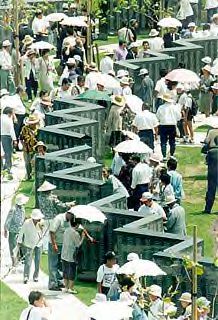
Photograph courtesy of Okinawa Times Publishers "Shashin Kiroku, Okinawa Sengoshi"
(Ruykyu Cultural Archives)
Note: The Cornerstone of peace has the names of everyone from every country that perished in the Battle of Okinawa.