 |
|
|
|
|
|
|
|
|
|
|
|
|
|
|
|
|
|
|
|
|
|
|
|
|
|
|
|
|
|
|
|
|
|
|
|
|
|
|
|
|
|
|
|
|
|
|
|
|
|
|
|
|
|
|
|
|
|
|
|
|
|
|
|
|
|
|
|
|
|
|
|
|
|
|
|
|
 |
|
|
Isshin-ryu Karate |
|
|
|
|
 |
|
|
|
|
|
 |
|
|
|
|
|
|
|
|
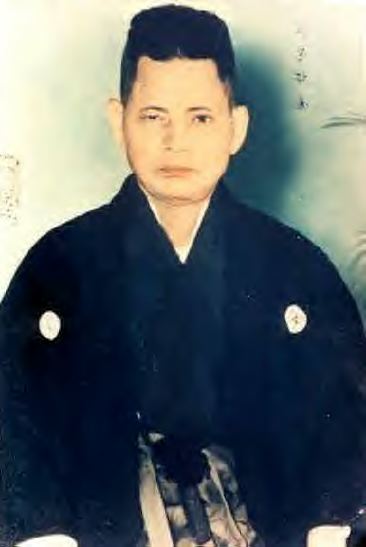
Tatsuo Shimabuku
Sept. 19 1908 - May 30 1975 |
|
|
|
Shinkichi Shimabuku was born in the year of the Monkey, Sept. 19, 1908. At birth he was given a girls name to fool the evil spirits. After the spirits were fooled he was given the Okinawan name of Kana, and the Japanese name Shinkichi. Shinkichi is what he used for all official documents and divided this name in half for his two sons, Shinso & Kichiro.
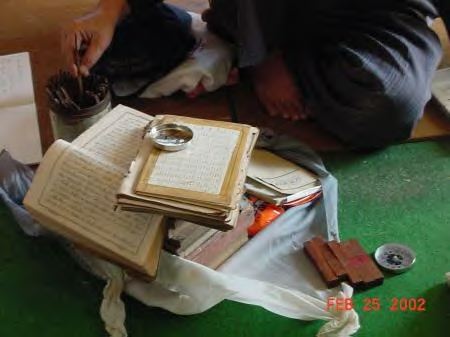
Around the age of 13, Shinkichi began his training in Karate with his uncle, Ganiku. He was employed as a principal for the Isshikawa Primary School. Ganiku was not very knowledgeable in Karate, and mainly instructed Shimabuku how to be a Samuchi (fortune teller). This included the study of the I-ching (book of changes), Feng Shui (fu shui), fortune telling sticks, and other books and instruments. |
|
|
|
 |
|
|
|
Shinso with some of Master Shimabuku's fortune telling tools
Photo courtesy of Jeff Perkins & Carol Womack |
|
|
|
Fortune telling was an important aspect of Master Shimabuku's life. When Shimabuku was older, people would come to him to ask if they were compatible as marital partners, would thier children be healthy, and many other questions. Shimabuku continued this practice until he started teaching the Marines in the mid-50's.
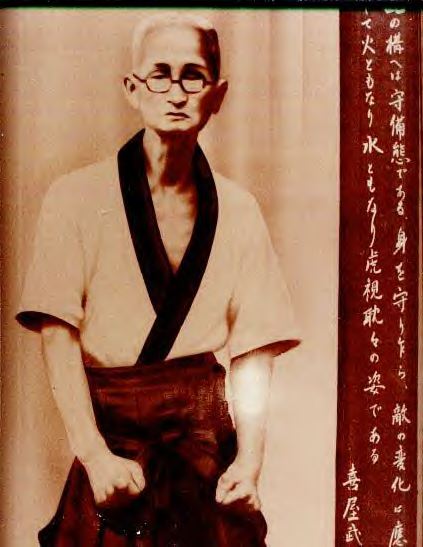
Around the age of 23-24, Shimabuku began training with Shuri-te and Tomari-te teacher, Chotokyu Kyan Sensei. Kyan taught Shinkichi many kata and retained these for Isshin-ryu:
1. Seisan
2.Niahanchi
3. Wansu
4. Chinto
5. Kusanku
6.Tokumine Nu Kun
Shimabuku may have also learned Kyan Nu Sai from him. |
|
|
|
 |
|
|
|
Chotokyu Kyan
1870 - 1945 |
|
|
|
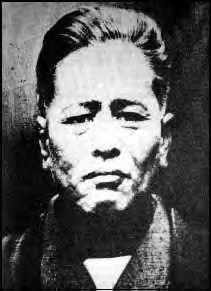
Shimabuku's next teacher was Chojun Myagyi. He founded Goju-ryu (hard/soft style). Shimabuku started with Myagyi when he was approx. 28 years old. He kept Seiunchin & Sanchin for Isshin-ryu. |
|
|
|
 |
|
|
|
Chojun Myagyi
1888 - 1953 |
|
|
|
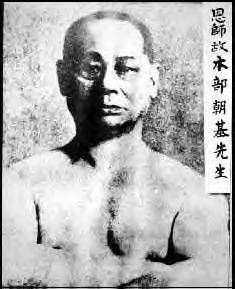
Shinkichi's also trained with Choki Motobu. From him he learned a form of Niahanchi Kata, Self Defense techniques (Kumite) & the importance of the Makiwara (punching board). |
|
|
|
 |
|
|
|
Choki Motobu
1871 - 1941 |
|
|
|
In 1939 Shimabuku traveled to the Philippines and stayed there for 2 years. While on the Philippines he gave Karate lessons to a theatre group and worked as a comedian.
During the years 1941-45, Shimabuku travels to Kyushu, Japan to protect his family against the war. After the "Battle for Okinawa" he brings his family back home. Around this time is when he begins teaching karate on Okinawa and calls his style Chan Migwa Te in honor of his teacher, Kyan. This is when he starts to use the name Tatsuo which means "Dragon Man".
Approximately 1951 Tatsuo is calling his style Sun Nu Su, which he later shortens to Sunsu. Su Nu Su was the name of an Eku dance done by his grandfather. The Mayor of Chan gave Tatsuo the nickname of Sunsu when he worked for the town as a tax collector.
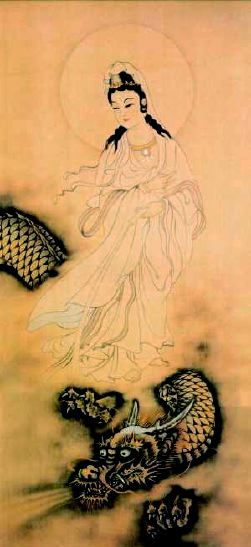
In 1955,in his home in Chan Village, Master Shimabuku was falling in and out of sleep. While he was relaxing around 7:30 PM. Shimabuku had a vision of a goddess riding a dragon. This goddess is called the Ryu-Zyu Kannon in Japanese, or Quan Yin in Chinese. |
|
|
|
 |
|
|
|
Ryu-Zyu Kannon / Quan Yin |
|
|
|
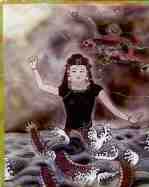
This Goddess told him he had been practicing karate long enough to create his own style and to create an image of her. He meditated 3-4 months on the image he was to create. The result was the Isshin-ryu No Megami/Kamisama (Goddess/diety of Isshin-ryu). He included the Kenpo Gokui (8 principles of the fist), in the Megami. He had the brother of one of his students, Eiko Kaneshi, paint a picture of her. |
|
|
|
 |
|
|
|
Isshin-ryu No Megami |
|
|
|
Master Shimabuku would do many types of meditation,when meditating for the Megami, he would lay on his side and look at pictures of landscapes. Ghost Mountain was a place where Tatsuo would go for another type of meditation. Most people were afraid to go there because of spirits, but Tatsuo would go there for specialty training twice a week. He would go around 3am and work on such things as Sanchin and sai. Ciso, Master Shimabuku's second son said that sometimes, while on the mountain, his father would see something that resembled a ghost or spirit. To prepare for the conflict, he would drop into Sanchin stance, but what he saw was nothing more than a shadow. (Personal interpretation: Master Shimabuku went to Ghost Mountain to heighten his awareness.)
Around 1955 Tatsuo started teaching the Marines. The first Marine Shinso remembered training with his father was named Cooper.
On January15, 1956 at his home in Chan Village, Master Shimabuku held a special meeting to announce the name Isshin-ryu for his new style. Even though this was the day he announced the style, he said Isshin-ryu had no birthday because it evolved over many years.. |
|
|
|
 |
|
|
|
A demonstration was held on March 27, 1956 to announce
Master Shimabuku's new Ryuha, Isshin-ryu. Seated Left to right: Kaneshi Eiko,
Kinjo Chisaku, Shimabuku Tatsuo and Shimabuku Eizo, younger brother of Tatsuo.
Photo courtesy of Sensei Soichi Nakahama. |
|
|
|
Between the years of 59-61 Tatsuo studied Kobudo under Tiara Shinken Sensei. Shinken taught Shimabuku Urashi Nu Kun, Shi Shi Nu Kun, Chatan Yara Nu Sai and
Hama Higa Nu Tuifa. |
|
|
|
 |
|
|
|
Tiara Shinken
1890 - 1970 |
|
|
|
In 1961, with Master Shimabuku's permission, AJ Advincula designed the Isshin-ryu patch. The original patch was supposed to be in the shape of a vertical fist with the thumb on the top, but the patch maker made a mistake and cut it out in the shape of a fist with the thumb on the side - the way other Okinawan Karate styles place the thumb. |
|
|
|
 |
|
|
|
Sensei Advincula in Feb of 1961 wearing the first Megami patch.
Notice Mrs. Shimabuku looking through the gate.
Photo courtesy of Ed Johnson. |
|
|
|
 |
|
|
|
 |
|
|
|
|
|
This is the first Isshin-ryu patch authorized by Master 25th anniversery Megami
Tatsuo Shimabuku and designed by Sensei Advincula This crest was released in 2000 to
Sensei Advincula is wearing this patch in the photo honor Master Shimabuku's passing.
taken in the Agena dojo shown above.
|
|
|
|
Master Shimabuku traveled to the States twice, once in 64, and again in 66. He was asked to return again but did not because he did not enjoy his first two trips.
Tatsuo quit teaching in 1971 and his son Kichiro took over the teaching at the dojo. On May 30th 1975 Master Shimabuku passed away from a stroke.
Let's please keep his dream alive and try to learn and pass on his teachings to best of our abilities.
Domo Arigato Master Shimabuku
Joey Paden
Dec. 4 2002
I want to thank Sensei Advincula for the history, photos, corrections,and everything he has shared with me. |
|
|
|
Home |
|
|
|
Sensei Advincula & Isshin-kai |
|
|
|
Dojo & Seminar Photos |
|
|
|
Dojo Schedule |
|
|
|
Okinawan Culture |
|