
| |
|
|
When all the stars exhaust their energy and if the density of matter in the Universe is sufficiently large, gravitational forces will eventually cause the Universe to stop expanding, and then to start falling back in upon itself. 100 million years before the final "crunch", individual galaxies would merge. Later, the remaining stars no longer attached to their parent galaxy would become dispersed throughout the contracting universe. They would move faster as the contraction progressed. Stars would be shattered from colliding with each other but many would already be destroyed.
The Universe will then end in a cataclysmic event famous physicist John Wheeler called the Big Crunch. The theory of the big crunch is the implosion of our entire universe into a black hole. This place of infinite density and zero volume is called a spacetime singularity. This singularity is a region, where according to the laws of general relativity, the curvature of spacetime becomes infinitely large and spacetime ceases to exist. Since tidal gravity is a manifestation of spacetime curvature, a singularity is also a region of infinite tidal gravity. In other words a region where gravity stretches all objects infinitely along some directions and squeezes them infinitely along others. All forms of matter are infinitely stretched and squeezed: even an individual atom, even the electrons, protons, and neutrons that make up atoms, and even the quarks that make up protons and neutrons.
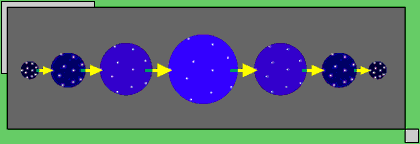
Illustration of the Big Crunch Theory
This is in theory what will happen to the Universe in the event of the big crunch. It is difficult to imagine what we would see and feel standing on the surface of the earth (assuming that the earth survived to this point in the chronolgy of the universe). The sky would be lit up by blueshift radiation and the atmosphere would become hotter that the stars themselves. The final end would be a fireball similar to that with which our Universe began.
Some scientiss theorize that the Universe could collapse into the same singular state as it began and then eventually explode outwards again in another Big Bang. In this way the Universe would last forever but would continually go through these phases of expansion and contraction, Big Bang and Big Crunch and so on...
This theory is sometimes referred to as the Oscillating Universe Theory.

Illustration of the Oscillating Universe Theory
Sites: An interesting discussion group on Black Holes and Singularities
Oscillating Universe Explained
A similar but different "crunch" theory: The No Boundary Universe.

