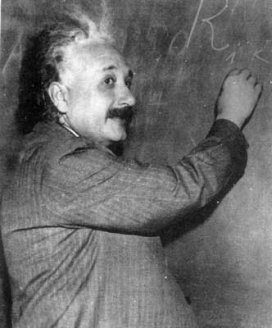
Albert Einstein
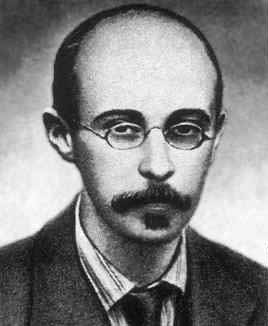
Alexander Friedmann
| Albert Einstein |
|
Alexander Friedmann |
It goes without saying that Albert Einstein's theory of relativity had a far reaching effect in the world of physics. Indeed, researchers today are still trying to understand all of the implications of relativity. Einstein himself was not aware of all of the things which follow from his theory. One scientist who used Einstein's theory to develop a view of the universe was the Russian mathematician, Alexander Friedmann. In the early 1920's he became the first person to embrace Einstein's still controversial theory and apply it to calculating the motion of the universe. Friedmann's calculations implied that the universe was not static, as was believed by most scientists of the day - including Einstein - but rather an expanding universe where after a long enough period of time, eventually the mutual gravitational attraction of all the matter slows the expansion to a stop. The universe then contracts, falling in on itself until it collapses into a singularity. This is referred to as the "Big Crunch" theory, or the closed universe since the size of the universe is finite.
However, the Friedmann Universe model also suggests that the big crunch is not the only possible fate for the universe. In fact, two other solutions exist which are very similar. First there is the open universe theory where there is not enough matter to halt the expansion, and the universe expands forever. This is known as the Open Universe Theory. Finally, in between the open and closed universe theories is the Flat Universe Theory, in the gravitational force of all matter in the universe is just right so that expansion eventually stops but the universe remains at that fixed size forever, slowly irradiating away all of its energy until eventually all the stars go out and the universe is left cold and dark. Please see our pages for more information on these topics.
Friedmann's theories were initially met with much skepticism. Einstein himself rejected this notion in favour of the static universe. Debate rages still in the scientific community as to which of these models, if any, is the correct one for our universe. Much of the speculation surrounds the density of the matter in the universe. If there is a set density of matter which will cause the universe to eventually collapse back on itself, then knowing the ratio of the true density of matter in the universe to this set collapsing density would theoretically allow us to know our fate.
 |
The Friedmann Universe, and its related theories are summarized here.

