

| |
|
|
Almost all societies contain within their theologies the idea of an "end time". The term commonly used for this belief is eschatology. Eschatology comes from the Greek word eschaton or eschata which means "end" or "last things", i.e. the "end" of the present evil age. It is a term which is closely associated with the Judaic/Christian portrayal of end times but this is not the only religion it should be applied to. Eschatology can be applied to most world's belief systems if it is looked at as simply the study of different culture's perspectives on the future of humanity. To help understand eschatology it can be broken into two categories; mythical eschatology and historical eschatology.
Mythical eschatology is usually representative of non-western religions, especially Eastern religions and religions found in non-literate societies. The cosmos in these societies is considered eternal. This does not mean that there teachings see the world as indestructible, rather they see the world as eternally recreated. Theology in these societies is primarily concerned with the eternal struggle between cosmos (order) and chaos (disorder). It is termed mythical because it is a philosophically conceived truth. It is an entirely theorized concept dealing with the human condition and its relation to the realm of the divine. Truth in these beliefs is usually described in non-temporal terms and stories. Emphasis in mythical eschatology is given to a cyclical universe. The world is created then proceeds through time and then ends. However, when the world ends the process is repeated and the beginning returns. Origin is the rise of a new cosmos (order) which is derived from chaos (disorder). Time in the new cosmos represents decay. All history represents the eternal struggle between order and chaos. Salvation is found only in returning to the source (i.e. an escape from time and the material world an end to the cycle).
Buddhism's eschatology can be categorized as mythical. It will be used here to highlight the main points of mythical eschatology. According to the Buddhist philosophy the universe is a macrocosm composed of innumerable worlds. (It is interesting to think of this imagery as similar to the modern multiverse theory of the universe). In order to compensate creatures for their good and evil deeds they are reborn into a world to which they deserve. This is an unceasing process governed by Kaman. Although Buddhism contains the idea that each one of the innumerable worlds will pass through periods of destruction and recreation it does not view this process as having any effect on the macrocosm. Therefore, the "end time" for Buddhists occurs when one reaches enlightenment and transcends the innumerable worlds. This world of enlightenment is called Nirvana and the result of reaching this world is redemption from the cycles of existence.
Historical eschatology on the other hand is grounded upon historically debatable events that are seen as key experiences that are fundamental to the progression of humanity. They perceive the world as having a beginning and progressing to an eventual end. It is highly subjective as an unknowable God is thought to elect certain individuals to usher in new movements. The chosen ones are known as prophets or messiahs. As you can see this requires belief. By studying past prophets and through literally taking their historical traditions as truth believers claim the world is progressing to a horrific end. A final battle between good and evil. A battle which will end with the good being saved while all others are punished. Judaism and Christianity are the belief systems most commonly associated with historical eschatology.
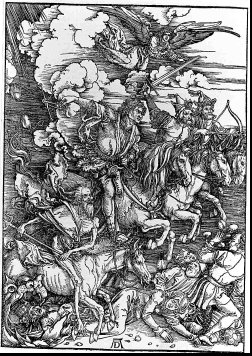 |
The most common representation of historical eschatology is the Christian apocalypse. The concept of the Christian apocalypse originated in the ancient pre-Islamic religion of Iran, Zoroastrianism. It dates approximately 6th century BC. Zoroastrianism's notion of the final judgement seeped into Judaic world view. With the coming of Jesus Christ the Judaic religion was split and the apocalypse tradition found another home. Christianity branched from Judaism as it embraced Jesus Christ as the prophesied messiahs sent to usher in a new world. This new religion brought with it a new prophecy of end times. For more information on the history of Western Apocalypse, please refer to this timeline.
The Christian apocalypse is contained in the Book of Revelations. This book describes the moments leading up to the final battle as well as describes the results. It prophesies that the signs of the coming end will be sharp increase in the presence of evil on earth. Satan will appear to rule the earth and most people will follow him. There will be only 144,000 people who will remain faithful to God. These people have been chosen since the beginning of time and will be spared from the final battle. Once these people are removed from the battlefield Jesus will return to the earth from the heavens. He will be riding a white horse and will be followed by the rest of God's army. Satan will be defeated and he will be tied up for 1000 years. In this 1000 year period the earth will be a paradise enjoyed only by the 144,000 chosen people. After 1000 years Satan must be released. He will again proceed to corrupt the world. This time however fire will come from the sky and kill all evil. Satan will be thrown into the lake of fire and sulphur where he will suffer for eternity. Then the final judgement of all the dead will take place. Those who have done good will live with God in a paradise. The others will join Satan in the lake of fire and sulphur where they will suffer eternally. |

