Although there has been no systematic research on the territory of Calatele township from the archeological point of view, still, after some diggings, most of them done by mistake, in the hearth of the villages were discovered important remnants, sign of the human presence in this area since the New Stone Age (period of the primitive commune history situated between Mesolithic and Paleolithic, 6500 and 2700 before Christ).
Therefore, over the territory of Calata village, on the hill called Varful Glimeii has been discovere a Neolithic establishment that was part of the second phase of Tisa culture (when the sedentariness is emphasized and when the copper working begins for small tools and adornments). There were identified six circular hovels, redused as dimension, with ceramics and lithic tools.
Over the territory of Calata village as well, have been discovered casually two Neolithic axes made of quartzite, one of them polished and the other one was hammer shaped and had a flat scruff.
Over the territory of Valeni village have been discovered ceramic fragments with indentures and stripes that belong to the Cotofeni culture (transition period from the late Neolithic to the early Bronze Age, 1900-1700 before Christ, the bearers of this civilization being the Indo-European tribes). In 1831 there have been discovered three golden knot rings (which are kept today at the museum from Vienna). Another similar knot has been in the museum from Budapest since 1898. These objects belong to the Bronze Age (1700-1150 before Christ).
Two axes found over the territory of Valeni village, one made of amphibolite, found in 1876 and one made of stone, found in 1879, also belong to the Cotofeni culture, a transition phase to the Bronze Age.
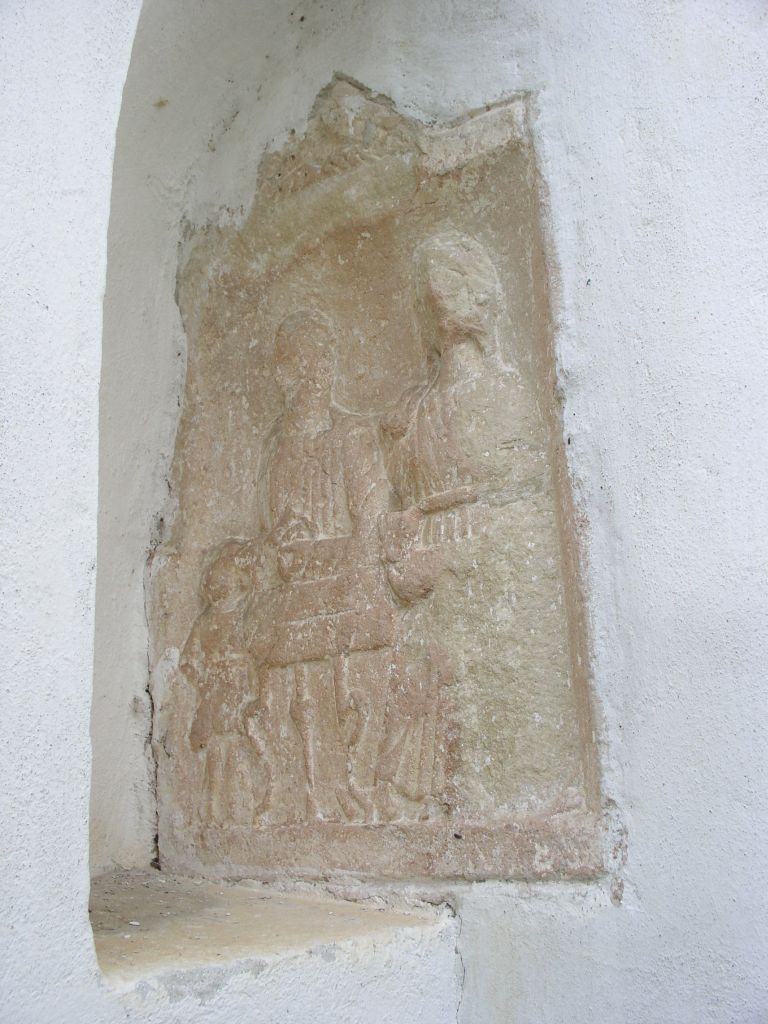
In the southern wall of the church from Valeni there is built a funeral relief from the Roman age. The relief of unknown origin represents two feminine figures. The research from 1906 revealed the fact that in Valeni there has been a Roman establishment. It is very likely that the area was inhabited by the free Dacians.