HOME | COMPLEXITIES | LABORATORY | TIPS | CLICHES | NEW FORUM | CLUB 57

click a pic for a tip |
|
| Buzzer Blades | 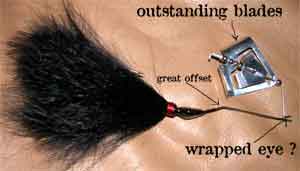 |
| Spoon Trailers | 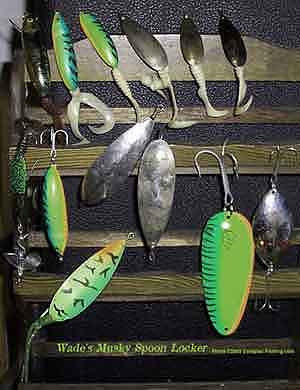 |
| Reef Hawgs |  |
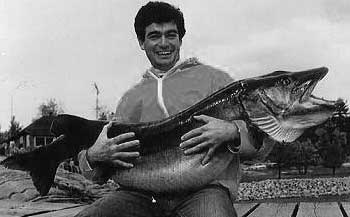
RELEASING YOUR TROPHY
"I'm fairly new to Musky fishing (2 years) and the lakes I have fished in Southern Wis. typicaly don't have large fish. My personal best was 32" CPRd. I have that big chance to fish the Chippewa Flowage in 2 weeks. Can anyone offer some advice on how to handle a large fish without harming it, or myself, in case I'm fortunate enough to catch one. Thanks in advance, Mark"
"Mark,
Glad you asked because I suspect there are a couple of people who are wondering the same thing. Think about that 32". It probably jumped and thrashed. Try to remember some of the traits of that C&R.
Now imagine that fish at 20-30 pounds. The sheer strength of this size of musky is exponentially greater. Plus the possible torque generated by any twists and turns of a big fish is also something to consider, especially if this fish is removed from the water (photos, hook removal unable to be performed in the water). Many experts have become very adept at a net free C&R which doesn't scar the fish in any way beyond the battle and hookset (usually), but requires a LOT of experience. I recommend using the right (but fairly common & affordable) tools for the job:
Very long needle nose pliers (some even prefer channel locks). Jaw spreaders. Some prefer a protective glove (for gripping the gill plate under the jaw). I would recommend a deep basket net with a big hoop (Beckmann makes a nice one but I've seen people use salmon or striper nets as well. The main thing is it's big & sturdy. Some have push in or collapsing handles to help with space in the boat.) Heavy gauge wire cutters for cutting hooks if needed (to save a fish or a fisherman).
Get some thin nylon rope and do yourself a favor and tie it to the ends of your pliers and spreaders and make a tether for them somewhere in the boat. Muskies can throw these tools and it will save you replacement costs if it did. Also, being prepared in advance is a good idea. Do you have a first aid kit for the boat? It's a good idea. How about some type of measuring tape already laid out in the boat? (Or mark some lengths on an oar or rail/seat, etc. somewhere in the boat.) The floating measuring sticks are great but a yard stick floats and those old wood carpenters rulers work too. As you may have guessed, getting the fish to cooperate won't usually happen.
If you're with a fishing partner they probably should be on net duty. If it's just you, that big net will be an extra bonus. Depending on the type of gear you're using and the distance the fish hit from the boat + fish size, you will have a variable battle time. Heavier gear usually means quicker releases and much greener fish. Lighter gear usually results in longer battles (with a greater chance of losing it) and fish that are much more beat. Is your gear musky ready? At least one good rod & reel with decent line (at least 30# test) and good leader is a must. Spinning outfits are usually much too light so I tend to use level wind bait casters. I use some old Abu Garcias made in Sweden my Dad gave me in the 60s and with good maintenace they still work perfectly today, so my loyalty goes to the baitcaster as reel of choice.
Now for the fun part. You've got a beauty on the line. You've managed to weather the jumps, the line wraps and mega-boils, the dive to the bottom and the dash for the motor prop and somehow you've still got this fish (make sure that drag is working right before you go out fishing). And after time resumes moving, you find yourself with a big fish in your net. Leave the fish in the water, in the net. As they say, it's the head part that breathes. Hit the free spool if you forgot. If the fish jumps the net you'll be glad you remembered to do this. The fish should calm down and your strategy is to get those hooks out, without hurting yourself or the fish. Spreaders help here, because they'll allow you to access the hooks and keep the fish from deciding you can't have that bait back. If it's a good catch you'll free the hooks with little damage to anything. If it's multi-hooked or deeply hooked you may need to cut the hooks out with your cutters. Those hooks are easily replaceable and the remaining metal will dissolve.
Let's say for brevity's sake all's gone well. Hopefully you're prepared for pictures if you're planning on taking them. (Of course, the curse of the camera is a powerful thing. I've caught an awful lot of my fish when I forgot the camera bag and can't count the number of skunkings when I was prepared. If you're not superstitious, make sure the film, batteries, lens, etc., are good to go BEFORE you hit the water.) Make those pics quick. Hold your breath. If you can't return that fish to the water by the time YOU need to breathe, chances are it really wants to breathe as well and will play a big part in a successful C&R. The pictures are nice for everyone else but trust me when I tell you this, you'll always remember that first big one!
While the fish is free and ready to go, hold it by the tail keeping the fish upright and glide it forward and back getting water passing through it's gills. As the fish revives you'll feel this strength return. When the fish wants to swim off on it's own power you'll know but once in a while they stay put. Give a little squeeze to the tail section (not the actual tail but the skinny part that meets the tail). Sometimes it wakes the fish up and they splash off leaving you fresh for the next one. Keep an eye on that fish to make sure you got it revived and you'll probably watch it slink away in good shape.
Whew! Hope I didn't leave out the important parts? But if memory serves me, this worked for me when I was actually catching musky. Remember, a legal on Chip is 45".
It's big fish time and the Chip is a great place this time of year. I doubt you'll be disappointed even if you don't raise a monster. It'll probably be a good time for Bobbie baits and Suicks (use natural colors) and bucktails in black w/green blades or white (hot this year). If the amazing warmth continues and fish are active without turnover - Hawg Wobblers, Creepers and Globes may still be working. Look for the freshest green weeds not the dying stuff. Of course, everyone's screaming use a sucker by now. If you do, please use a quick-strike rig. The water's still low so be careful. When you get back, let me know how you did.
And by all means, read the post by suckerchucker on turnover on this board if you're not familiar with it, as the first week of October can be tricky or amazing.
Hope this helps get the mental prep done. Good luck to you. -Wade"
Larry Ramsell/Moderator 9-18-03
2. "RE: New to muskies" In response to message #1
"Wow! What a great and detailed response from Wade. Great job Wade!!
If I may Mark, I would like to add a couple of details/thoughts myself and "tweak" some of Wade's ideas:
If you are by yourself, a camera with a 10 second delay timer is great for taking self photo's. Find a solid place in the boat to set it an appropriate distance from where you will be "handling" the fish so that it will get you and the fish in the picture. Not the easiest thing to do when excited, so work it all out ahead of time. 10 seconds isn't long to get ahold of a good fish and get it up for a photo, especially if you are inexperienced, so perhaps just lifting the net with the fish in it would be the easiest/best/safest thing to do.
If you don't already have a good/big net, I STRONGLY recommend (and use) the new Beckman "Fin Saver" (the Pro model is big enough, but they do have one bigger). The mesh is much smaller to prevent splitting the fishes fins and tail and it is rubber coated. The net bag is straight sided and has a flat bottom and it works just like a "holding pen" beside the boat allowing the fish to stay in the water and breathe without getting stressed.
Don't skimp on bolt cutters! Cheap ones do not easily cut heavy muskie lure hooks. Knipex (if you can find them) is far and away the best (about 40 bucks). A modest price to pay to save a fish!
To elaborate on reviving the fish (if necessary), when you "move" them back and forth in the water, do NOT pull them backwards too fast as you could damage the gills. It is the forward movement that forces water and oxygen thru the gills. If the fish can stay upright on its own, and is breathing (the mouth and gills are moving) moving them shouldn't be necessary. Just maintain control of the fish by holding the tail until it regains it composure/strength. When you feel the fish is ready, just tap the dorsal fin with your hand and prepare for a bath, as they will ususally explode and take off. If the fish cannot remain upright on its own, you may need to "burp" it to remove the excess air from its air bladder (which is below center and can cause a tired fish to roll upside down). To do this, hold the fish's back against the side of the boat, hold the tail with one hand and take the other and starting at the anal fin end of the stomach, gently push against the stomach while moving your hand up the stomach toward the head. Often you will see the air "burp" from the fish. After that, they should be "good to go".
Good luck and we all hope you get the chance to use all of this information!
Muskie regards, Larry Ramsell www.larryramsell.com"
|
|
|
|
Larry Ramsell's Limited Edition
John Dettloff's musings on Louie tells quite a story about the man and the lore. |
||
© 2006 Complex Fishing/Superclammy, Ltd.
Publishing / All Rights Reserved
|