HOME | COMPLEXITIES | BLOG | LABORATORY | TIPS | CLICHES | CLUB 57
Always click a pic for more details
|
COMPLEXITIES
| 2008 |
HOME | COMPLEXITIES | BLOG | LABORATORY | TIPS | CLICHES | CLUB 57
Always click a pic for more details
|
COMPLEXITIES
| 2008 |
VHS update
A new fish virus was discovered in LakeMichigan and Lake Winnebago in May2007. The virus may also be present in Lake Superior and the Mississippi River.The viral hemorrhagic septicemia virus,or VHS, is not a threat to people whohandle fish or want to eat their catch. However, it can spread easily to healthy fish that eat infected fish or absorb watercarrying the virus.
VHS and YOU Keep Wisconsin’s waters healthy
- You can help prevent the spread of VHS by purchasing your bait from a licensed Wisconsin bait dealer.
- Removing aquatic plants, animals and mud from your boat, trailer and equipment is a good practice when leaving any water.
- Disposing of your bait fish or properly preserving them for future use can help keep VHS from entering into new waterbodies.
Anglers’ favorites like musky, walleye, bluegill and trout are most susceptible to VHS. To keep them healthy and prevent this deadly fish disease from spreading, anglers should not move water or live fish away from a waterbody and they should buy their bait from licensed Wisconsin bait dealers.
For information on specific regulations and the VHS virus inWisconsin, visit dnr.wi.gov/fish/vhs
ESOCID LYMPHOSARCOMA HITS SAWYER COUNTY, WISCONSIN
LOCATED IN NELSON LAKE, CHIPPEWA FLOWAGE, LOWER TWIN LAKE...
Nelson Lake is located roughly 6 miles north of Hayward, Wisconsin in Sawyer County.Nelson just happens to be across Highway 63 from a stretch of the Namekagon River I know best and have fished for both esox varieties. So when I heard that lymphosarcoma has been confirmed in the pike population of Nelson, the news hit hard. It is expected that the Nelson pike fishery will suffer. This will be temporary in the eyes of the WDNR but tragic for anglers fishing there the next few years or even longer. What a shame.Then there's confirmed pike cancer in the Chippewa Flowage. This comes at the same time the DNR finally starts using the Chip as a brood stock lake. Infected pike in Fyke Nets caused the stoppage of musky netting operations for this season. How many more setbacks can Hayward get at once?
Well, to make matters even worse, there are rumors Lower Twin Lake has musky with this disease! As part of the Tiger Cat Flowage, Lower Twin has a very high density musky population. If this is indeed fatal to musky, we should see a dramatic change in this fishery as well. I'll wait to see reports confirming it in the TCF, but for what it's worth, my source is MORE than credible.
Lymphosarcoma, in its advanced state, is usually fatal to pike and is ALWAYS fatal to musky. Now, while Nelson is known for its pike fishing, locals guides speak of a very limited musky population as well. The disease is spread by contact usually thought to happen during spawning rituals. Let's hope the Hayward DNR can get a handle on this situation immediately and get a warning out to the public with some factual information. Frank Pratt, Hayward DNR Biologist, told the Sawyer County Record he sees good news here because lymphosarcoma is species specific. That troubles me because fish management has changed the bass and walleye fishery on Nelson over the years. Is this perceived as an opportunity/window for the latest experiments with the walleye population? Normally I wouldn't suggest something so silly, but, after watching Round Lake and others in the Sawyer County water management district suffer caused by ridiculous biological blunders, I do know better. Frank, if you're reading this, WTF!!!
This disease has been known to be present in pike for over 80 years and is present all across North America including Canadian waters. EL is not a danger to other fish species. It is NOT recommended to consume any infected fish. Of course, if you pulled this fish out of the water would you touch it let alone eat it?!! Man that's one, funky fish.
- Pike with Esocid Lymphosarcoma can't transmit the disease to humans.
- Esocid Lymphosarcoma is caused by a virus.
- It is NOT recommended people consume any infected fish.
- DON'T RETURN THESE FISH BACK TO THE WATER
For more information read: K. Wolf. Fish Viruses and Viral Diseases 1988, 38
LURE PROFILE #1: WEEDLESS SPOONS
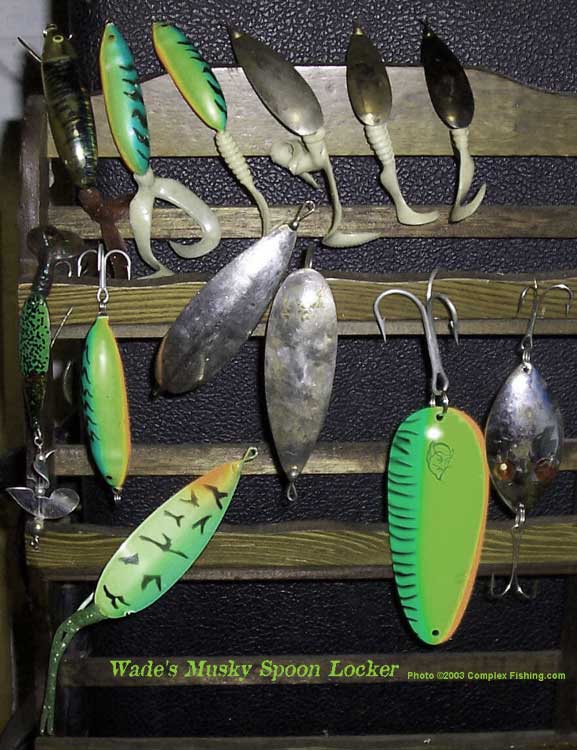
One of my all-time favorite baits (both in confidence and for versatility) is the weedless Spoon:1.25 oz Johnson Silver Minnow or largest Rapala Weedless
2 most productive colors = silver or firetigerAlways tipped with:Mr Twister Twin-tail (in white, black, yellow or brown) with the bulk of the body removed leaving just enough to slide up the hook to the body) or Uncle Josh Pork Frog or Strip or Zoom Power Worm 4" (in sparkle colors especially yellow)Gear I use:6" single-strand 135# bronzed wire leader + split-ring only (ball-bearing swivel between superbraid and leader. (I make my own leaders and shrinkwrap the wire wraps to eliminate line abrasion.)
50 - 80# Power Pro moss or Spectron black spot
Medium action 7'6" FigRig (with balancing kit) + Abu 6500 Ultra cast (or Tica Caiman)Incredibly overlooked casting bait for musky. Fires like a rocket and is very good for pinpoint casting areas like reeds/timber, "slop pockets" or precise weed edge contours. I add the BB swivel because hard twitches can cause the bait to spin and you want the bait to "swagger" and wobble/flutter. By adding a trailer the spoon becomes a bigger target and has increased lift when cranked/twitched. This really comes into its own in big current areas on flowages and rivers. If you pike fish, you know how effective a spoon is and how deadly the flutter can be. This does work on musky too.
Although the straight-crank retrieve (slow to med speed) creates a great wobble and can sometimes out produce any other technique, I tend to favor "twitching" and rarely straight-retrieve my spoons. Since it doesn't float, how you'll twitch your spoon will be dictated by current and trailer selection.
I love fishing current with spoons. Each direction your retrieve takes (with, against or cross-current) will dictate the amount of twitch or cranking speed. When casting, be prepared to work the bait when it contacts the water. Similar to a bucktail, you want to engage the bait on water contact, adding a slight direction change with the first twitch. Subtlety is everything so you'll need a rig with sensitivity and sometimes a rod with a lighter tip can help "soften" your twitching technique. Over-twitching will cause the bait to spin/roll. You want to impart a flutter & swim action and this is where "reading the current" will come into play.
Depending on your lure/trailer choice, current & casting direction will find you varying twitching methods. I like the straight up twitch (pulling rod towards you in an upward motion) but caution is needed to ensure good potential hookset technique. Holding the rod just slightly above the horizontal plane and twitching up with SMALL taps/twitches. The side-twitch (small taps, almost like the motion in using a glider) is another effective twitching technique and allows greater freedom in hookset strategies since a low hookset posture/swing is possible here.
Why am I stressing hookset? This weedless spoon is a single hook bait. Low hooking percentage but extremely HIGH triggering percentage. Why use a single hook bait? I love the challenge don't you??? And, the ACTION (and results) I get. It is one of my favorite bluebird baits. And spring choices. And slop baits. And river baits. And...
In the early part of the 2005 season and bluebird, post-frontal conditions, try a spoon next time you're looking for something new and you're fishing cover/structure. Open water spoons (with trebles) like Eppingers are also great spoons (and are fantastic trolling spoons too) but I wanted to stick with one type/style for a limited condition/approach. My 2 color choices seem to cover all water clarity/conditions and I usually pick a trailer to contrast the body color.
Since there has been a lot of talk about pressure and ways to counter the affects, I would say I rarely see guys throwing spoons. But in my experience, they can produce action on days when everyone else is skunking out and they can be thrown all day long into very tight locations.
And I didn't mention my "Single Hook Theory". We all know muskies can't resist the challunge either!
CURRENT CONSIDERATIONS: Fishing Flowages & RiversI've probably fished flowages and rivers more than any other type of water and one thing I've noticed - expecting muskies to be doing what we think they'll be doing is often a mistake.
Despite traditional theories and techniques (i.e.: fish with the current because predators lie in wait facing upstream), I have often found fish susceptible to presentations going against-current or cross-current. In fact, I tend to work against the current more often than not. It helps to impart/increase lure action and like the oft-mentioned "Hawg Wobbler in the current" approach, fishing against the flow can help create presentational choices.For instance, the against-the-current approach with the "right" lure can impart an illusion of speed. (Jointed cranks for instance.)On one very small river I fish sometimes, I've even found muskies hiding in the current breaks present inside a mini-rapids area where most would be reluctant to fish. The appearance of current can be deceiving from the boat perspective no matter the wind or current conditions.
Wind generated currents have been a hot topic lately frequently discussed by Dick Pearson. IMHO, the "windy side" cliche has its merits to say the least (and who am I to argue with Dick P?) but it is often simply BS. Lest we not forget, Graham Bristow's Geo Bay pig of 2003 (57") came from the calm side of an island on a Depth Raider in heavy wind.
I think current's affect on lure action should be considered every bit as much as "projected" baitfish & predator location. And the seldom mentioned "stealthy nature" of a bait going against the current is sometimes very important (i.e.: you're working water you haven't stirred up or entered yet with your boat/vessel).If the theory/fact that predators face the current is true more often than not, a bait going against the flow will travel over/past a musky from behind. Wouldn't this possibly trigger a response since this fish wouldn't have the luxury of eye-balling your presentation nearly as long?
Well maybe I didn't prove anything but when have any of the opinions out there been validated with empirical data? Afterall, this IS musky fishing... ø/:¬)>
RELEASE STRATEGIESWhile I was fishing I was able to watch a guide put his newbie clients on a dandy 40+ inch Tiger Musky. They were instructed on the fine points of C&R while the new musky angler was allowed to gain release experience. All in all, a potentially happy ending with the fish being released to the waters of Crane Lake, albeit, after a dozen different photo opps.I mention this fish for one reason-
Time OUT Of WaterIn an article I wrote last Christmas titled Ethics Over Ego, I asked the reader to think about the number of pics we all need. If it's not a trophy, is it a personal best or first legal? Or perhaps something else that distinguishes this fish? Surely we do not need a pic of EVERY fish we catch? And how about some in-water pics instead? Muskies, Inc. discussed this very topic back in early summer '04 and agreed that too much time out of water, coupled with vertical holds, is probably a death sentence for the fish. The bigger the fish, the harsher the conditions, the quicker you must return the fish to the water. Which is why an in-water release makes the MOST sense.
Ten seconds out of the water for a quick pic while you hold your fish horizontally is the MOST preferred method for out-of-water pictures. Action shots in the net are the coolest shots in my opinion. Planning your release options and having ALL of your tools ready to go (including cameras) are extremely important components of a musky hunt.
1. BE PREPARED before you get in that boat. Have your release gear ready (and tethered too).
2. Get all camera gear in a usable place.
3. Know where the fish is going.
4. Consider keeping the fish in the water as much as possible, if not entirely. Really!
5. If you fish alone, invest in a tripod and a camera with a timer.
6. Use a net and keep the fish corralled instead of hand landing it.This will help increase the fish’s odds for a successful release. If you never lift the fish out of the water in the net, your fish will not suffer the stress and split fins so common in net landings. To further increase your C&R success, a coated bag is a big aid and pen-style bags really help manage the fish in-water.
7. ALWAYS WET YOUR HANDS BEFORE CONTACT WITH THE FISH! Always please.
8. HORIZONTAL HOLDS ONLY PLEASE!When posing for THE shot, hold the fish in a manner that supports the weight (and internal organs) of the fish and also minimizes your contact with the fish as much as possible. (The hotter the temps the more important this becomes.) The real question becomes, how do you lift a fish out of the net horizontally? Answer: exactly!!!! Not very easy is it? Pictures in-water please!9. Use the “Leech Lake Lip Lock”Wherein the fisher gets a good head grip for control - is VERY important. This will help obtain a good start for your “money shot” and allow for better holds. It's also the best way to hold the musky in your net if hook removal calls for it.10. SMILE! It's not a mug shot. How cool do you think you are? If you want to be a rock star, join a BAND!Congratulations to the lucky angler that caught this fish and the guide for teaching proper technique. Maybe next time, a few less pics will get that fish back in the water a whole lot sooner? And if you happen to see my boat working a drift straight at the area you have just slid into, please also consider the potential cut-off you have just executed. Who knows, next time, my picture example will be YOUR poor manners!
WARMING UP WITH THE OTHER ESOX
Early pike fishing has always helped get me ready. And some of the gear is useable for both fish so you might gain from a little "calibration".
My favorite Springtime cliches:
- Find/fish the green weeds/new growth
- Downsize
- Fish slower
- Don't use topwater
Depending on your water type/conditions these comments are as true as they are bs. (Read our Tips & Cliches pages for more speculation.)
However, I've found that a smaller, slower presentation in fresh greens is actually a great early season strategy. Warm water tends to hold early growth because sunlight is hitting that area, attracting forage. Warm water is always key in opening day strategies.
I'd also watch the weather 2-3 weeks before your trip observing the general climate trend of the spring/late spring transition. Cloudy, cold, wet weeks before opener will create a different set of conditions than a warm & sunny month leading up to the new season. This will give you clues about location/presentation/structure/baitfish, etc. And as for topwater in the cold water of spring? A 6-7 inch walk-the-dog has produced fish for me in water temps over 50 degrees.
My favorite opener baits (casting in stained/flowages):
- Mepp's Musky or Giant Killer (usually black hair and hot or silver blade)
- Superunknown (Homemade) WTD surface glider (green/black)
- Johnson's Silver Minnow (firetiger) + Zoom worm (yellow/sparkle)
- Rapala Super Shad Rap (perch)
- Bomber Jointed Long A (chartreuse)
- Storm Jointed Thunderstick (black/yellow)
- Joe's Bucktail (firetiger blade/black)
- Hirsch's Ghosttail (bronze blade/brown/gray/white)
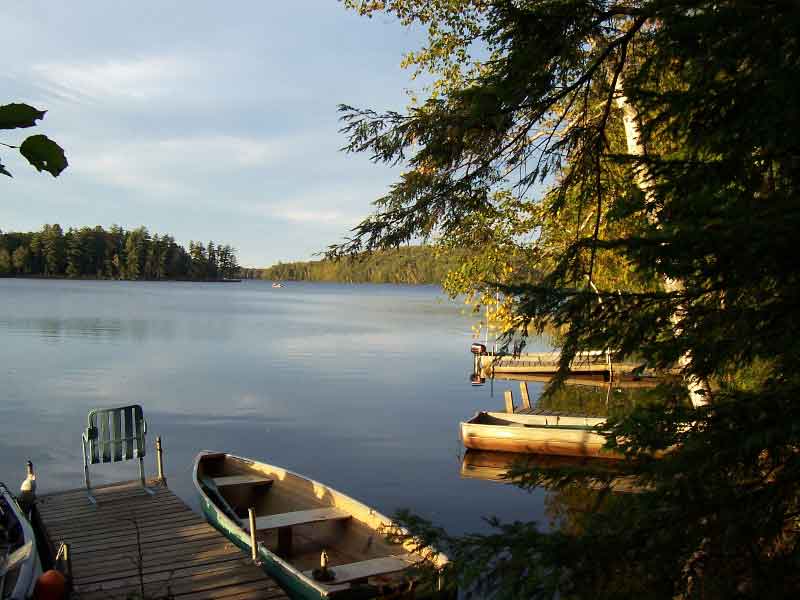
(Photo "Dockside" © 2004 Dinky DeLope)
THANKS!
To ALL of you that have given us a look and a plug.
Owned & operated by Superclammy, Ltd. Publishing USA An Illinois company Since 1995
© 2008 Complex Fishing/Superclammy, Ltd. Publishing All Rights Reserved. All photos © Superclammy, Ltd. Publishing/Complex Fishing and taken by Wade unless otherwise noted. All logos and/or trademarks belong to their respective owners/holders.