HOME | COMPLEXITIES | TIPS | CLICHES | CLUB 57
HOME | COMPLEXITIES | TIPS | CLICHES | CLUB 57
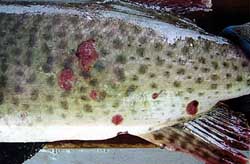
EMERGING DISEASE INFECTS MUSKY IN ST. CLAIR
A rash-like disease called piscirickettsia has been discovered on some muskellunge caught in Lake St. Clair, the state's most popular fishing lake, said Mohamed Faisal, professor of aquatic and animal medicine at Michigan State University. - By Gene Schabath / The Detroit News
Go to the Detroit News article by clicking the lesions pictured above. Yuck!
Technically Speaking
MUSKY DIET STUDIES
Conducted by Tom Burri from University of Wisconsin-Stevens Point Four years of study in 34 Wisconsin lakes.
1092 Muskies were studied and stomach contents were found in 375 of these fish.
The results are as follows (in percentages):Yellow perch, 30.1
Darters, 9.5
Suckers 8.4
Bluegill 7.0
Shiners/chubs 6.0
Crappie 5.7
Sm/Lm Bass 2.9
Crayfish 2.9
Frogs 1.5
Northern/Muskie 1.4
Walleye 0.9
Carp 0.7
Mudpuppy 0.7
Unidentified food 17.2Percentages should be corrected for percent of total VOLUME which makes suckers #1 and perch #2 on the muskie hit list.
"As percent of total volume that any given species makes up in muskellunge diet in northern Wisconsin, here are the numbers:Suckers - 46.6%
Perch - 16.9%
Crappie - 7.0%
Pike / Musky - 4.7%
Various Unidentified Minnow Species - 4.6%
Bluegill / Sunfish - 4.5%
Walleye - 3.4%
Bass - 3.1%
Unidentified Fish - 3.0%
Bullhead - 2.4%
Frog - 0.9%
Cisco - 0.9% (due to time of year and location of capture - ciscoes are deep and fish were captured in warm summer months shallow)
Mudpuppy - 0.6%
Crayfish - 0.4%
Rock Bass - 0.2%
Mouse - 0.2%
Darter - 0.2%
Mudminnow - 0.1%
Tadpole - 0.1%
Carp - 0.1% (due to the absence of carp in most northern Wisconsin lakes * )
* They must not be looking very hard? I see this as another flawed study really but it does give us all some good clues. -Wade
'WHAT IS TURNOVER?'by suckerchucker / aka- Jack Schwab as posted at Pastika's BB
“Turnover” describes an EVENT that actually happens when, as a lake cools during the late fall, the water reaches the same temperature from the surface to the bottom.
First, understand that not every body of water has a “turnover”. Rivers and streams that constantly flow, small “flowages” that are fed and drained by rivers (causing a continuing current) and shallow windswept lakes do not turnover (except in any deeper holes that do not receive much current flow or wind).
We all know that water gets warm in the summer, from increasing air temperatures and the increasing intensity of sunlight. Warm winds add to the heating. If you wade out into a lake in the spring, the surface water is warm, but beneath that warm surface water it is much colder. That is because the surface water absorbs the heat. During the spring and summer, the surface water continues to warm, but that heat takes much time to reach the depths, and the deeper water is ALWAYS cooler than the surface water.
Over the course of the spring and summer, the water will form LAYERS, with the warmest water as the top layer, a narrow middle layer of water where the temperature rapidly CHANGES from warm to cold (called the “thermocline”), and the cold bottom layer. A molecule of warm water actually WEIGHS LESS that a molecule of cold water, so the warmest water molecules are always floating above the colder water molecules, with the “mixing” area (thermocline) in the middle. The warm top layer contains most of the oxygen, caused by surface winds mixing the water and the photosynthesis of plants adding oxygen to the surrounding water as they absorb sunlight. The warmer top and middle layers of water contain most of the plant and fish life, because plants need sunlight and fish need oxygen to live. The cold bottom layer is usually pretty much devoid of fish and plants, because of the lack of oxygen and sunlight reaching those depths. (Some fishable species can and do survive with less oxygen. Catfish and carp, certain members of the trout family and adult northern pike can and do spend substantial time in less oxygenated water during warm months.)
Starting about mid to late August, depending on latitude, the surface water begins to cool, because there are less hours of sunlight (shorter days). As the days continue to shorten, and the water absorbs even less sunlight, shallower plants begin to die. As they turn brown, fall to the bottom and decompose, they actually remove oxygen from the surrounding water, so fish leave those areas and head for deeper cover. The surface water continues to cool, and those molecules of now cooler water drop deeper into the water column, causing the thermocline (middle layer) to expand, and the warm surface layer to shrink.
As days pass, colder fall winds and cold rain chill the surface water even more, continuing to cool the entire water column as the fall season progresses. The warmer top layer of water cools and shrinks, and the cooler middle layer expands.
Eventually, the actual TURNOVER happens. The (by now) cold surface water (top couple of feet) is getting very cold very quickly, and it’s molecules, being heavier, actually fall through the middle layer and mix into the very cold bottom layer of water.
This is “TURNOVER”. (I won’t get into the actual process of WHAT happens, because that won’t help you catch any fish). This usually happens gradually, but CAN happen in a matter of a day or two, or even in HOURS, if a really cold blast of air hits the area, with lots of wind and or icy rain, sleet or snow, and holds for a few days. There is no PARTICULAR surface temperature that causes this to happen, as I’ve seen it occur when the surface temperatures are anywhere from as high as 57 down to about 48 degrees. You should also be aware that not all the waters in your latitude will “turnover” at the same time. Shallower, dark water lakes are first to turn over, and the deep, clear lakes are last.
When turnover occurs, the lake is in turmoil. The top two layers of water now mix with the cold bottom layer, re-oxygenating it, and the temperature equalizes from the surface to the bottom, and fishing generally STINKS! Sometimes, the water does too! The crud that has accumulated on the bottom becomes unsettled, and some of it will actually rise to the surface, and you can actually smell it! It will look like chunks of mossy slime, or just shapeless blobs of crud, and the water column is full of the stuff. On normally clear rocky lakes, you will notice lots of particles in the water, and on highly vegetated, dark water lakes, the water can look like sewage! Fish are impossible to locate, and can be anywhere. This condition usually lasts for about a week.
Hope this clears up the question...- Suckerchucker(You can read his column "Muskies 101" in Midwest Outdoors Magazine)
TURNOVER SCIENCEThe technical aspects of this topic are covered in the research here:
D/O
Dissolved oxygen (DO) refers to the volume of oxygen that is contained in water. Oxygen enters the water by photosynthesis of aquatic biota and by the transfer of oxygen across the air-water interface. The amount of oxygen that can be held by the water depends on the water temperature, salinity, and pressure. Gas solubility increases with decreasing temperature (colder water holds more oxygen). Gas solubility increases with decreasing salinity (freshwater holds more oxygen than does saltwater). Both the partial pressure and the degree of saturation of oxygen will change with altitude. Finally, gas solubility decreases as pressure decreases. Thus, the amount of oxygen absorbed in water decreases as altitude increases because of the decrease in relative pressure.
Once absorbed, oxygen is either incorporated throughout the water body via internal currents or is lost from the system. Flowing water is more likely to have high dissolved oxygen levels than is stagnant water because of the water movement at the air-water interface. In flowing water, oxygen-rich water at the surface is constantly being replaced by water containing less oxygen as a result of turbulence, creating a greater potential for exchange of oxygen across the air-water interface. Because stagnant water undergoes less internal mixing, the upper layer of oxygen-rich water tends to stay at the surface, resulting in lower dissolved oxygen levels throughout the water column. Oxygen losses readily occur when water temperatures rise, when plants and animals respire, and when microbes aerobically decompose organic matter.
Dissolved oxygen may play a large role in the survival of biota in temperate lakes and reservoirs during the summer months, due to a phenomenon called stratification. Seasonal stratification occurs as a result of water's temperature-dependent density. As water temperatures increase, the density decreases. Thus, the sun-warmed water will remain at the surface of the water body (forming the epilimnion), while the more dense, cooler water sinks to the bottom (hypolimnion). The layer of rapid temperature change separating the two layers is called the thermocline.
At the beginning of the summer, the hypolimnion will contain more dissolved oxygen because colder water holds more oxygen than warmer water. However, as time progresses, an increased number of dead organisms from the epilimnion sink to the hypolimnion and are broken down by microorganisms. Continued microbial decomposition eventually results in an oxygen-deficient hypolimnion. If the lake is in a eutrophic state, this process may be accelerated and the dissolved oxygen in the lake could be depleted before the summer's end. As the organic molecules are broken down by microbes, oxygen is removed from the system and must be replaced by exchange at the air-water interface.
Each step above results in consumption of dissolved oxygen. If high levels of organic matter are present in a water, microbes may use all available oxygen.
TEMPTemperature determines many physical characteristics of a water body during different seasons of the year. In the winter, water's temperature-dependent density allows aquatic life to survive. Ice is formed at 0 degrees Celsius. Thus, ice will remain at the top of the water body. Sun shining through the ice will serve to warm the water below slightly, keeping the temperature just above freezing. Water at 4 degrees C is the most dense, and will sink to the bottom and be replaced by lighter 1 - 3.9 degrees C water. The continual process of heating and sinking keeps the water body from freezing entirely.
In addition, temperate lakes stratify during the summer because of water's temperature-dependent density. Stratification prevents the mixing of oxygen and nutrients in the water body, and often encourages dissolved oxygen depletion.
Stratification is a seasonal phenomenon that is the result of the heat of the summer substantially raises the temperature of the upper water layers. As water temperatures increase, the density decreases. Thus, sun-warmed water will remain at the surface of the water body (forming the epilimnion), while the more dense, cooler water settles at the bottom (hypolimnion). The layer of rapid temperature change separating the two layers is called the thermocline.
During the spring, stratification will break down allowing mixing of oxygen and nutrients. As spring approaches, the ice melts and the water body achieves a uniform temperature of 4 degrees C. Any slight wind will create currents that mix the nutrients and the oxygen throughout the entire water body (spring overturn).
During the fall, the water body loses heat until the temperature of the water body is uniform at 4 degrees C. Wind creates circulation, which distributes oxygen and nutrients throughout the water body (fall overturn). Eventually, the surface water layer falls below 4 degrees C, becomes less dense, and remains at the surface. Ice will form if temperatures are low enough; otherwise, this upper layer will remain just above 0 degrees C. Deeper water will remain roughly at 4 degrees C until spring.- Smith, 1990.
SUCKERS ON THE MOVEA lot of you are tossing in those suckers and are also a bit unclear about ILLEGAL aspects of trolling (or how to avoid a violation of the law) in Sawyer County Wisconsin waters.This comes from the WDNR-
"Position fishing is a style of fishing where anglers may maneuver their boat, by a motor, in such a way that allows them to vertically jig lures or still fish with live bait. Boat movements are generally not continuous in a relatively consistent direction, rather the motor is used to maintain the position of the boat over a location or bottom structure.
EXAMPLES - Under this definition, You MAY do any of the following:
1) Use your motor to slowly move around specific structure, fishing with bottom bouncers fished in a vertical or near-vertical presentation;
2) Use your motor to move around specific structure, vertically jigging for fish;
3) Re-position your boat while still fishing with a bobber;
4) Move or reposition your boat to maintain your position around a specific location.
Occasional deviation from a completely vertical presentation of the fishing lines is expected and allowed.Under this definition, you MAY NOT do any of the following:
1) Play out and trail lines from the boat while moving across the lake in a consistent, uninterrupted manner;
2) Use downriggers or planer boards to trail live bait or artificial lures while operating a motor; or
3) Trail a minnow behind the boat while casting an artificial lure with uninterrupted use of a motor;The key in interpreting this rule is a consistent application and understanding of "uninteruppted", which is, of course, difficult!. In my experience, while moving along a weed line, rock bar, point, etc., casting an artificial lure for muskies, the motor is only used to slowly move along the area being fished and it is also helpful for maintaining a desired distance away from the area you are fishing. However, while you may legally cast and retrieve with uninteruppted use of the motor, in my experience, that usually means using an electric motor in bursts for less than about 30 seconds at a time.
My interpretation would be that you may trail a sucker on a second rod while casting and moving along the shoreline, etc., as long as you only occasionally reposition the boat and move slowly along the area being fished, with "short" bursts of an electric motor. Constant, uninteruppted use of the motor (for example, to move to or approach another fishing area with more than about 1 minute of uninteruppted motor use) would require that the sucker be removed from the water before proceeding. A general rule of thumb would be that your motor should be off for more time than it is on while the sucker is in the water. Conversely, if your motor is running more often than not while that sucker is in the water, you should pull the sucker in!Sincerely,Monique Currie
Wisconsin DNR"
White Sucker
Identifying characteristics: Single dorsal fin, sucking mouth with no barbels, long cylindrical body. The white sucker has coarser scales, the longnose has fine scales, but visually, with only one in hand, they are difficult to distinguish.The Catostomidae, or sucker family, is closely allied with the minnow family. Suckers are soft-rayed fishes that possess a toothless, protractile mouth with distinctive thick lips. The longnose and white suckers are two of the most common representatives of this family in Michigan's Great Lakes.
Both the white and the longnose sucker are bottom feeding fish and spend most of their time in shallow, warm waters. In bays, estuaries and tributary rivers, both species make their homes in holes and areas around windfalls or other underwater obstructions. However, longnose suckers have been found as deep as 600 feet in Lake Superior.
As youngsters under 12 inches in length, suckers are eaten by northern pike, muskellunge, bass, walleyes and burbot. Sucker fry are preyed on by Atlantic Salmon and fish-eating birds. Sea lampreys damage sucker populations in areas where lake trout are scarce. As bottom feeders, both species dine exclusively on aquatic plants, algae, and small invertebrate animals - especially worms and crustaceans. White suckers have been accused of consuming large quantities of eggs from more desirable fish species, but there is no conclusive evidence to support this contention. The longnose sucker is not a serious predator of fish eggs.
For more fish identification visit the DNR from Michigan HERE.
Support Project Green Gene
Owned & operated by Superclammy, Ltd. Publishing
An Illinois company.
Since 1995Page designs, images and content by Wade
© 2008 Complex Fishing/Superclammy, Ltd. Publishing / All Rights Reserved
All photos, logo and content not written or produced by SLP belong to their respective copyright holders.