Suggestions for the next library visit.
If you must possess any of these titles, please patronize your local independent book seller. Use the big corporate chains as a last resort.
VELOROO BLOG
Birth of an Empire
 by Conn Iggulden
He was born Temujin, the son of a khan, raised in a clan of hunters migrating across the rugged steppe. Temujin’s young life was shaped by a series of brutal acts: the betrayal of his father by a neighboring tribe and the abandonment of his entire family, cruelly left to die on the harsh plain. But Temujin endured—and from that moment on, he was driven by a singular fury: to survive in the face of death, to kill before being killed, and to conquer enemies who could come without warning from beyond the horizon.
Through a series of courageous raids against the Tartars, Temujin’s legend grew. And so did the challenges he faced—from the machinations of a Chinese ambassador to the brutal abduction of his young wife, Borte. Blessed with ferocious courage, it was the young warrior’s ability to learn, to imagine, and to judge the hearts of others that propelled him to greater and greater power. Until Temujin was chasing a vision: to unite many tribes into one, to make the earth tremble under the hoofbeats of a thousand warhorses, to subject unknown nations and even empires to his will.
Thirteen Moons
 by
Charles Frazier
by
Charles FrazierAt the age of twelve, under the Wind moon, Will is given a horse, a key, and a map, and sent alone into the Indian Nation to run a trading post as a bound boy. It is during this time that he grows into a man, learning, as he does, of the raw power it takes to create a life, to find a home. In a card game with a white Indian named Featherstone, Will wins - for a brief moment - a mysterious girl named Claire, and his passion and desire for her spans this novel. As Will's destiny intertwines with the fate of the Cherokee Indians - including a Cherokee Chief named Bear - he learns how to fight and survive in the face of both nature and men, and eventually, under the Corn Tassel Moon, Will begins the fight against Washington City to preserve the Cherokee's homeland and culture. And he will come to know the truth behind his belief that "only desire trumps time."
The Great Deluge
Hurricane Katrina, New Orleans, and the Mississippi Gulf Coast
 by Douglas Brinkley
First came the hurricane, one of the three strongest ever to make landfall in the United States -- 150-mile- per-hour winds, with gusts measuring more than 180 miles per hour ripping buildings to pieces.
Second, the storm-surge flooding, which submerged a half million homes, creating the largest domestic refugee crisis since the Civil War. Eighty percent of New Orleans was under water, as debris and sewage coursed through the streets, and whole towns in south-eastern Louisiana ceased to exist.
And third, the human tragedy of government mis-management, which proved as cruel as the natural disaster itself. Ray Nagin, the mayor of New Orleans, implemented an evacuation plan that favored the rich and healthy. Kathleen Blanco, governor of Louisiana, dithered in the most important aspect of her job: providing leadership in a time of fear and confusion. Michael C. Brown, the FEMA director, seemed more concerned with his sartorial splendor than the specter of death and horror that was taking New Orleans into its grip.
In The Great Deluge, bestselling author Douglas Brinkley, a New Orleans resident and professor of history at Tulane University, rips the story of Katrina apart and relates what the Category 3 hurricane was like from every point of view. The book finds the true heroes -- such as Coast Guard officer Jimmy Duckworth and hurricane jock Tony Zumbado.
Throughout the book, Brinkley lets the Katrina survivors tell their own stories, masterly allowing them to record the nightmare that was Katrina. The Great Deluge investigates the failure of government at every level and breaks important new stories. Packed with interviews and original research, it traces the character flaws, inexperience, and ulterior motives that allowed the Katrina disaster to devastate the Gulf Coast.
The White Earth
 by Andrew McGahan
When young William's ineffectual father is killed in an accidental fire, he is cast upon the charity of an unknown great-uncle, John McIvor. The bitter, childless old man had been brought up to expect to marry the heiress to Kuran Station-a grand estate in the Australian Outback-only to be bitterly disappointed by his rejection and the subsequent selling off of the land. His life has been devoted to putting the estate back together; he has only recently partially succeeded and moved into the disintegrating, once-elegant mansion, Kuran House.
McIvor tries to imbue the boy with his obsession for the land. He enlists him to work in a crackpot political party he is active in, whose policy is to thwart the aborigines' attempts to recover ancestral territory. For recently-passed laws entitle the native peoples to reclaim certain sacred sites. And McIvor knows that concealed in the heart of his land is a cave that harks back to the Dreamtime.
William's mother desperately wants her son to ingratiate himself, so that he will become John McIvor's heir. But what no one knows, because neither his uncle nor his mother actually see him, is that William is ill and that his condition is gradually worsening.
The Weather Makers
How Man Is Changing the Climate and What It Means for Life on Earth
 by Tim Flannery
Sometime this century the day will arrive when the human influence on the climate will overwhelm all other natural factors. Over the past decade, the world has seen the most powerful El Niño ever recorded, the most devastating hurricane in two hundred years, the hottest European summer on record (which killed twenty-six thousand people in two months), the first South Atlantic hurricane ever, and one of the worst storm seasons ever experienced in Florida. With one out of every five living things on this planet committed to extinction by the levels of greenhouse gases that will accumulate in the next few decades, we are reaching a global climatic tipping point.
The Weather Makers is both an urgent warning and a call to arms, outlining the history of climate change, how it will unfold over the next century, and what we can do to prevent a cataclysmic future. Originally somewhat of a global warming skeptic, Tim Flannery spent several years researching the topic and offers a connect-the-dots approach for a reading public who has received patchy or misleading information on the subject. Pulling on his expertise as a scientist to discuss climate change from a historical perspective, Flannery also explains how climate change is interconnected across the planet.
Along with a riveting history of how climate change has shaped our planet’s evolution, Flannery offers specific suggestions for action for both lawmakers and individuals, from investing in renewable power sources like wind, solar, and geothermal energy, to offering an action plan with steps each and every one of us can take right now to reduce deadly CO2 emissions by as much as 70 percent.
The Pale Horseman
 by Bernard Cornwell
Uhtred, Northumbrian born, raised a Viking and now married to a Saxon, is already a formidable figure and warrior. But at twenty he is still arrogant, pagan and headstrong, so not a comfortable ally for the thoughtful, pious Alfred. But these two, with Alfred’s family and a few of Uhtred’s companions, are apparently all that remains of the Wessex leadership after a disastrous truce.
It is the lowest time for the Saxons. Defeated comprehensively by the Vikings who now occupy most of England, Alfred and his surviving followers retreat to the trackless marshlands of Somerset. There, forced to move restlessly to escape betrayal or detection, using the marsh mists for cover, they travel by small boats from one island to another, hoping that they can regroup and find some more strength and support.
They seek refuge in Athelney, a tidal swamp to which Alfred’s kingdom has shrunk. Uhtred finds himself torn between his Danish foster brother and the winning Vikings, and his growing respect for the stubborn leadership of Alfred. He must decide whether to rebuild the Saxons’ strength from his watery base and help them to take on the Vikings once more.
New Revelations of the Americas before Columbus
 by Charles C.
Mann
by Charles C.
MannTraditionally, Americans learned in school that the ancestors of the people who inhabited the Western Hemisphere at the time of Columbus's landing had crossed the Bering Strait twelve thousand years ago; existed mainly in small, nomadic bands; and lived so lightly on the land that the Americas was, for all practical purposes, still a vast wilderness. But as Charles C. Mann now makes clear, archaeologists and anthropologists have spent the last thirty years proving these and many other long-held assumptions wrong.
In a book that startles and persuades, Mann reveals how a new generation of researchers equipped with novel scientific techniques came to previously unheard-of conclusions. Among them: In 1491 there were probably more people living in the Americas than in Europe. Certain cities-such as Tenochtitlan, the Aztec capital-were far greater in population than any contemporary European city. Furthermore, Tenochtitlan, unlike any capital in Europe at that time, had running water, beautiful botanical gardens, and immaculately clean streets. The earliest cities in the Western Hemisphere were thriving before the Egyptians built the great pyramids. Pre-Columbian Indians in Mexico developed corn by a breeding process so sophisticated that the journal Science recently described it as "man's first, and perhaps the greatest, feat of genetic engineering." Amazonian Indians learned how to farm the rain forest without destroying it-a process scientists are studying today in the hope of regaining this lost knowledge. Native Americans transformed their land so completely that Europeans arrived in a hemisphere already massively "landscaped" by human beings.
Mann sheds clarifying light on the methods used to arrive at these new visions of the pre-Columbian Americas and how they have affected our understanding of our history and our thinking about the environment. His book is an exciting and learned account of scientific inquiry and revelation.
 by James Lee Burke
For Dave Robicheaux, life in Louisiana is filled with haunting memories of the past -- images from Vietnam, the violent streets of New Orleans, and his own troubled youth. In Crusader's Cross, a deathbed confession from an old schoolmate resurrects a story of injustice, the murder of a young woman, and a time in Robicheaux's life he has tried to forget.
Her name may or may not have been Ida Durbin. It was back in the innocent days of the 1950s when Robicheaux and his brother, Jimmie, met her on a Galveston beach. She was pretty and Jimmie fell for her hard -- not knowing she was a prostitute on infamous Post Office Street, with ties to the mob. Then Ida was abducted and never seen again.
Now, decades later, Robicheaux is asking questions about Ida Durbin, and a couple of redneck deputy sheriffs make it clear that asking questions is a dangerous game. With a series of horrifying murders and the sudden appearance of Valentine Chalons and his sister, Honoria, a disturbed and deeply alluring woman, Robicheaux is soon involved not only with the Chalons family but with the murderous energies of the New Orleans underworld. Also, he meets and finds himself drawn into a scandalous relationship with a remarkable Catholic nun.
THE TRIUMPH OF THE SUN
 by Wilbur Smith
In the Sudan decades of brutal misgovernment by the ruling Egyptian Khedive in Cairo precipitate a fierce and bloody rebellion and Holy War headed by a charismatic new religious leader, the Mahdi or 'Expected One'. The British are forced to intervene to protect their national interests and to attempt to rescue the hundreds of British subjects stranded in the country." Along with hundreds of others, British trader and businessman Ryder Courtney is trapped in the capital city of Khartoum. It is here that he meets Captain Penrod Ballantyne of the 10th Hussars, as well as the British Consul, David Benbrook, his comely 17-year-old Rebecca Benbrook; and her younger twin sisters, Saffron and Amber. Against the vivid and bloody backdrop of the siege of Khartoum, in which British General Charles George Gordon is killed and the British retreat, these three powerful men and a woman fight to survive.
 by Paul
Dickson and Thomas B. Allen
by Paul
Dickson and Thomas B. AllenIn the summer of 1932, at the height of the Depression, some forty-five thousand veterans of World War I descended on Washington, D.C., from all over the country to demand the bonus promised them eight years earlier for their wartime service. They lived in shantytowns, white and black together, and for two months they protested and rallied for their cause—an action that would have a profound effect on American history.
President Herbert Hoover, Army Chief of Staff Douglas MacArthur, and others feared the protesters would turn violent after the Senate defeated the "bonus bill" that the House had passed. On July 28, 1932, tanks rolled through the streets as MacArthur's troops evicted the bonus marchers: Newspapers and newsreels showed graphic images of American soldiers driving out their former comrades in arms. Democratic candidate, Franklin Roosevelt, in a critical contest with Hoover, upon reading newspaper accounts of the eviction said to an adviser, "This will elect me," though bonus armies would plague him in each of his first three years.
Through seminal research, including interviews with the last surviving witnesses, Paul Dickson and Thomas B. Allen tell the full and dramatic story of the Bonus Army and of the many celebrated figures involved in it: Evalyn Walsh McLean, the owner of the hope diamond, sided with the marchers; Roy Wilkins saw the model for racial integration here; J. Edgar Hoover built his reputation against the Bonus Army radicals; a young Gore Vidal witnessed the crisis while John dos Passos, Sherwood Anderson, and Sinclair Lewis wrote about it. Dickson and Allen also recover the voices of ordinary men who dared tilt at powerful injustice, and who ultimately transformed the nation: The march inspired Congress to pass the G. I. Bill of Rights in 1944, one of the most important pieces of social legislation in our history, which in large part created America’s middle class.
THE GREAT MORTALITY
An Intimate History of the Black Death, the most Devastating Plague of All Time
 by John Kelly
John Kelly's narrative account of the medieval plague, from its beginnings on the desolate, windswept steppes of Central Asia to its journey through the teeming cities of Europe." The Great Mortality also looks at new theories about the cause of the plague and takes into account why some scientists and historians believe that the Black Death was an outbreak not of bubonic plague, but of another infectious illness - perhaps anthrax or a disease like Ebola. Interweaving a modern scientific methodical analysis with portrait of medieval medicine, superstition, and bigotry, The Great Mortality achieves an air of immediacy, authenticity, and intimacy never before seen in literature on the plague.
FLESHMARKET ALLEY
 by Ian Rankin
A shocking murder in the dark streets of the flesh trade exposes an even more sinister underworld.
On a notorious street where propriety and decadence clash, in the basement of a newly renovated bar, the bones of a woman and child are discovered beneath a cement floor. It's an unusually gruesome find, even for Fleshmarket Alley. When Inspector John Rebus is called to investigate, every fact he finds unleashes a host of new questions. Are the bones those of a mother and child? Are they actual human remains or fakes? Were they planted there - and if so, why?
It could be nothing more than a ruthless and enterprising pub owner looking to create a local legend that will help lure trade. Or it could be something far worse - something as grisly as the death of a recent immigrant found brutally murdered at a local housing project, or the murder of Donald Cruikshank, a recently paroled rapist whose body is found just as a young woman goes missing. The missing girl is a friend of Inspector Rebus's colleague Detective Siobhan Clarke, and Siobhan is shocked to find herself in the same intricate web of murderers as Rebus - all somehow tied to that pile of bones under Fleshmarket Alley.
In a race to stop the killings before more bodies turn up - even as the possibility of romantic entanglements distracts and entices them - Rebus and Siobhan plumb the darkest corners of their beloved city and confront the lawless, conscienceless men who dwell there. Writing with the unstoppable narrative force that has made him one of the bestselling writers in the world, Edgar Award-winner Ian Rankin delivers his most explosive and surprising mystery yet.
THE EUROPEAN DREAM
How Europe's Dream of the Future is Quietly Eclipsing the American Dream
 by Jeremy Rifkin
The American Dream is in decline. Americans are increasingly overworked, underpaid, and squeezed for time. But there is an alternative: the European Dream-a more leisurely, healthy, prosperous, and sustainable way of life. Europe's lifestyle is not only desirable, argues Jeremy Rifkin, but may be crucial to sustaining prosperity in the new era.
With the dawn of the European Union, Europe has become an economic superpower in its own right-its GDP now surpasses that of the United States. Europe has achieved newfound dominance not by single-mindedly driving up stock prices, expanding working hours, and pressing every household into a double- wage-earner conundrum. Instead, the New Europe relies on market networks that place cooperation above competition; promotes a new sense of citizenship that extols the well-being of the whole person and the community rather than the dominant individual; and recognizes the necessity of deep play and leisure to create a better, more productive, and healthier workforce.
From the medieval era to modernity, Rifkin delves deeply into the history of Europe, and eventually America, to show how the continent has succeeded in slowly and steadily developing a more adaptive, sensible way of working and living. In The European Dream, Rifkin posits a dawning truth that only the most jingoistic can ignore: Europe's flexible, communitarian model of society, business, and citizenship is better suited to the challenges of the twenty-first century. Indeed, the European Dream may come to define the new century as the American Dream defined the century now past.
Explorer, Naturalist, and Buccaneer: The Life of William Dampier
 by Diana &
Michael Preston
by Diana &
Michael PrestonCharles Darwin called his books "a mine of information" and took them aboard the Beagle. Jonathan Swift and Daniel Defoe used his experiences as inspiration in writing Gulliver's Travels and Robinson Crusoe. Captain James Cook depended on his observations while voyaging around the world, and Admiral Nelson urged all his officers to study his books. Samuel Taylor Coleridge called him a genius and "a man of exquisite mind." In the history of exploration, few have ventured farther or achieved more than Englishman William Dampier (1651-1715). Yet, whereas the exploits of Magellan, Cook, Shackleton, and a host of legendary explorers have been widely chronicled, those of Dampier have been virtually invisible for more than a century -- an omission that Diana and Michael Preston have redressed in this vivid, compelling life story.
At a time when surviving a voyage across the Pacific was cause for celebration, Dampier journeyed three times around the world, sailing more than 200,000 miles in his lifetime and witnessing people, places, and phenomena no European had seen. As a young man he spent several years in the swashbuckling company of buccaneers in the Caribbean and Pacific, learning to survive in their bloodthirsty, uncertain world, before setting off on his first journey around the globe -- a many-year odyssey, much of it spent in the theretofore mysterious Pacific and Southeast Asia. Later, his best-selling books about his experiences were a sensation; the vividness of his prose and accuracy of his descriptions put armchair readers in the midst of unknown worlds and introduced many words into the English language, including barbecue, chopsticks, and kumquat. Over time, Dampier's observations and insights influenced generations of scientists, explorers, and writers.
Dampier's powers of observation were astonishing. He was the first to deduce that winds cause currents and the first to produce wind maps across the world, surpassing even the work of Edmund Halley. His insights on land were equally astute: For example, he introduced the concept of the "sub-species" that Darwin later built into his theory of evolution, and his description of the breadfruit was the impetus for Captain Bligh's voyage on the Bounty. Dampier reached Australia eighty years before Cook, and he later led the first formal expedition of science and discovery back to Australia. So influential was Dampier that today he has more than one thousand entries in the Oxford English Dictionary. To trace Dampier's colorful life, the Prestons followed his footsteps around the world; interweaving Dampier's colorful prose into their narrative, they bring the same immediacy of his life and times as Dampier brought to his own reading public. A Pirate of Exquisite Mind restores William Dampier to his rightful place in history, as one of the pioneers who shaped our understanding of the natural world.
IN THE MOON OF RED PONIES
 by James Lee
Burke
by James Lee
BurkeIn James Lee Burke's last novel featuring Billy Bob Holland, Bitterroot, the former Texas Ranger left his home state to help a friend threatened by the most dangerous sociopath Billy Bob had ever faced. After vanquishing a truly iniquitous collection of violent individuals, Billy moved his family to west Montana and hung out a shingle for his law practice. But in In the Moon of Red Ponies, he discovers that jail cells have revolving doors and that the government he had sworn to serve may have become his enemy. His first client in Missoula is Johnny American Horse, a young activist for land preservation and the rights of Native Americans. Johnny is charged with the murder of two mysterious men -- who seem to have recently tried to kill Johnny themselves, or at least scare him off his political causes. As Billy Bob investigates, he discovers a web of intrigue surrounding the case and its players: Johnny's girlfriend, Amber Finley, as reckless as she is defiant -- and the daughter of one of Montana's U.S. senators; Darrel McComb, a Missoula police detective who is obsessed with Amber; and Seth Masterson, an enigmatic government agent whose presence in town makes Billy Bob wonder why Washington has become so concerned with an obscure murder case on the fringes of the Bitterroot Mountains. As complications mount and the dead bodies multiply, Billy Bob is drawn closer to the truth behind Johnny American Horse's arrest -- and discovers a greater danger to himself and to his whole family. How Billy Bob strikes back at evil and protects his kin is the masterful triumph of In the Moon of Red Ponies.
 by
Bryce Courtenay
by
Bryce Courtenay
The Year That Rocked the World

by Mark Kurlansky
Everything was disrupted. In the Middle East, Yasir Arafat’s guerilla organization rose to prominence . . . both the Cannes Film Festival and the Venice Biennale were forced to shut down by protesters . . . the Kentucky Derby winner was stripped of the crown for drug use . . . the Olympics were a disaster, with the Mexican government having massacred hundreds of students protesting police brutality there . . . and the Miss America pageant was stormed by feminists carrying banners that introduced to the television-watching public the phrase “women’s liberation.”
Kurlansky shows how the coming of live television made 1968 the first global year. It was the year that an amazed world watched the first live telecast fromouter space, and that TV news expanded to half an hour. For the first time, Americans watched that day’s battle–the Vietnam War’s Tet Offensive–on the evening news. Television also shocked the world with seventeen minutes of police clubbing demonstrators at the Chicago convention, live film of unarmed students facing Soviet tanks in Czechoslovakia, and a war of starvation in Biafra. The impact was huge, not only on the antiwar movement, but also on the medium itself. The fact that one now needed television to make things happen was a cultural revelation with enormous consequences.
In many ways, this momentous year led us to where we are today. Whether through youth and music, politics and war, economics and the media, Mark Kurlansky shows how, in 1968, twelve volatile months transformed who we are as a people. But above all, he gives a new understanding to the underlying causes of the unique historical phenomenon that was the year 1968. Thoroughly researched and engagingly written–full of telling anecdotes, penetrating analysis, and the author’s trademark incisive wit–1968 is the most important book yet of Kurlansky’s noteworthy career.
The Man-Eating Predator in the Jungles of History and the Mind
 by
David Quammen
by
David Quammen
ANY HUMAN HEART
by William Boyd
Love and Vengence in Miami and Havana
by
Ann Louise Bardach
On the Trail of Ancient Roman Tourists
 by
Tony Perrrottet
by
Tony Perrrottet
Global Capitalism and the Death of Democracy
 by
Noreena Hertz
by
Noreena Hertz Of the world's 100 largest economies, fifty-one are now corporations, only forty-nine are nation-states. The sales of General Motors and Ford are greater than the GDP (gross domestic product) of the whole of sub-Saharan Africa, and Wal-Mart now has a turnover higher than the revenues of most of the states of Eastern Europe. Yet few of us are fully aware of the growing dominance of big business: newspapers continue to place news of the actions of governments on the front page, with business news relegated to the inside pages. But do governments really have more influence over our lives than businesses? Do the parties for which we vote have any real freedom of choice in their actions?
Already sparking intense debate in England and on the Continent, The Silent Takeover provides a new and startling take on the way we live now and who really governs us. The widely acclaimed young socio-economist Noreena Hertz brilliantly and passionately reveals how corporations across the world manipulate and pressure governments by means both legal and illegal; how protest, be it in the form of the protesters of Seattle and Genoa or the boycotting of genetically altered foods, is often becoming a more effective political weapon than the ballot-box; and how corporations in many parts of the world are taking over from the state responsibility for everything from providing technology for schools to healthcare for the community.
While the activities of business, frequently under pressure from the media and the consuming public, can range from the beneficial to the pernicious, neither public protest nor corporate power is in any way democratic. What is the fate of democracy in the world of the silent takeover?
Picasso, Modigliani, Matissse, and the Birth of Modern Art
 by
Dan Franck
by
Dan Franck
TRUE HISTORY OF THE KELLY GANG
 by
Peter Carey
by
Peter Carey
Women Approaching Physical Equality
 By
Colette Dowling
By
Colette Dowling The Adventures and Fate of the First English Colonists in America
 By
Giles Milton
By
Giles Milton
Taking Aim at the Brand Bullies
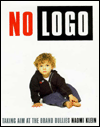 by
Naomi Klein
by
Naomi Klein  by
Alistair MacLeod
by
Alistair MacLeod  by
Sarah Walters
by
Sarah Walters
Travels Among Serpents
 by
Jeremy Seal
by
Jeremy Seal  by
Bill Bryson
by
Bill Bryson How the Modern Women's movement Changed America
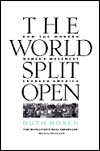 by
Ruth Rosen
by
Ruth Rosen
MARY QUEEN OF SCOTS
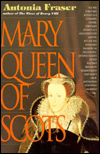 by
Antonia Fraser
by
Antonia FraserTHE RIDERS
 by
Tim Winton
by
Tim Winton 
SOLE SURVIVOR
 by
Derek Hansen
by
Derek HansenHIGHLANDERS
A History of the Gaels
 by
John Macleod
by
John Macleod
 by
James Kelman
by
James Kelman
homehistorytenetssplendid
links vox archives communiques
to the clanmahir gallery
lassiesS.I.M.telegraph