Welcome, everyone and anyone. Here and only here will you find the long-sought and ever-elusive information regarding the Carnivorous Tree Octopus.
Widespread are the legends of the creature. They tell of men strolling peacefully and contentedly through forests, when they are voraciously pounced upon. An allegedly colossal octopus wastes no time in consuming a man, its large mouth sliding easily over the unsuspecting man's head. Eight writhing tentacles make short work of one man's body, helpfully stuffing and shoving the man's briefly struggling body into the clasp of the deadly cephalapod.
Though these sublunar, once-aquatic animals do consume humans, they feast primarily upon large mammals, such as deer. Generally, they drop from the trees onto a protrusion an animal has, such as our conveniently located head. The fall often results in a failed capture, but powerful tentacles make escape extraordinarily difficult, and the octopus's great size enables its great speed.
Ground attacks occur as well, so shunning trees isn't a flawless safeguard against them. Occasionally they do lash out a few tentacles from under a log or some object, with the remaining tentacles gripping the ground securely. Many an unfortunate mammal has been caught in this way.
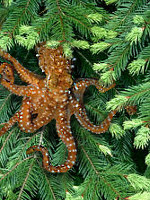
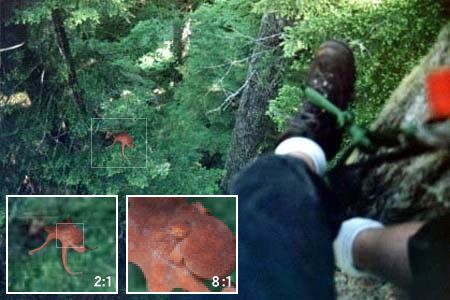
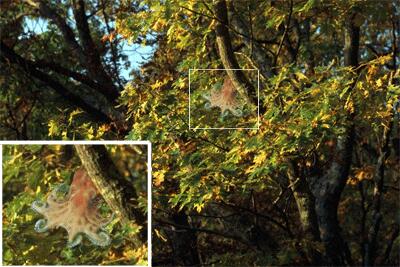
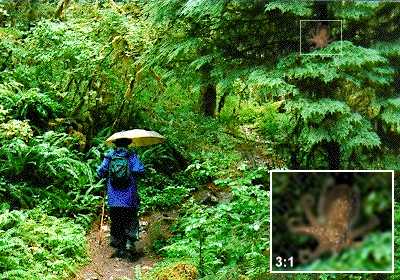
When dormant, the octopi generally take on an orange and pink form (see photos). However, like many octopi, these tree-dwellers do possess the ability to camouflauge themselves, a handy possession when plotting murder.
Certainty can not be had as to a Carnivorous Tree Octopus' full size when the survivors are at a minimum (zero) and other information is severely restricted.
Other capturing techniques exist, as can be assumed considering the intelligence of an animal like this. Often, an octopus can conceal itself within the boughs, branches, and leaves of a tree. Little difficulty is what the octopus has as its powerful tentacles grip a hopeless mammal or man and hoist it, writhing, upwards. A beak bite and some tentacle constriction and the prey is swiftly done for.
The least often used technique of catching large mammals is also, perhaps, the most interesting. Occasionally a Carnivorous Tree Octopus will fasten one or two of its strong tentacles to a distant tree branch, extending them taut, while keeping its weight on the branch it is perched on. If an unlucky mammal happens to stray near that far away tree, the octopus shoves itself off the bough its on and, swinging from the second branch, flings itself into the warm-blooded fool and collapses on it, crushing its life out as fast as it can. This style of killing is especially useful for killing large prey that can escape easily, such as elk.
More is to come... |