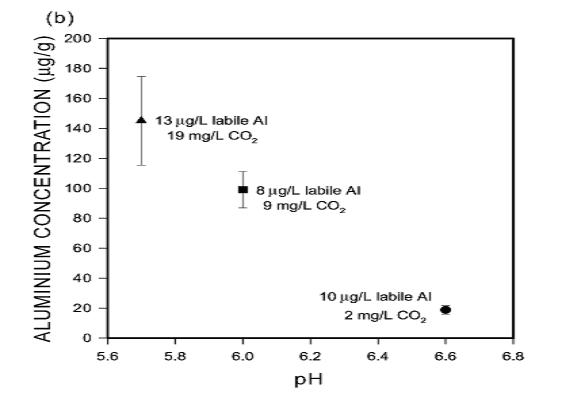
Aluminium (Al) is one of the important factors in the toxicity of acidified waters to freshwater fish species because low pH and high concentrations of Al have been of particular concern in affected waters. Al mobilization in its soluble forms from soil to aquatic ecosystems is an important consequence of acidification of lakes and steams. There are different soluble forms of Al toxic to aquatic biota that may pass onto wider food wed becoming potentially toxic to all living organisms including human through bioaccumulation and biomagnifications processes. Gills, skeleton, kidney, liver and muscles are the main target organs for Al toxicity; former three being more susceptible. The effects of pH and Al on fish vary not only from species to species but also among different life stages. Though relationship between Al and toxicity has been well understood, to know the mechanisms through which Al exerts its toxic properties needs more research. Liming, shell-sand filter and additions of seawater, uses of silicon are some of the important processes used for the detoxification of acidity and Al. Aluminium (Al) is one of the most frequent elements appearing in the biosphere (Poleo, 1995; Gromysz-Kalkowska and Szubartowska, 1999; Weng et al., 2002). It is one of the important factors in the toxicity of acidified waters to freshwater fish species (Poleo et al., 1997). The relationships between Al chemistry and toxicity is now well understood, still a lot remains to be done in knowing the mechanisms through which it exerts its toxic properties (Berthon, 2002). Acid precipitation has led to increasing concentration of several trace elements including Al in rivers and lakes which may cause fish death (Reitz et al., 1996; Alloway and Ayres, 1997). The concentration of Al in rain at about 0.012 mg/l may reach a level of 0.45 mg/l in soil solution and 0.14 mg/l in streams, the mobility of which (Al3+) increases at pH > 4.0 (Alloway and Ayres, 1997). Many different forms of aqueous Al compound are considered toxic to aquatic biota including fish. Low pH and the high concentrations of certain metals have been of particular concern in affected waters (Engleman and McDiffett, 1996). Although the involvement of Al in biological systems is very low (Williams, 1996), it has been recognised as an important toxic agent to large parts of aquatic as well as terrestrial ecosystems (Rosseland et al., 1990; Rodushkin et al., 1995). On the other hand, the aqueous Al might have positive effects on Atlantic salmon mainly to reduce ectoparasitic (Gyrodactylus salaries) population provided that the fish population itself is not affected (Soleng et al., 1999). The paper mainly discusses the toxic effects of aqueous Al on fishes in acidic water. An attempt has been made to describe the toxic forms of aqueous Al (speciation); bioaccumulation and bioavailability; target organs on fish; combined effects of acidity and aluminium (including mixing zones); and the processes of detoxification. The paper finally ends with a conclusion. The soluble Al includes free Al3+ [Al(H2O)63+] ion, monomeric inorganic complexes (with OH- and F-), fine colloidal mineral Al and Al associated with dissolved organic matter (Weng et al., 2002); the free Al3+ being seasonally variable probably due to microbial nitrification and the resultant soil acidification (Umemura et al., 2003). The most toxic forms of Al are known to be aqueous hydroxo-Al species [Al3+, AlOH2+ and Al(OH)2+], but the complexing agents like organic acids and fluorides (Al-Org and Al-F) can greatly decrease the toxic forms (Bi et al., 2001). Among different forms of Al species, Al-Si complexes (the non-toxic species) can be an important part of the total dissolved Al concentrations (as much as 50 %) showing great influence of silica on Al and cannot be discarded as in the past (Boudot et al., 1994; Neal, 1995). Industrial waste is one of the main reasons for water pollution by Al. In addition to high Al concentrations in water polluted by industrial sources, ecologically significant toxicity of Al has been caused by acid rain (Rosseland et al., 1990). Combination of some other natural factors like poor acid soils, presence of wet moors and peat bogs are also responsible for presence of Al in water because the geology of the area influences Al concentration in addition to mineralization and the pH of the river (Guibaud and Gauthier, 2003). Labile Al can enter into the food chain and thus can pass onto different trophic levels becoming potentially toxic to all living organisms including human beings (Drabek et al., 2003). Poleo (1995) describes the process of Al polarisation as the main mechanism of acute toxicity of Al to fish, disagreeing with the precipitation of solid Al(OH)3 or cellular internalisation of Al3+. High concentration of Al in water has strong correlation with Al accumulation in fish organs like kidney, skeleton and gills whereas liver and muscles accumulate relatively low concentrations (Figure 1). Such an accumulation in different organs may have some negative effects depending on total Al concentrations unlike direct toxic effects of ionic Al forms (Rodushkin et al., 1995). It has also found to be associated to the brain and heart of the rainbow trout due to chronic exposure resulting in the systematic accumulation causing a distinct neuropathology in the brain (Exley, 1996). It mainly reduces the number of skin mucous cells associated with the overall mucification of skin and gills and finally reduces the activities of gill enzymes leading to osmoregulatory failure (Rosseland et al., 1990; Berntssen et al., 1997; Exley, 1998). Though Al accumulates in different organs of the body mentioned above, it has profound effects on the gills, the most sensitive organ; and three main consequences of toxic effects on fish can be documented (after Rosseland and Staurnes, 1994; Havas and Rosseland, 1995) as: 1. Respiratory disturbances due to interlamellar mucous clogging, Al precipitation and reduced membrane fluidity; 2. Osmoregulatory disturbances due to net loss in ion uptake (Na+, Cl- and Ca2+) caused by Al binding to gill surface, intracellular Al accumulation, increased membrane permeability and damage of epithelium; and 3. Circulatory disturbances characterized by very high levels of hematocrit due to reduced blood plasma volume, erythrocyte swelling, and release from spleen. Fig. 1: Al concentrations in water and fish organs of the Kola North lakes. Source: Rodushkin et al. (1995). The mobilisation of Al in soluble forms from soil to the aquatic ecosystem is an important consequence of acidification of lakes and streams (Radic and Bralic, 1995; Rodushkin et al., 1995; Williams, 1996; Alloway and Ayres, 1997; Goulding and Blake, 1998; Stutter et al., 2001; Palmer and Driscoll, 2002; Driscoll et al., 2003). The pH and concentration of inorganic monomeric Al are the key factors for toxicity in acid water (Rosseland and Henriksen, 1990). Al concentration in water is inversely proportional to pH, i.e., Al concentration decreases as water pH increases (Guibaud and Gauthier, 2003); and its solubility increases dramatically below about pH 4.5 and become the most important factor responsible for fish kills in acidified lakes (Walker et al., 2001). Acid precipitation associated with the combustion of the fossil fuels is, therefore, one of the responsible factors for increasing Al concentration in lakes and rivers that eventually cause death of fish (Reitz, et al., 1996) because low pH and high concentration of inorganic monomeric Al affect nearly all levels in the physiology and behaviour of fish (Rosseland and Henriksen, 1990). Exposure of fresh water fishes to elevated concentrations of Al is also due to the leaching of Al from soils and sediments (Cronan and Schofield, 1979). Similarly, the episodes like rainstorm high in sea-salts in coastal areas (with acidic soils) causes increase in acidity and Al concentration in the discharge, e.g., in January 1993, the Lake Terjevann catchment was found to be exposed to an extraordinary high sea-salt loading causing in Cl- concentration doubled and labile inorganic Al (Ali) quadrupled which persist for many months with serious toxic effects on aquatic biota before returning to pre-event level (Andersen and Seip, 1999). In another study by Bjerknes et al. (2003), acute mortality of Atlantic salmon has been recorded from fjord-based fish farms in western Norway, often related to snowmelt and heavy rainfall during the winter, probable cause being the increased mobility of reactive Al (Ala) and increased Al accumulation on gills during flood episodes. Although the effects of Al on physiology of some biota (e.g., growth on algae) is highly pH dependant, the effects of acidification at the biological surface are much more important than are its effects on Al speciation in the solution (Parent and Campbell, 1994). This is also supported by a fact that underestimation of inorganic Al by traditional methods can be corrected by estimating gill-Al as a valuable indicator of inorganic-Al in rivers (Rosseland et al., 1999/2000; Kroglund et al., 2001b). In addition gill-Al is valuable in monitoring effects of Al at concentration close to or below the analytical detection limit because even very low concentrations of Ali (6�2 mg l-1) can reduce marine survival of Atlantic salmon (Kroglund and Finstad, 2003). The extent of the effects of pH and Al may vary among species to species, among life stages as well as between sex. For example, Keinanen et al. (2000) compared the responses of acidic water and Al on the newly hatched yolk-sac fry of an acid tolerant species, pike, and acid-sensitive species, roach. Roach developed symptoms like decrease in swimming activity, the rates of ventilation, oxygen uptake, yolk absorption and growth as well as reduction in sodium influx in addition to the fry death at Al concentrations of 50 mg l-1 and pHs 5.25-6.7 in a 1-day test. Whereas pH down to 4.0 and Al concentrations up to 600 mg l-1 caused only partial mortality in pike during a 10-day exposure. The critical chemical limit may also vary among different life history stages of fish populations, e.g., size-dependant sensitivity: small fish were more sensitive to pH while large fish were more sensitive to Al (Rosseland et al., 2001). Furthermore, there were indications that a larger sensitivity to acid water with elevated aluminium in females than in males in Atlantic salmon (Ytrest�yl et al., 2001). Sub-lethal levels of Al can alter the energy budget of Atlantic salmon living in acid surface waters (Brodeur et al., 2001); the combined effect of which with the build-up of carbon dioxide and reduced pH may be detrimental to Atlantic salmon smolts at very low concentrations as shown in figure 2 (Fivelstad et al., 2003). Fig. 2. Accumulation of aluminium in the gills for the three groups and physiological parameters of Atlantic salmon smolts for the control group (�), the medium carbon dioxide group (g) and the high carbon dioxide group ( ? ). Source: Fivelstad et al. (2003). It has also been documented that the decrease in acidification permits the reestablishment of a viable population of fish species in river. Kroglund et al., (2001a) found re-existence of salmon fries in the River Otra, Norway from 1995 where its population was lost during the 1960�s due to acid rain and industrial and municipal pollution. The reestablishment of the salmon population was mainly facilitated by reduction in acid deposition causing a rise of pH from 5.2 to 5.7 and reduction in inorganic monomeric Al from 71 to 28 mg Al l-1 above the industrial area during last ten years. Similarly, significant signs of recovery from acidification have been recorded (by McCartney et al., 2003) in upland Scotland where labile forms of Al and acidity were significantly declined creating a suitable condition for sustainable brown trout population. However, limited availability of spawning fish due to remoteness and physical barriers stop colonisation from other areas for self-recovery, therefore, careful introduction of juvenile fish could be a better way to re-establish the sustainable population (Hesthagen et al., 2001; McCartney et al., 2003). Bioaccumulation of Al by bryophytes was significantly correlated with optimal pH range (4.5-6) and the transplantation of those bryophytes from circum neutral to more acidic sites showed a significant increase of Al in tissues and vice versa (Engleman and McDiffett, 1996). The bioavailability of Al to a grazing invertebrate is influenced by both oligomeric silica and humic acid; and Al bound to humic acid may still be bioavailable via grazing (Desouky et al., 2002). Accumulation of Al in aquatic macroinvertebrates, an important food source to many fish and some birds, may provide a route of entry of Al into the wider food chains (Elangovan, 1999). Accumulation of Al has been identified in birds through the diet (freshwater invertebrates) causing impaired hatching success to the later, thus linking toxic effects of Al between aquatic and the terrestrial ecosystems through food chain (Rosseland et al., 1990). Liming is one of the processes of detoxifying Al following the increase in pH of water indicating the strong influence of pH level in the process (Kroglund et al., 2001b). The detoxification of Al by liming to pH 6.3 was better than to pH 6.1 for the recovery of Atlantic salmon, e.g., return to normal gill morphology, blood homeostasis and establishment of seawater tolerance within 210 hrs of exposure to treatment (Kroglund et al., 2001c). Though the liming increases the pH considerably to the downstream, the mixing zone that occurs at confluence site of acidic river and the limed river (a few seconds after mixing) proved to be highly toxic to fish (�tland and Barlaup, 1995) due to an effect of the transformation of Al into high molecular weight precipitating species causing necrosis and plasma ion loss in the gills, the most sensitive organ (Rosseland et al., 1992), therefore, mixing zones are detrimental to migrating trout (Verbost et al., 1995). Several species of fish including Atlantic salmon and brown trout can, however, avoid the most toxic mixing zones, e.g., acidic water and high Al concentrations (�tland and Barlaup, 1995; Hesthagen et al., 2001). Silicon helps in the elimination of acute aluminium toxicity in fish when silicic acid reacts with aluminium to form hydroxialuminosilicates (HAS), one of the predominant forms of Al in acidified environment, which are extremely insoluble and play an important role in controlling the release of Al from soil to the aquatic environment (Exley et al., 1997; Exley et al., 2002). However, Camilleri et al. (2003), when tested the hypothesis that silica reduces the toxicity of Al, found no significant effects of silica on reducing toxicity of Al at pH 5.0 to a tropical freshwater fish (Mogurnda mogurnda) in Australia as <1 % of Al being complexed with silicate. For culturing Atlantic salmon, Arctic char and brook trout, a shell-sand filter and additions of sea-water were used to neutralize acidic brook water aiming to increase the pH and to reduce the concentrations of labile Al. Absolute (100 %) mortality after 6 days exposure to acidic brook-water showed no mortality after treatment by both of the methods (Rosseland and Skogheim, 1986). Total organic carbon is also an important factor in controlling Al toxicity because of a strong relationship with concentrations of all fractions of Al and is particularly important in controlling the activities of both inorganic and organic Al fractions (van Hees et al., 2001; Stutter et al., 2001; Peuranen et al., 2003). The pH and concentration of inorganic monomeric Al are the key factors for toxicity in acid water. Inorganic monomeric Al affects nearly all levels in the physiology and behaviour of fish; main target organs being gills, skeleton, and kidney. Al toxicity is mostly associated with the acidification because its solubility increases dramatically below pH 4.0 and it becomes the most important factor responsible for fish kills in acidified water bodies. Some episodic events, e.g., snowmelts and heavy rainfall during the winter, rainstorm high in sea-salt have their profound effects in the toxicity due to increase in acidity and Al concentrations in water. Toxic effects of Al may vary among different species and among different life stages of fish. Toxic Al forms from aquatic biota may pass onto the different trophic levels of food chain through bioaccumulation and biomagnifications processes and become potentially toxic to all living organisms including human. Detoxification of Al and acidity has been in use for re-establishing sustainable population of fish, e.g., liming, shell-sand filter, additions of seawater etc. Re-establishment of the viable population of fish is possible in detoxified (or recovered) water bodies provided that the spawning fish species have migratory access to these areas. Alloway, B.J., Ayres, D.C., 1997. Chemical Principles of Environmental Pollution. Second Edition. Blackie Academic & Professional, London SEI 8HN, UK. Andersen, D.O., Seip, H.M., 1999. Effects of a rainstorm high in sea-salts on labile inorganic aluminium in drainage from the acidified catchments of Lake Terjevann, southernmost Norway. Journal of Hydrology 224(1-2), 64-79. Berntssen, M.H.G., Kroglund, F., Rosseland, B.O., Wendelaar Bonga, S.E., 1997. Responses of skin mucous cells to aluminium exposure at low pH in Atlantic salmon (Salmo salar) smolts. Canadian Journal of Fisheries and Aquatic Science 54, 1039-1045. Berthon, G., 2002. Aluminium speciation in relation to aluminium bioavailability, metabolism and toxicity. Coordination Chemistry Reviews 228(2), 319-341. Bi, S.P., An, S.Q., Yang, M., Chen, T., 2001. Dynamics of aluminium speciation in forest-well drainage waters from the Rhode River watershed, Maryland. Environmental International 26 (5-6), 377-380. Bjerknes, V., Fyllingen, I., Holtet, L., Teien, H.C., Rosseland, B.O., Kroglund, F., 2003. Aluminium in acidic river water causes mortality of farmed Atlantic salmon (Salmo salar L.) in Norwegian fjords. Marine Chemistry 83(3-4), 169-174. Boudot, J-P., Merlet, D., Rouiller, J., Maitat, O., 1994. Validation of an operational procedure for aluminium speciation in soil solutions and surface waters. The Science of the Total Environment 158, 237-252. Brodeur, J.C., �kland, F., Finstad, B., Dixon, D.G., McKinley, R.S., 2001. Effects of subchronic exposure to aluminium in acidic water on bioenergetics of Atlantic salmon (Salmo salar). Ecotoxicology and Environmental Safety 49(3), 226-234. Camilleri, C., Markich, S.J., Noller, B.N., Turley, C.J., Parker, G., van Dam, R.A., 2003. Silica reduces the toxicity of aluminium to a tropical freshwater fish (Mogurnda mogurnda). Chemospheres 50(3), 355-364. Cronan, C.S., Schofield, C.L., 1979. Aluminium leaching response to acid precipitation: Effects on high-elevation watersheds in the northeast. Science 204 (4390), 304-306. Desouky, M.M., Powell, J.J., Jugdaohsingh, R., White, K.N., McCrohan, C.R., 2002. Influence of oligomeric silicic and humic acids on aluminium accumulation in a freshwater grazing invertebrate. Ecotoxicology and Environmental safety 53(3), 382-387. Drabek, O., Boruvka, L., Mladkova, L., Kocarek, M., 2003. Possible methods of aluminium speciation in forest soils. Journal of Inorganic Biochemistry 97(1), 8-15. Driscoll, C.T., Driscoll, K.M., Mitchell, M.J., Raynal, D.J., 2003. Effects of acid deposition on forest and aquatic ecosystems in New York State. Environmental Pollution 123(3), 327-336. Elangovan, R., Ballance, S., White, K.N., McCrohan, C.R., Powell, J.J., 1999. Accumulation of aluminium by the freshwater crustacean Asellus aquaticus in neutral water. Environmental Pollution 106(3), 257-263. Engleman Jr, C.J., McDiffett, W.F., 1996. Accumulation of aluminium and iron by bryophytes in streams affected by acid-mine drainage. Environmental Pollution 94(1), 67-74. Exley, C., 1996. Aluminium in the brain and heart of the rainbow trout. Journal of Fish Biology 48(4), 706-713. Exley, C., 1998. The precipitation of mucin by aluminium. Journal of Inorganic Biochemistry 70(3-4), 195-206. Exley, C., Pinnegar, J.K., Taylor, H., 1997. Hydroxyaluminosilicates and acute aluminium toxicity in fish. Journal of Theoretical Biology 189(2), 133-139. Exley, C., Schneider, C., Doucet, F.J., 2002. The reaction of aluminium with silicic acid on acidic solution: an important mechanism in controlling the biological availability of aluminium? Coordination Chemistry Reviews 228(2), 127-135. Fivelstad, S., Waagb�, R., Zeitz, S.F., Hosfeld, A.C.D., Olsen, A.B., Stefansson, S., 2003. A major water quality problem in smolt farms: combined effects of carbon dioxide, reduced pH and aluminium on Atlantic salmon (Salmo salar L.) smolts: physiology and growth. Aquaculture 215(1-4), 339-357. Goulding, K.W.T., Blake, L., 1998. Land use, liming and the mobilization of potentially toxic metals. Agriculture, Ecosystems and Environment 67(2-3), 135-144. Gromysz-Kalkowska, K., Szubartowska, E., 1999. Aluminium - its ecological role and toxicity for animals. Medycyna Weterynaryjna 55(4), 229-223. Guibaud, G., Gauthier, C., 2003. Study of aluminium concentration and speciation of surface water in four catchments in the Limousin region (France). Journal of Inorganic Biochemistry 97(1), 16-25. Havas, M., Rosseland, B.O., 1995. Response of zooplankton, benthos, and fish to acidification: and overview. Water, Air, and Soil Pollution 85, 51-62. van Hees, P., Lundstrom, U., Danielsson, R., Nyberg, L., 2001. Controlling mechanisms of aluminium in soil solution � an evaluation of 180 podzolic forest soils. Chemosphere 45(6-7), 1091-1101. Hesthagen, T., Berger, H.M., Schartau, A.K.L., N�st, T., Saksg�rd, R., Fl�ystad, L., 2001. Low success rate in re-establishing European perch in some highly acidified lakes in southernmost Norway. Water, Air, and Soil Pollution 130, 1362-1366. Keinanen, M., Peuranen, S., Nikinmaa, M., Tigerstedt, C., Vuorinen, P.J., 2000. Comparison of the responses of the yolk-sac fry of pike (Esox lucius) and roach (Rutilus rutilus) to low pH and aluminium: sodium influx, development and activity. Aquatic Toxicology 47(3-4), 161-179. Kroglund, F., Finstad, B., 2003. Low concentrations of inorganic monomeric aluminium impair physiological status and marine survival of Atlantic salmon. Aquaculture 222(1-4), 119-133. Kroglund, F., Kaste, �., Rosseland, B.O., Poppe, T., 2001a. The return of the salmon. Water, Air, and Soil Pollution 130, 1349-1354. Kroglund, F., Teien, H.C., Rosseland, B.O., Salbu, B., 2001b. Time and pH dependant detoxification of aluminium in mixing zones between acid and non-acid rivers. Water, Air, and Soil Pollution 130, 905-910. Kroglund, F., Teien, H.C., Rosseland, B.O., Salbu, B., Lucassen, E.C.H.E.T., 2001c. Water quality dependent recovery from aluminium in Atlantic salmon smolt. Water, Air, and Soil Pollution 130, 911-916. McCartney, A.G., Harriman, R., Watt, A.W., Moore, D.W., Taylor, E.M., Collen, P., Keay, E.J., 2003. Long-term trends in pH, aluminium and dissolved organic carbon in Scottish fresh waters; implications for brown trout (Salmo trutta) survival. The Science of the Total Environment 310(1-3), 133-141. Neal, C., 1995. Aluminium speciation variations in an acidic upland stream draining the Hafren spruce forest, Plynlimon, Mid-Wales. Journal of Hydrology 164(1-4), 39-51. Palmer, S.M., Driscoll, C.T., 2002. Acid deposition: Decline in mobilization of toxic aluminium. Nature 417(6886), 242-243. Parent, L., Campbell, P.G.C., 1994. Aluminium bioavailability to the green-alga Chlorella-Pyrenoidosa in acidified synthetic soft-water. Environmental Toxicity and Chemistry 13(4), 587-598. Peuranen, S., Keinanen, M., Tigerstedt, C., Vuorinen, P.J., 2003. Effects of temperature on the recovery of juvenile grayling (Thymallus thymallus) from exposure to Al + Fe. Aquatic Toxicology 65(1), 73-84. Poleo, A.B.S., 1995. Aluminium polymerization -- a mechanism of acute toxicity of aqueous aluminium to fish. Aquatic Toxicology 31(4), 347-356. Poleo, A.B.S., �stbye, K., �xnevad, S.A., Andersen, R.A., Heibo, E., V�llestad, L.A., 1997. Toxicity of acid aluminium-rich water to seven freshwater fish species: a comparative laboratory study. Environmental Pollution 96(2), 129-139. Radic, N., Bralic, M., 1995. Aluminium fluoride complexation and its ecological importance in the aquatic environment. The Science of the Total Environment 172(2-3), 237-243. Reitz, B., Heydorn, K., Pritzl, G., 1996. Determination of aluminium in fish tissues by means of INAA and ICP-MS. Journal of Radioanalytical and Nuclear Chemistry 216(1), 113-116. Rodushkin, I., Moiseenko, T., Kudravsjeva, L., 1995. Aluminium in the surface waters of the Kola Peninsula, Russia. The Science of the Total Environment 163(1-3), 55-59. Rosseland, B.O., Blakar, I.A., Bulger, A., Kroglund, F., Kvellstad, A., Lydersen, E., Oughton, D.H., Salbu, B., Staurnes, M., Vogt, R., 1992. The mixing zone between limed and acidic river waters: complex aluminium chemistry and extreme toxicity for salmonids. Environmental Pollution 78(1-3), 3-8. Rosseland, B.O., Eldhuset, T.D., Staurnes, M., 1990. Environmental effects of aluminium. Environmental Geochemistry and Health 12(1-2), 17-27. Rosseland, B.O., Henriksen, A., 1990. Acidification in Norway � loss of fish populations and the 1000-lake survey 1986. The Science of the Total Environment 96(1-2), 45-56. Rosseland, B.O., Kroglund, F., Staurnes, M., Hindar, K., Kvellestad, A., 2001. Tolerance to acid water among strains and life stages of Atlantic salmon (Salmo salar L.). Water, Air, and Soil Pollution 130(1-4), 899-904. Rosseland, B.O., Massabuau, J-C., Grimalt, J., Hofer, R., Lackner, R., Rognerud, S., Lien, L., 1999/2000. The ecophysiology and ecotoxicology of fishes as a tool for monitoring and management strategy of high mountain lakes and rivers in acidified areas. Zoology 102(2-3), 90-100. Rosseland, B.O., Skogheim, O.K., 1986. Neutralization of acidic-brook water using a shell-sand filter or sea-water: effects on egg, alevins and smolts of salmonids. Aquaculture 58(1-2), 99-110. Rosseland, B.O., Staurnes, M., 1994. Physiological Mechanisms for Toxic Effects and Resistance to Acidic Water: an Ecophysiological and Ecotoxicological Approach. In: C.E.W. Steinberg and R.F. Wright (Eds.), Acidification of Freshwater Ecosystems: Implications for the Future, pp 227-246. John Wiley & Sons Ltd. Soleng, A., Poleo, A.B.S., Alstad, N.E.W., Bakke, T.A., 1999. Aqueous aluminium eliminates Gyrodactylus salaries (Platihelminthes, Monogena) infections in Atlantic salmon. Parasitology 119, 19-25. Stutter, M., Smart, R., Cresser, M., Langan, S., 2001. Catchment characteristics controlling the mobilization and potential toxicity of aluminium fractions in the catchment of the River Dee, northeast Scotland. The Science of the Total Environment 281(1-3), 121-139. Umemura, T., Usami, Y., Aizawa, S., Tsunoda, K., Satake, K., 2003. Seasonal change in the level and the chemical forms of aluminium in soil solution under a Japanese cedar forest. The Science of the Total Environment. Article in press, corrected proof. Verbost, P.M., Berntssen, M.H.G., Kroglund, F., Lydersen, E., Witters, H.E., Rosseland, B.O., Salbu, B., Wendelaar Bonga, S.E., 1995. The toxic mixing zone of neutral and acid river waters: acute aluminium toxicity in brown trout (Salmo trutta L.). Water, Air, and Soil Pollution 85(2), 341-346. Walker, C.H., Hopkin, S.P., Silby, R.M., Peakall, D.B., 2001. Principles of Ecotoxicology. Second Edition. Taylor & Francis, London, UK. Weng, L., Temminghoff, E.J.M., Van Riemsdijk, W., 2002. Aluminium speciation in natural waters: measurement using Donnan membrane technique and modelling using NICA-Donnan. Water Research 36(17), 4215-4226. Williams, R.J.P., 1996. Aluminium and biological systems: an introduction. Coordination Chemistry Reviews 149, 1-9. Ytrest�yl, T., Finstad, B., McKinley, R.S., 2001. Swimming performance and blood chemistry in Atlantic salmon spawners exposed to acid river water with elevated aluminium concentrations. Journal of Fish Biology 58(4), 1025-1038. �tland, A., Barlaup, B.T., 1995. Avoidance of toxic mixing zones by Atlantic salmon (Salmo salar L.) and brown trout (Salmo trutta L.) in the limed river Audna, Southern Norway. Environmental Pollution 90(2), 203-208. |
| Effects of Exposure to Aluminium on Fish in Acidic Waters Chhatra Mani Sharma Department of Ecology and Natural Resource Management (INA), Agricultural University of Norway (NLH), P.O. Box 5003, 1432, �s, Norway |
 |
 |
| Home | Family | Curriculum | Thesis TU | Thesis NLH | Publications | Term Papers | Recent Paper | Proposal | Nepali Poems |
 |
 |
| You are here: Home>>Term Papers>> Effects of ........ |
| Abstract |
| Introduction |
| Aluminium speciation and its toxic forms in water |
| Target organs on fish |
| Acidification and aluminium |
| Bioaccumulation and biomagnifications of aluminium |
| Detoxification of aluminium |
| Conclusion |
| References |
 |
 |
