
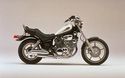
VIRAGO HISTORY
"15 Years of Viragos---Since 1981, Providing that Unique American
Style".
Mention motorcycle to a crowd of motorcyclists,
and Harley-Davidson usually comes to mind. Mention Yamaha
to that same crowd, and look out for a fight. But Yamaha
has been slowly building a heritage of its own around their
Virago line of cruisers.

The 1981 Virago 750 was the original V-twin cruiser from
Japan, and 15 years later it is still, arguably , the most
popular Japanese bike in what has become an American styling
tradition. Back in the mid to late 1970's a new style of motorcycle
began appearing on the American scene - the Custom.
Tired of the Universal Japanese Motorcycle look, owners
were personalizing their bikes themselves. But US-based
stylists for the Big Four kept noticing the popularity of one
home-grown look - the chopper. High, pull-back handlebars,
brightly chromed exhaust pipes, stepped seats with sissy bars
and extended front forks were the rage among customizers.
The stylists pleaded with Japan to offer this flair in a"factory"
package. Hence the Customs and Specials were born.
Based on the Standard models, Customs provided the rider
with extra styling touches like spoked wheels, plush stepped
seats and two-tone paint jobs. They were an instant success,
often out-selling the Standard models they were based on.
But, of course, the most popular bike to customize
continued to be Harley-Davidsons. During that nascent period,
Yamaha's Manager of Motorcycle Product Planning in the U.S.
was Ed Burke. Burke's research found that although riders loved
the look of the UJM-based Customs, they also wished to have the
appearance and power characteristics of an air-cooled V-twin,
but at a better price.
So Burke, working closely with Yamaha's engine designer
"Hap" Ueno, headed up a new project and together they developed
something very unique. The design centered around a75-degree
V-twin with an offset rear cylinder. They figured this layout would
offer the optimum balance of wheelbase, weight bias, and vibration
control while providing improved cooling for the rear cylinder --
Harley-Davidson cylinders are not offset -- they share a crankpin
with fork-and-tongue connecting rods (one rod is normal and the
other is forked on the end so it has two journals and resides
on the same centerline as the other rod).
So in 1981, the XV750 Virago was born. Quite a departure from
any previous Japanese design, the Virago became the first
mass-produced street bike to use a single shock rear suspension.
Other unique styling touches Burke incorporated into the original
design were low-maintenance shaft drive, air-adjustable forks,
cast aluminum wheels, and of course, lots of Custom features -
low-slung frame, high handlebars, stepped seat, and plenty of
chrome. To give the Virago motor that "open air" look, the
engine was hung from the stamped-steel backbone frame in
stressed-member fashion. The unusual frame also doubled as
an airbox, housing the air filter. It was an immediate sales hit,
one that continues today. And it was the start of a importer's
phenomenon - the V-twin cruiser - that had all the other
manufacturers following suit.
Over the ensuing years, the Virago has undergone several
notable changes. In 1982, Yamaha introduced a larger version
of the750, the XV920 Virago.
The 920 offered several deluxe features not found on the 750,
such as dual front discs, adjustable handlebars, and
liquid-crystal display gauges. In 1983, the baby of the family
was introduced, the XV500 Virago. The 750 and 920 Viragos
each came in a Midnight version for 1983, replete with
high-gloss black paint, and blacked-out engines with
gold accents. The troublesome liquid-crystal display on
the 920 was replaced with more traditional analog gauges.
Yamaha brought about a major redesign for both the 750
and 920 Viragos in 1984. Riders wanted the bikes to have
even more custom styling features - like more chrome and
even more of a "chopper-like" appearance. So the air
filters were moved outboard of the engine and chrome
air cleaner covers were mounted over top. The mono-shock
rear suspension was scrapped in favor of exposed, dual shocks
with bright chrome springs and bodies that actually worked
much better than the mono-shock ever did.
The gauges were enlarged for improved readability, and a
"teardrop" gas tank completed the styling make-over. 1984
was also the first year of the Harley-induced U.S. government
tariff regulations, and the 750 Virago was reduced to 699cc to
squeak in under the tariff cutoff. Conversely, the 920 Virago
was enlarged to a full 1000cc, and a secondary, one-half
gallon fuel tank was added under the seat to bolster its
small 3.3 gallon main tank. The Viragos remained unchanged
until 1986, when the 1000 was bumped up in displacement
to 1,063cc and renamed the XV1100 Virago. The secondary fuel
tank was eliminated and the main tank enlarged to 4.4 gallons.
1987 saw the littlest Virago grow to 535cc, and in 1988
the motorcycle import tariff was rescinded, allowing the return of
the 750cc Virago. Other than the introduction of new paint
schemes every couple of years, Yamaha hasn't changed
the Virago since. And why should they?
The classic -- dare we say traditional -- lines of the Virago
series have amassed quite a following in its 15 years,
spawning the Virago Owners Club along the way, and has
become one of the most popular cruiser bikes in history!!!
[Virago Pics!]
[ People pictures!]
[ My littlest Biker!]
[ The Virago History]
[What's New?]
[ Used Bike Checklist]
[ Great Antiques]
[Fractals]
[Better than Guys!]