Section D : Scroll through,
|
|
|
At some point one may ask, 'but where did the wheel die set come from?' This needs a good answer, since the fact is that the die set is of key importance to production of the purifiers. The answer concerns a capacity to make industrial models and molds. This is not necessarily a complex subject, so this background is important. The basics of the techniques outlined here can be learned within a few days or weeks.
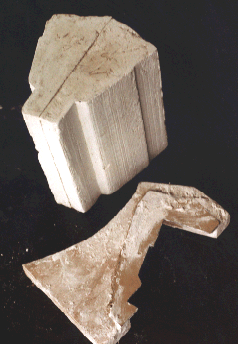
Picture D1 :The model and template for the die, eighth section Plaster-of-paris was used here to make the model for the one eighth section of the die. This model is used to make the two piece mold shown in picture C2, which is in turn used to make the eight pieces for the die set. Picture D2, below, shows the line to follow for the template shown in picture D1. The model is made in two identical halves, which are put together using contact glue. The half sections are made by pulling the template along a straight edge, over plaster that has thickened, and will soon set, so there may be only two or three minutes of working time. Unlike a lot of molds for ceramics, the two piece mold shown does not have a separate, bottom piece. Rather, the two pieces of the mold are placed directly on the table or surface where the job is to be done. So the concrete, from which the die pieces are made, is poured directly onto the surface under the mold. A plastic separator is, however, needed once again, and this is placed under the mold, allowing release when it is time to remove the concrete die piece. |
|
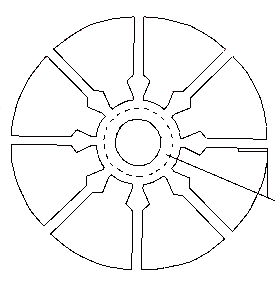
At the center of the drawing in picture D2 is a small circle, representing the inside space of the earthenware purifier. During the pressing this circle will be occupied by the wooden spindle seen in picture B1. The full-sized drawing (outside diameter = 22.5 cms.) can be laminated between strips of transparent tape, and used as a guide for placement of the die pieces, each time a purifier is pressed, or at least while becoming accustomed to the process.
Picture D2 : The original drawing for the die set and individual die piece. A second circle, outside the first is shown as a dotted line. This is the surface to which the purifier will be pressed. So there is a third circle, outside the second, described by the eight 'faces' of the eight pieces of the die set. This means that the entire drawing shows the position of the die pieces for the beginning of the pressing process, at the time the clay material powder is spooned into the cavity. In the tightening of the bolts, which accomplishes the pressing, the eight die pieces move inwards, to stop at the dotted line. The drawing is also necessary in order to make the template shown in picture D1, as can be seen in the bisecting of the die piece at right. The template can be made by gluing this part of the drawing onto a piece of wood, about 3 mm. thickness, then cutting out and shaping the space within. The template in picture D1 was made in this way. |
|
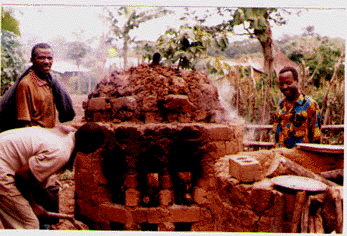
Several hundred common red brick can be used to build this kiln, bricks normally used for building construction. This kiln can be used to fire filters and porous grog disks, upto about 700C.
Picture D3 : A suggested, 'Improved Bonfire Kiln.' The kiln was designed with the aid of the book, An Improved Bonfire Kiln, a publication of the organization, Intermediate Technology of the U.K. The book describes use of the kiln for earthenware water containers, primarily handbuilt. But whatever ware is being fired, this is stacked inside the cylinder of the kiln into a rough dome shape, which is covered with wet clay, straw and broken bricks or pots. The kiln design is also an environmentally responsible improvement in comparison to the use of an open fire. For the improved, cylindrical kiln shown, a higher temperature can be reached using less fuel, also giving increased strength to filters, stoves and other ware. As to disinfection, dilute silver nitrate is applied to the purifiers after a first firing, and just prior to a second. An alternative to this is the application of colloidal silver after a single firing, provided this material is available. But where silver nitrate is used the second firing is necessary in order to burn off the nitrates. This is done at the first visible red, a temperature of about 475C. It is accomplished by filling the kiln with sawdust, or other combustible, then sealing the kiln off from air. The continued combustion seeks oxygen, and pulls this from the inside of the purifiers. Thus the nitrate, which contains oxygen is pulled out of the purifier, leaving silver metal. Attention to safety is a consideration in making silver nitrate. Nitric acid is available from university chemistry departments, as should be the case with the proper skills.
|
|
|
The purifiers are now ready to be fitted with cover caps in plastic buckets. The first water to go through the filter contains extraneous nitrates in small amounts, and should be thrown away. The purifier is then ready for use. But as with several other kinds of production implicit in making the purifiers, it is necessary to begin making silver nitrate. This can be done by purchasing the metal from a jeweler, disolving it in nitric acid, then diluting it to a maximum of 5% solution.
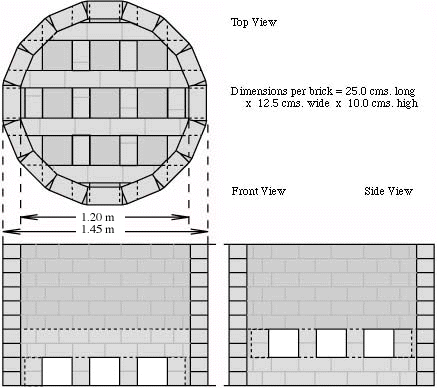
Picture D4 : A plan for a small kiln Picture D4 shows front, side and top section views for a kiln like the one in picture D3. The side view shows three holes, into which wood fuel is placed, and replenished over the course of the firing, about four to six hours. At the front view three holes are also shown, with the bottom at ground level. These three holes allow oxygen to get under the wood fuel, to facilitate improved burning. Note that in U.S. dollars the cost of wood fuel per purifier can be expected to be about 20 cents or less. This kiln is appropriate for production of several kinds of ware, another of which is stove liners, used in making fuel efficient cook stoves. Efficient packing of the kiln can be accomplished by placing filters or grog within the stove liners, which are larger, for example. This concludes our description of this method of making appropriate water purifiers, a project model which can be considered widely applicable. As stated at the beginning, the purifiers are undergoing a series of bacteriological challenge tests, to verify the effectiveness of silver at removing pathogens. Some early results are expected and will be posted on this page. The purifier is intended to be effective against water born illnesses, and we are confident it is sustainable. The project model described here should allow those at risk to play a part in purifier production. � 2000 Ceramiques d'Afrique |
|
|
You are at the end of the tour.
Click here if you would like to take the tour again. Click here to go to Ceramiques d'Afrique HOME |
|
A Introduction |
|
B Pressing Purifiers |
|
C Model, Mold and Die Making |
|
D Press Design and Firing- Conclusion |
|