Section B : Scroll through,
Pressing the Water Purifier
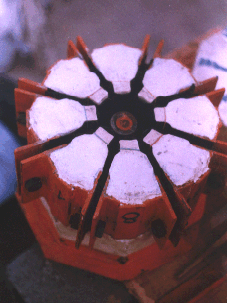
Picture B1 : The die 'cavity' is ready to be filled with the clay powder
In this picture the 'wheel die set' shown is ready to be filled with the clay powder. Inside the cavity in the center is the wooden spindle, around which the material is spooned. This powder is tamped down firmly with a wooden stick before beginning to press. Pressing is done at this stage by tightening the bolts, around the periphery.
Notice that all surfaces in contact with the powder are covered with 1mm. plastic, which in this case is black. The plastic makes release easy, when finally ready for the removal of the filter. Shown also are eight rubber bands that are holding the plastic in place, forming a kind of circle just outside the cavity, but rubber bands are not needed once the plastic becomes accustomed to the shape. Note that these dies were made with hydrostone, a dense plaster of paris, something that would not generally be available in a region of low income. Because of this the die set shown in picture C1 was made of concrete, a common material.
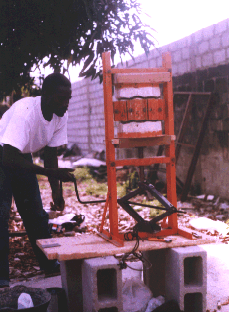
Picture B2 : Pressing the top and bottom of the purifier
Note that the press shown is also used for forming the porous grog disks that are shown in picture A4. These disks are pressed into a short piece of PVC, plastic pipe, using a dowel which fits freely inside to do the pressing.
The material used to press the porous grog disks is upto 40% wheat flour, and 60% red clay. The clay powder made from combining these materials is pressed when it contains no more than about 10% water content. By contrast a conventional, 'moist clay' contains about 30% water.
Water content can be judged in several ways that do not require the use of a scale. But the10%, low water content also means that the clay can dry out by several percent during handling, to as low as 5 or 6%. For this reason it is good to constantly bag any clay that is not being used. For dry press clay material, you know that you have about 6% water content when a powder, squeezed in one hand, keeps its shape; less water content and it will fall apart. The drying also gives a reason why it is difficult to know the exact, percentage water content. The press operators can pick up an intuitive sense for water content, however, an inexpensive scale is still necessary, in order to weigh the clay and flour into the proper proportion.
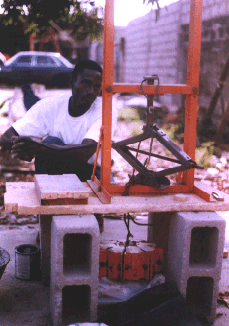
Picture B3 : Under the press, the spindle is removed from the filter
Now that the pressing has been completed for the sides and top and bottom of the purifier, it is time to pull out the wooden spindle. The die set can be seen under the press. After bracing this in place, not shown, the jack is pumped up and the spindle is released.
After removal of the spindle the die set is taken apart and the filter removed. The seams of the purifier are immedeately cleaned smooth, and the entire outside surface is burnished with a spoon. This improves strength.
The purifier in picture B4. is made of : 45% red clay powder (30 mesh), 10% wheet flour, and 45% porous 'grog,' (30 mesh), the pre-fired material shown in picture A4. Fortunately, 30 mesh sieve screen is widely available, used in several kinds of food processing.
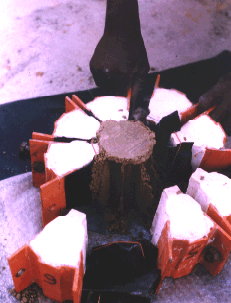
Picture B4 : The purifier is removed from the dies
The porous grog is also processed very carefully, with attention to proper mesh sizes. But in the beginning, when first combining materials, the correct way of mixing the clay, flour and water, is to mix all of the water to the clay. The clay and water combination must be allowed to stand, while becoming a little more plastic. A bit of extra water may be helpful. After thirty minutes the flour should be mixed in with a lot of mixing alternated with size reduction by breaking larger particles. When well mixed the clay material should be spread out to dry for an hour or two, in order to dry back to the correct, 8 to 10% water content.
After pressing and cleaning, the purifier needs no more than a day or two to dry, because of the low water content. It is then ready for firing. � 2000 Ceramiques d'Afrique
Click here to proceed to section C.

