Introduction

Pressing Purifiers
Model, Mold and
Die Making
Press Design and
Firing- Conclusion
|
A Introduction |
|
B Pressing Purifiers |
|
C Model, Mold and Die Making |
|
D Press Design and Firing- Conclusion |
|
Section A: Scroll through the
|
|
|
The Ceramiques d'Afrique, earthenware purifier is designed to remove the pathogens that cause dysentery, cholera and typhoid, water-born, gastro-intestinal diseases. The appropriate technology is widely applicable because the two primary materials needed are red clay and wheat flour, which are easily found almost anywhere. Because the technology is so widely applicable, the purifier could be considered an important development in the water and health sectors.
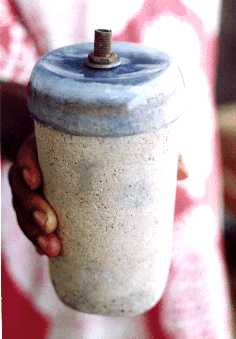
Picture A1 : a purifier candle, ready for fitting to a bucket. Bacteriological challenge tests for the purifier still need to be undertaken, in order to confirm the system works as described here. But tests have indicated 99% removal of particles of all sizes, down to 1.0 micron. This should indicate that for pathogen removal a high percentage could also be expected. A tiny amount of silver material may also be applied to the earthenware, as a disinfectant, in order to prevent regrowth of bacteria in the purifier wall. In fact, appropriate testing will be needed throughout the life of any purifier project, including random tests. The additional, pending bacteriological tests will be reported as results are completed. Testing is all the more important because other purifier manufacturers do not consider earthenware, red clay to be a suitable material. This is because there are different materials, for example, a white clay, which tend to have the smaller pore sizes which can filter out additional pathogens. Red clays have larger pore sizes, making the 99% removal by filtration somewhat surprising. Other testing is being undertaken in order to account for the reasons behind this. (It should be noted that red clay and wheat flour are not used because they are the best materials for the job, but because they can be found almost anywhere.) In general, it is not widely understood by water experts that when micro-organisms make contact with silver particles they are starved of oxygen and die, a process known as oligodynamic action. As a disinfectant silver can be applied in its colloidal form, or as silver nitrate, where the colloid is not available. Tests in Central America have proven silver effective in this way for a larger, 'filter bucket' promoted by the Nicaraguan based NGO, Potters for Peace. Though the effectiveness of the silver has not been widely understood by scientists, there is agreement that silver does prevent the regrowth of bacteria within purifier media. |
|
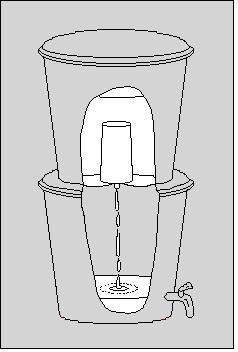
The purifier system is two tiered. The upper bucket contains the purifier candle, and is periodically filled with the water, suspected to contain pathogens. The lower, catchment container is for the purifed water, which drips through a tube, connected through a hole in the bottom of the upper bucket. The only fitting for buckets other than the purifier candle is the plastic spigot, at the bottom of the catchment bucket.
Picture A2 : A cutaway drawing of the two tier purifier system The purifiers have been designed to give one liter of flow per hour, with the intent that this should meet the drinking water needs of a small family, five or six persons. It is necessary to frequently top off the upper bucket, enough to maintain this rate of flow. It is possible to localize the installation of purifiers in buckets, nearer those who will be using the purifer system. Thus, the purifier candles may be shipped hundreds of kilometers, or more, from where they are made before they are sealed into the buckets. In this way the candles can be easily shipped in small containers, without fear of damage. An added feature of this scenario is that income generating opportunities are open for those doing installation. |
___________________________________________________________________
|
|
The startup cost for filter production can be remarkably low, with nearly all tools and materials available locally. The purifier can be considered appropriate because it is effective, low-cost and easy to use. But the widespread applicability of purifier manufacturing may be what makes the project model sustainable in the long term.
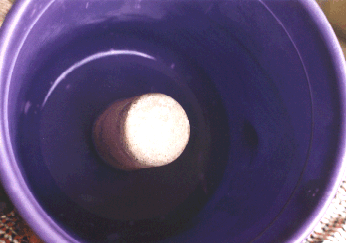
Picture A3 : The candle attached to the inside of a bucket. Materials needed to close off the end of the filter can be seen in picture A1. The cover cap is the cut-off bottom of a mineral water bottle. In the center of this is a short piece of threaded, iron tube, fit tightly in place by nuts and washers. The sealant used is a small amount of silicone. Another suggested sealant is wax. Earthenware water purifiers are 'dry-pressed' using a simple machine, as in section B, following. As indicated materials used include only clay and flour. But the purifiers could be considered highly processed, since half the material used is pre-fired, consisting of a porous 'grog.' This pre-fired powder is made from the same red clay and flour. The development of porous grog has been key in making possible the production of the earthenware purifiers. The rate of flow for these dry-pressed, earthenware purifiers is six times that of purifers made using a moist clay, the type of clay predominantly used by most potters. For purifiers made with porous grog the purifier wall is much more open and porous than is the case with ware that has been made of moist clay. |
|
|
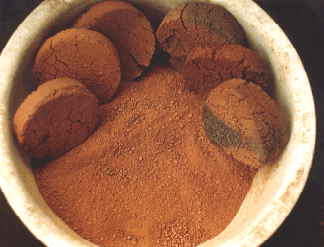
Porous grog is a combination of two materials: a red clay and a very fine grained combustible, which burns out, leaving holes. It is because of this that the permeability of the purifier is improved.
Picture A4 : Porous grog, disks and powder The combustible used here is wheat flour, which is about 350 mesh (ie. having 350 holes per linear inch of sieve screen). Flour is used because it is available almost anywhere in the world. On the other hand it is likely that better combustibles can be found, to substitute for flour, since this can be difficult to work with, more like a bread than a clay material. Flour simply serves as a kind of reference material because of its availability, but it has proven effective in achieving good flow. The porous grog shown is formed into disks, which are also pressed on the machine shown in section B. The disks facilitate stacking in the kiln, and uniform exposure to heat. Following the firing the disks are crushed to powder without great difficulty, since the big addition of pores makes them much less strong than normal earthenware. � 2000 Ceramiques d'Afrique |
|
|
You are at the end of section A.
Click here to go to section B. |
|
A Introduction |
|
B Pressing Purifiers |
|
C Model, Mold and Die Making |
|
D Press Design and Firing- Conclusion |
|
