Kerala, God`s own
country, world`s own economic and social mind
twister. . .Kerala is the smallest state in
India, a country where 400 million live under the
poverty line and literacy is only about 50% (30%
for women). It has 30 million inhabitants and it
is India`s most densely populated state, with
about 800 persons pr squate kilometer. Economic
wise it is one of India`s weakest with very few
industries, production and an high unemployment
rate.
But then I ask you to
read under The striking
facts.
The striking facts.
. .
100% literacy,
certified in 1991.
A relegious diversity
of 60% Hindus, 20% Christians, 20% Muslims. Even
a community of 22 Jews exists. Still it`s a
relegious peaceful state where all the groups
live together in tolerance and harmony.
Infant mortality is 11
within 1000 born. In the US it is 8 within 1000
born, some places even more than Kerala.
Life Expectancy : 77
for female, 75 for male.
Birth rate is at
replacement level, which means that the
population growth is minimal, or non-existent.
Kerala has solved one of the biggest 3rd World
problems, high population growth.
In country where there
is a unnatural high ratio of male vs female,
Kerala has more female than male. Like in the
western world women live longer than men.
Shortly said : QUALITY
OF LIFE IN KERALA IS AS HIGH AS IN THE WESTERN
WORLD. WE TAKE AWAY MEASURES OF MATERIAL WEALTH,
AND SEE THAT THIS STATE IN A COUNTRY WITH 3rd
WORLD SIGNS HAS ALL THE SIGNS OF THE WESTERN
WORLD.
|
An
literate story. . . how Kerala became India`s 1st
and only literate state. . .Taken from Bill McKibbens DoubleTake,
where he has written about Kerala`s development
"The government,
particularly the leftists who governed for much
of the late 1980s, continued to press the issue,
aiming for "total literacy," usually
defined as a population where about 95 percent
can read and write. The pilot project began in
the Ernakulam region, an area of 3 million people
that includes the city of Cochin. In late 1988,
50,000 volunteers fanned out around the district,
tracking down 175,000 illiterates between the
ages of 5 and 60, two-thirds of them women. The
leftist People's Science Movement recruited
20,000 volunteer tutors and sent them out to
teach. Within a year, it was hoped, the
illiterates would read Malayalam at 30 words a
minute, copy a text at 7 words a minute, count
and write from 1 to 100, and add and subtract
three-digit numbers. The larger goal was to make
people feel powerful, feel involved; the early
lessons were organized around Brazilian teacher
Paolo Freire's notion that the concrete problems
of people's lives provide the best teaching
material. "Classes were held in cowsheds, in
the open air, in courtyards," one leader
told the New York Times. "For fishermen we
went to the seashore. In the hills, tribal groups
sat on rocks. Leprosy patients were taught to
hold a pencil in stumps of hands with rubber
bands. We have not left anyone out." For
those with poor eyesight, volunteers collected
50,000 donated pairs of old eyeglasses and
learned from doctors how to match them with
recipients. Of the 175,000 students, 135,000
scored 80 percent or better on the final test,
putting the region's official literacy rate above
96 percent; many of the others stayed in
follow-up classes and probably had learned enough
to read bus signs. The total cost of the150 hours
of education was about $26 per person. Organizers
knew the campaign was working when letters from
the newly literate began arriving in government
offices, demanding paved roads and hospitals.
"
In 1991 UN and India`s
Goverment were proud to certify Kerala as India`s
1st fully, 100% literate state.
Full article
Bill McKibben : Kerala, India by Daniel McKibben
|
It
twists one`s mind . . . If it was so easy as people
volunteering and teaching illiterates how ta read
and write, then how come people are suffering all
over the world? Couldn`t all the problems of the
world be solved using the same method?
No, there must be
something else. You won`t live to 77 and 75 by
reading and writing. Literacy is only (though
huge) a step towards the right direction. But
I`ve just said that Kerala is one of India`s
economically weakest states with a high
unemployment rate. How can it have all the
qualities of the western world?
One positive feature
was the Land Reform. Land was distributed amongst
the people long back so .they could build their
home there and make a living of the harvest which
would grow on the land. Today 90% of Kerala`s
population live on their own land.
It has also a very good
health system which fully ensures immunsiation
against dangerous diseases, and medecines are
available everywhere for a low cost.
But there most be more,
a rock sturdy reason behind Kerala`s remarkable
social development, for economically it is poorly
developed. So what is it ?
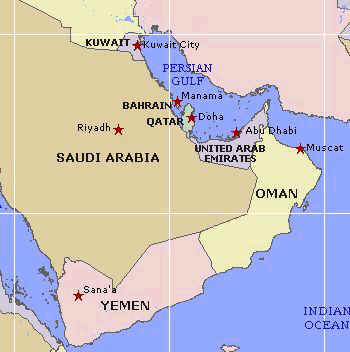
LOOK TOWARDS ARABIA,
SEEK THE OPPORTUNITIES IN THE MIDDLE EAST
. . .
|
| Looking
towards Gulf. . . In the 1800`s for many Europeans
the USA was the land of the opportunities, an
escape route for a better life. "The
West" was a dream which came true for many
from all over Europe.
Today the US is dream
of opportunities for many Mexicans. Like the
Europeans who dreamt about "The West",
Mexicans dream about "El Norte", an
escape to the North.
In the state of Kerala,
a similiar although not alike situation has been
existent the last 30 years with educated
Keralites seeking for a visa to the Gulf. Large
scale emmigration to the Gulf region has made
many places in Gulf countries a mini Kerala (like
Muscat, capital of Oman, Bahrain, Dubai in the
Emirates).
Starting with any kind of work, many return as
"Gulf princes" with well paid jobs
(comparing to salaries in the state itself) and
are able to take care of their familiy.
In Kerala you will see
people living in big houses and estates which are
results of this Gulf money which is flowing in.
Some end up in businesses, but only very little
for reasons which will be discussed. The money
spent making houses and buying luxury goods and
items create some work and income for people for
a period of time, but in a long term view there
isn`t anything good coming out of it. The state
gets nothing for developement.
So one of the main
reasons for Kerala`s development is becuase of
this Gulf money, which is running in like much
needed blood.
|
Artificial development ? Now one can ask. Is this idyllic
social picture if Kerala a result of artificial
development? What would have happened if the Gulf
jobs and money didn`t exist?
And what will happen if
one day this influx of money from the Gulf stops
completely? What happens when educated people
can`t hope of going and returning as "Gulf
princes"?
There isn`t any large
scale industries in Kerala which can provide
worthwhile jobs for engineers and other educated
people. Unemployment is already high amongst
people in Kerala, things won`t get better if
people loose the opportunity to get work in Gulf.
Gulf money which could
have been used for starting businesses and
creating jobs have been spent on houses and
luxury for the families. But people in the Gulf
and other foreign places can`t be blamed, there
hasn`t been an environment for investment in
Kerala. A famous film in Kerala starring
Malayalee star Mohanlal called
"Varavelppu" is a movie about a man
returning from the Gulf to start a business in
Kerala. He invests in a bus and starts "Gulf
Motors". But the Bus Employees Union Leader
creates a hell for the man, and in the end he is
forced to shut down his business. He then returns
to Gulf. This is a story which is taken from the
reality. Many industries and businesses have been
forced to shut down because of strikes led by
Union leaders (who in the end fill their own
pockets at the price of the labourers). People
living abroad are too scared to invest in Kerala.
External links on
this matter
Kerala ignores global economic
changes: PM Vajpayee
Prime minister Vajpayee`s speach
on this matter
|
A weak and vulnerable
economy Because
of no special kind manufacturing and production
in large scale industries the state gets no large
scale incomes. Instead it goes and lend money
from the World Bank and Asian Development Bank,
which actually puts the state in a bigger trap.
Future incomes will have to be used to pay of the
never-ending debt instead of creating jobs and a
healthy economy.
As mentioned there is
no manufacturing and production of the resources
in Kerala. Because Kerala have a lot of resources
which can create incomes for the people and the
state.
Resources like these
can be made things out of, manufactured and
exported in large scale:
- Spices (pepper etc),
can be packed in large scale and exported
- Rubber
- Fruits like mangoes,
jackfruit, watermelon and also local fruit types
can be manufactured in packages and exported.
Drinks can be made.
- Coconut, which has
totally lost it`s value in the state. Many
products (powder, dessicated coconut, drinks,
ingredients in food, chocolate and other
products) can be made out of coconuts.
- Herbs and plants
which can be used to make oils, treatment
ointments, medecines, creams and so on.
- Industries which
produce things can be set up to create work and
jobs, and income for the state
But nothing is being
done. Kerala has scared of investment, and it`s
own resources is being wasted.
The state of Kerala
with all it`s plus points live it`s life on the
edge, surviving by holding on to the rope thrown
in from the Gulf. If that rope gets cut it will
be a steep fall.
|

 to visit