 What
we are, what we want, what we think

Engineering contents
Solar
energy
The Mobius
strip
Social contents
An
economic analysis of Amartya Sen`s theories
Economic
and social mind twister, Kerala, God`s own country?
The
genius next door. . .
Extra. . .
A
JavaScript example
Famous Indian people search
Archive
Indian
legend from Denmark
External links
----------------------------
HowStuffWorks
- Learn how Everything Works! - Superb interesting web site
----------------------------
Gulf Construction Worldwide - Online
Edition
FT.com Home Europe - The Financial Time
Human Development Report 2
|
An economic view
Here I`ll try
to explain some of the ground sentences for Amrtya Sen`s
work on welfare economics :
- Famine doesn`t need
to occur when food supply is low. It can even
occur when food supply is high enough, but the
people are unable to buy it because they don`t
have any money. (this kind if starvation
suffered by people is prominent in many
countries, like India, who doesn`t lack food, but
people lack money)
- Famines have never
happened in (modern) democratic countries because
the leaders of such nations are spurred into
action by free-media and political reasons to
save their citizens. But in undemocratic nations
there won`t be anyone to hold the rulers
accountable for their actions when millions die
of famine (if, of course, the rulers neglect
the disaster).
- Poverty shouldn`t
necessarily be measure by the share of population
under the poverty line because then it wouldn`t
show the improvments made if for example the poor
people of the country got higher wages which
still were under the poverty line. Therefore Sen
has himself created an formula which can more
precisely measure the poverty in a society. The
formula is
P = H · [I
+ (1 - I) · G]
Where P is
poverty, H is the share of the population under
poverty, and G is something called the Gini
coefficient, which is the measuring of the degree of
income inequality and I is the distribution of
income. G and I only regard people in
poverty and leaves out those above the line. (This
formula therefore enables to measure the degree of
poverty in a society and gives us a deeper look of how
everything is).
- Sen has also created
a formula to measuring welfare in a society, a
contraire to the indicators like income per
capita, which measures average salary of the
society (measuring average salary gives often
a false picture of reality, as people may have
enormous salaries, while people in poverty may
have many times lower). The formula is :
y · (1 - G)
Here y is the
income per capita and G is the Gini coefficient,
which`s explained above. Sen explains that welfare in a
society has many factors, not just the income. Income
creates good oppurtunities for the welfare, but things
like health are equally important. (of course one
will automatically presume that a place where everyone
has good income normally also has people with good
health, but that`s not always the case). The UNDP
welfare indicator is one who takes all these factors into
account, living standard is measured by income per
capita, life expectancy and literacy. Therefore it gives
a good pinpoint of the welfare in a society.
The Press Release of the Royal Swedish Academy gives good
explanation of Sen`s theories.
Here are some extra links
writings by Amartya Sen :
Autobiography of Amartya Kumar Sen (short form)
Tagore and His India by Professor Sen
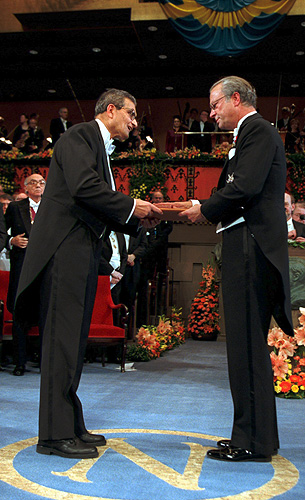 Amartya
Sen, recieving the Nobel Prize from the Swedish
King. Picture credit to http://www.nobel.se,
the Nobel Prize site.
|
You are the visitor  to visit www.global-engineering.tk Thank you very much. to visit www.global-engineering.tk Thank you very much.
If any copyright laws
are broken then we are glad to remove any
copyrighted info of this site. Contact at : [email protected]
Copyright©2003 www.global-engineering.tk We won`t allow the written text
be taken directly without asked permission,
although the facts given are free to take.
|
|