|
SOUTH CROFTY-WHAT DOES IT MEAN? Lying between two Cornish towns-Camborne and Redruth , you will still see the site and remains of South Crofty Tin Mine. Ask anyone in the area and in fact Cornwall and see the look of admiration spring into their eyes. Crofty was Cornish tin. Yes it’s closed now. It finished as a Mine in March of 1998. I was there on the last few weeks as people left to find new employment. I was there when we had to rip the ‘guts’ out of the mine. ‘Switch the pumps off’. That was the order one day. People, whether they were supporters or just trying to get in on the act, paraded with their banners and St Piran flags outside of the mine in Dundance lane. We inside were very much in the news.
I remember driving in one morning to be faced by a reporter, cameraman and angry protesters trying to get us to stop what we were ordered to do. What could you say to these people? My words were, ‘We’re going as slow as we possibly can’. It seemed to help, as they could see the anguish in my eyes. It never stopped the inevitable. All we heard was ‘Give Wilf Hughes a chance’. He was a Welshman who had spent most of his years in mining and supposedly had a plan to save Crofty. I saw some of his people go underground to look at future prospects but they were very hesitant in making any sort of statement. Small pumps were removed to surface. All the locos were dismantled and with the various Transformers taken to surface. All these items, we knew in our hearts, would never see the underground at Crofty again. Someone has tried to make a go of the mine but so far they haven’t come up with a viable plan to satisfy the local authorities. I hope they do but perhaps the last of the Crofty miners won’t be there to take advantage of it. I started at South Crofty in September 1982. I had been on the books to start for over a year but unfortunately things always took a long time with some of the managers. I was from Falmouth, probably looked on suspiciously by those from Redruth and Camborne. In fact, one Electrician, the Shop Steward was quite open and wondered why they couldn’t find an Electrician from the local area. That wasn’t a pleasant introduction but one that wasn’t important to me. I worked on the surface and underground and eventually a group of four of us became responsible for looking after The Mill. By this time we had become a part of a company called Charter Consolidated. They were in fact, I believe, a part of the International group Rio Tinto Zinc. Hard but very rewarding was the way I would judge my time at the Mill. The personnel there were excellent and a great sense of comradeship built up. Not everything ran smoothly. For instance, one afternoon a lady arrived at the Mill in quite a state and after trying to cool her down it appears that her husband had left his False Teeth at home and she had come with them. I gingerly accepted them from her and took them to a most receptive husband. A successful run place with a very high turnaround of tin. Everything seemed to be going ‘Honky Dory’ until Oct. 1985. The bubble burst. Tin had been kept at an artificial high. £10,000 at the beginning of the year and then the Crisis emerged. The value was reduced to £3,300. That was half of the production costs. Financial support was granted from the government. One of it’s mines, Pendarves, closed. The Mill at South Crofty was stopped. All milling would be carried out at Wheal Jane Mine but her mining would cease. Basically we had a Management buy out. No one really knows how much the ‘Dirty Dozen’ actually paid for the mine. I had heard a figure of £1000 per person but that was never confirmed.
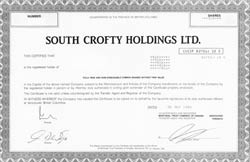
Two Electricians, including myself, went back with the surface and underground Electrical Department. I eventually went to the Locomotive Shop and as an extra job looked after the Cap Lamp section of the mine. This part of my life there was very good and things took on a different aspect for me. I never felt out of place there. Things took a nasty turn in the early months of 1990. The Firm decided to lessen the workforce and they did by using a Points system. This took on the form of the person’s ability to perform his duties, his attendance records and general use to the firm. The total number of points that could be attained was 45. One poor chap at South Crofty accumulated 19 points. He certainly had backing from his Foreman and manager! He fought for his case and the management could not find fault in what he implied but still laid him off. One ironical factor was that the Engineer who made out the points didn’t even know some of the men by face. Another thing was that the person with 19 points knew that there were others in the same department that were going to new jobs. So within a week that man was asked to rejoin the company. Most people that he met when he came back shook him by the hand all except his Foreman and Manager. We were all made redundant later on, but some were asked to stay for a short period while the firm found their feet. We were all on £4.25p per hour, including management. That period lasted for another seven years. The small workforce and high production caused the firm to have a serious rethink and eventually more and more miners and personnel were employed. In the meantime our wage had gone up in stages to £4.80p per hour. My period in the Loco Shop carried on without much trouble. The only ‘snag’ or problem was the lack of heating in the building. I spent about four years in there without any form of heating and kept a record one winter of the temperatures. One momentous day I remember. It was so cold in the workshop, I was working in my ordinary clothes with a pullover, a pair of overalls, a donkey jacket and a ‘balaclava’. A member of the staff came in, knowing only too well that he should have shown some interest in my health, and casually said, ‘Cold today, isn’t it Cedric?’ When Robinson’s Shaft became unsafe, we were unable to bring locos up to the surface for daily repairs and so all locos and charging facilities were installed on the different levels. We had some workshops where we could perform our duties but other repairs had to be done on site. As time went on there were two of us seconded to the Fitters Department. This caused some ‘back biting’ with one or two people in the Electrical Department but we just got on with our job and never had any complaints from the Mining Department. We worked a ‘call in ‘ system where we were on call. Failures of some pumps in awkward areas were a serious problem. On one particular level it was necessary to use a home-made raft to float a spare pump to its position. Working up to your waste in cold water is not a pleasant thing to do in the middle of February. 15% of our wage was removed giving £4.12 an hour in the latter months of trying to save the mine. Eventually our wage increased to an hourly rate of £4.50p plus the princely sum of 34p underground allowance. Yes, some miners earned big wages. Some Electricians worked a double shift during the weekends to get extra revenue but come end of the day, Tin was at a low premium and Wages took a lot of the Company’s budget. Money was raised from certificates around the county and eventually at the eleventh hour a loan came from Canada, dare I say it, with strings. All these things didn’t stop the inevitable- the closure of South Crofty. The following picture is of a copy of a share certificate issued by the company to members of the workforce.
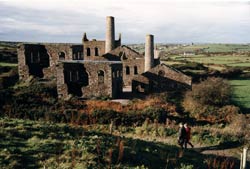
There seemed to be WorldWide interest in this last Cornish tin mine. I’ve never seen so many cameras and microphones. Luckily, Blue Peter had been here a few weeks previously and so they didn’t see the demise. Below is a scene across the downs showing some remains of old mine workings. Are we faced with South Crofty coming to this type of exposure?
I never saw any tears shed. I’ve seen them at retirement do’s but not here. I never felt the same as a person whose parents and grandparents had worked in the industry. I accepted South Crofty as a job but felt a slight bit of pride to belong to a magnificent workforce. There were hard men and gentlemen there. It was a privilege to work with them.
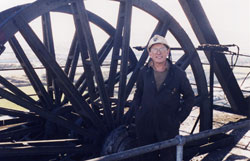
This is not an attempt to take away the many interesting articles, books and magnificent photographs that have been recorded about Crofty. Go into any bookshop and if you find a section on Cornwall I should imagine that you will probably find something about Crofty. Go to the County Museum in Truro and see some of the many artefacts. At the moment, it is possible to visit some workings at South Crofty on an organised tour. To do this it’s necessary to get in touch with the present developers- BASERESULT HOLDINGS LTD. Tel. 01209 715777. If you want a more factual look at a mine museum then visit GEEVOR TIN MINE at Pendeen. Tel. 01736 788662. www.geevor.com Then there is the CORNWALL’S INDUSTRIAL DISCOVERY CENTRE Tel. 01209 210900. www.trevithicktrust.com These places are a wealth of information. What I have done, with the help of a very knowledgeable tutor, is to give an ordinary man’s personal memories. Perhaps someone out there might give a different picture. Who knows? Perhaps the Phoenix will rise from the ashes! The photo below shows the author on Cook's Headgear. In previous years the author would help in installing the annual Christmas tree at the top of the headgears and, while illuminated, the trees could be seen from miles around at night.
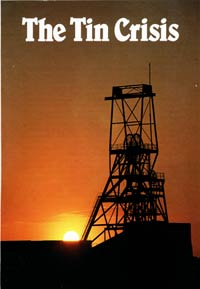
ACKNOWLEDGEMENTS Most of the photos (or snaps) that you see have been taken by myself over the years that I worked at South Crofty. I have been able to obtain some photographs from various publications that were issued to members of the workforce. My team Leader with the fitters, Steve Smith, was able to take the photos of the water rising in the lower levels of the mine. A magnificent drawing of Robinson's Engine House by Ken Dockery 1984 A miner Shrink Stoping by P.R. Deacon The Tin Crisis by Tim Guthrie Robinson's Engine House (photo) by Ashley Peters The site has taken some time to evolve but looking at it I do hope that it might satisfy people interested in Cornish Tin. The site would never have come about without the expertise of my tutor Mr Grant Bucknell. I watch in amazement as his fingers flow across the keyboard of the computor. The only thing in comparison is watching a master musician playing a Sradivarius violin. He's done a great job! Most of all I would hope that whoever logs on to the site will enjoy our efforts
South Crofty Home | The Miners
| Other Workers | Milling Click here to switch to Falmouth Docks website. |