
Chernobyl Children in Need Supporting needy children in and around the village of Ozarichi,Belarus.

|
|
Chernobyl Children in Need Supporting needy children in and around the village of Ozarichi,Belarus. |
|
| About Ozarichi | About Chernobyl | Sponsor a Child | Current Projects | The Children | Status as a Charity | About CCIN | Fund-raising Events |
The 1986 Chernobyl Disaster
In March 1986, under the former Soviet government, a dreadful nuclear accident
occurred at the Chernobyl plant in Northern Ukraine. Tests were being conducted
on Unit 4 of the Reactor, which eventually led to a meltdown, Tonnes of nuclear
material was thrown up into the atmosphere, which then spread across Ukraine
and Belarus. Due to attempts to keep the accident a secret, international help
was not requested by the USSR and inadequate procedures were used to contain
the resulting damage.
"Unit #4 of the Chornobyl nuclear complex, located at Pripyat, Ukraine, exploded in the early morning of 26 April 1986 at approximately 01:24:00 hrs Kyiv time. The explosion and the following graphite fire spewed some 185 million curies of deadly radioactive debris onto the city of Pripyat and the surrounding area. The present-day republics of Belarus, Ukraine and the Russian Federation were particularly severely contaminated by the radioactive dust spread by the air currents throughout eastern, northern and central Europe, and, indeed, around the world. Next to the atomic bombs dropped on Hiroshima and Nagasaki on the 6 and 9 August 1945, it remains (hopefully forever) the world's worst nuclear tragedy. Its consequences, which have already been enormous, shall remain with the planet earth for the next 250,000 years" - quoted from http://www.infoukes.com/history/chornobyl/zuzak/page-07.html.
For a more detailed history, please click onto the following links:
http://www.world-nuclear.org/info/chernobyl/inf07.htm
http://www.chernobyl.org.uk/page2.htm
http://history1900s.about.com/msub74.htm
Effects on the Belarus people
1.1 A reactor overheated and exploded, causing a major fire, sending deadly
radioactive isotopes into the atmosphere, much of which fell onto the countryside
of Southern Belarus.
1.2 Thousands of local residents, together with firemen, scientists, police
and army personnel, plant workers and government officials died in subsequent
weeks and months due to massive overdoses of radiation.
1.3 Evacuation of the immediate area, including Pripyat, a town of some 14,000
people, many of whom worked at the nearby Power Station, and eventual closure
of the nuclear plant has failed to prevent the continuing calamity of Chernobyl,
which will go on claiming lives and creating health problems for residents of
the Gomel region for literally hundreds of years to come.
1.4 Young children are the most vulnerable, living as they do in a dangerous
environment with heavily contaminated water, food, air, soils and foliage.
1.5 Consequently, with weak immune systems, they may develop skin and blood
disorders, serious eyesight and hearing deficiencies, thyroid problems and mal-functioning
internal organs.
1.6 Worse still, cancerous tumours or leukaemia can arise, while many babies
have been born with serious genetic deformities, arising from constantly high
radiation levels. Sadly, large numbers of children are also orphaned early in
life.
As a result of the land in Belarus being so contaminated, the whole country
has become a biological and ecological disaster area. The people of Chernobyl
were exposed to radioactivity 90 times greater than the Hiroshima bomb; the
people of Belarus are continually being exposed to radiation emanating from
particles of heavy metal isotopes which covered nearly all of the country to
a greater or lesser degree.
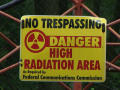 |
Radiation
|
|
A few of the shocking statistics that are available are listed below
(We understand that they are estimated and may only be approximate)
*70% of the contamination fell on Belarus.
*1900tons of highly radioactive Uranium and graphite exploded into the atmosphere.
*It is believed that in excess of 40% of the highly radioactive elements such as Caesium, Plutonium and Strontium also went into the atmosphere. These elements have half -lives ranging from hundreds to thousands of years.
*There are hotspots of radiation throughout Belarus.
*There are very few places that do not have some contamination. Most foodstuffs such as milk, meat, eggs and vegetables are home produced and contain some contamination.
*Through initial over-exposure to Iodine 131 (1000 times permitted levels) which concentrates in the thyroid gland, there is, 14 years on, an estimated increase in thyroid cancer and pre-cancer symptoms of 800%.
*An estimated 13,000 firemen and other workers who helped clean up the Reactor and the surrounding countryside after the accident are now dead, while a further 70,000 are believed to be seriously ill or disabled.
*The children of 14 years ago are now having children of their own with increasing
percentages of deformities and medical problems.