|
|
Menu |
|
|
Menu |

All cats need to be groomed whether they are a pure bred long hair or domestic short hair cat. Grooming your cat helps to remove dead hair that they may ingest and end up having hair balls logged in their digestive system. Grooming helps to stimulate the oil glands and helps to keep their coat soft and shiny. Long haired cats need to be groomed more frequently, perhaps daily whereas short haired cats should be combed and brushed about once a week. Commence grooming as soon as your new cat has had a chance to get comfortable with you and with its new environment. Grooming reinforces your relationship with your cat. It allows you to bond with each other. This gives you a chance to check your pet's skin and coat and any other problems that may arise such as enflamed gums, bare patches on their coat and external parasites. It should be a pleasant experience for both you and your pet. Reward your pet with a special appropriate treat for good behavior once the grooming session has ended. Your cat will begin to understand soon enough, that after he/she gets combed, brushed, clipped and cleaned that a special reward will follow. Remember to be persistent. Find a time during the day or week when both of you are relaxed to begin the session. Cats are creatures of habit. They like routine. Anything that disrupts their routine disrupts them.
If by chance you waited a while before getting your cat used to the grooming routine, alot of patience will be required on your part. You will have to start slowly and gently. Allow your cat to sniff and play with the brush and comb but exercise caution when doing so. A brush bristle or tooth of a comb can pierce or scrape the roof of the cat's mouth making the grooming session rather painful. Do a section per grooming session. Praise and reassure your cat often. Just let your cat know that you want to help not hurt.
There are a few areas to cover when grooming your cat.
Their coat requires combing and brushing and possibly removal of knots in their fur
Their nails may require clipping if your cat is an indoor cat
Their teeth need to be checked and brushed
Their eyes, nose, ears and anus may require cleaning as well.
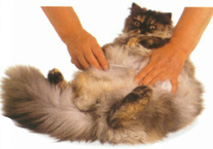 |
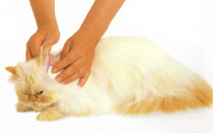
Knots in the
fur tend to start between the back legs, behind the front legs and behind the ears. Using a wide tooth comb, begin combing these areas first. Comb the fur on the abdomen. |
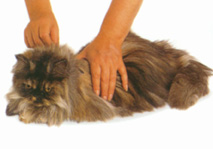 |
Remove
knots and tangles that develop at the wispy ends on top of neck and back. Work one section at a time. Part the hair and from the roots, gently comb upward. |
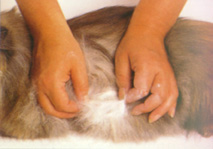 |
With each
section completed, check skin for dandruff and small black flecks. If black specs are present, shake a few on a white surface and moisten with water. If they turn red, your pet an house will require flea treatment. Remove any tangles by hand. |
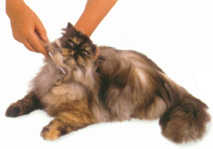 |
Knots and mats
are common behind ears and on the ruff because it is difficult for a cat to reach. For these areas, comb the hair in an upward motion. |
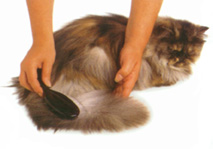 |
To
complete the grooming, finish by brushing the tail.Cats do not like having their tail brushed along its length. Part the hair and gently brush to either side. If this is the end of your grooming session, don't forget to give your cat the special treat, preferably something that will not stick to your cat's teeth. |
Trim your cat's nails regularly if your cat remains indoors. If you cat goes outside, your cat needs its nails to climb and defend itself.
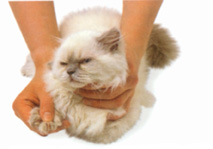
Trimming the cat's nails is painless if done properly. Most cat's do not enjoy having their nails trimmed so it would be best if you get them used to the idea when they are young. Older cat's grow long nails which may penetrate the paw pad. Should this occure, please consult with your veterinarian. Allow the cat to get accustomed to having his paws touched and nails extended. If not, it may require two people to get the job done. One person to hold the cat and perhaps to give puss a tummy rub and lots of reassurance to distract him from the other person who will trim the nails. Always use a guillotine nail clipper. If your cat likes to move around when you are trying to trim it's nails, change the location of where you trim so that your cat does not associate one place with nail trimming. Reward with a food treat once the job is complete.
 |
Press
gently behind the claw to extend the nail. You will see a brown to white tip. Inside the center is the pink "quick". Do not cut the "quick" as it is living tissue and will bleed |
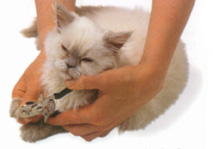 |
Place the
guillotine clippers over the tip of the nail infront of the "quick". Squeeze the handles and cut straight across the claw. Reassure your cat that everything is fine. Reward with a food treat and play with your cat when you are finished. |
Please refer to the Oral Hygiene page.
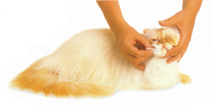 |
Some breeds such as
the persian and other "flat faced" felines require more attention to these areas especially the eyes. The tears overflow and your cat produces a dark red stain on the hairs around the eyes. The nasal secretions form crusts around the nostrils. To remove the excess tear flow stains and nasal crusts, simply moisten a cotton ball with an antiseptic eyewash, preferably a solution that your vet has recommended. Gently clean these areas. If you notice that your cat seems to have way too much tear overflow, sneezes frequently or has alot of nasal discharge, consult your veterinarian. |
Not too many people, including myself, up until I started this page, realize but the anal sacs of your cat can get blocked. Should your cat be constantly licking its anal area, it means the sacs are blocked. This is called impacted anal sacs. As disgusting as it may sound, these sacs must be emptied. Ask your veterinarian to show you how to manually empty these impacted anal sacs. You may want to wash your hands when you are done this interesting task!
 |
A gritty dark wax
build-up in your cat's ears may be |