|
|
Menu |
|
|
Menu |

Imagine how your teeth would look and feel if you did not brush them daily. The same applies to your cat's teeth. Unless you are providing some form of dental care regularly, you are neglecting an important factor in the overall health of your cat.
Gum disease is one of the most common conditions seen by veterinarians. The problem begins when plaque and tartar are allowed to build up on your pet's teeth. Bacteria lives in the plaque which can infect the gum tissue and the roots of the teeth which results in disease and tooth loss. The same bacteria contained in the plaque can also enter the blood stream through the network of blood vessels located near the gums and teeth. Certain heart, liver and kidney diseases have been associated with these bacteria as seen in recent studies.
Persistent bad breath
Sensitivity around the gums
Pawing at the mouth
Loss of appetite
Plaque ( not really visible unless it is stained)
Bleeding, inflamed or receding gums
Tartar (rough brown hard material on the teeth)
Loose or missing teeth
Difficulty eating and chewing food
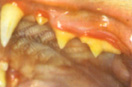 |
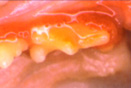 |
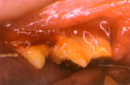 |
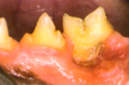 |
|
Mild
Gingivitis |
Moderate Gingivitis |
Severe
Gingivitis |
Periodontal
Disease |
The first step is to have your cat's teeth checked by a veterinarian. It may be necessary to have your pet's teeth cleaned above and below the gumline. This procedure will require your pet to be put under anesthesia. The risks previously associated with this procedure have been greatly reduced due to recent advancements in anesthetic techniques and materials. If you have any concerns regarding this procedure, please discuss them with your veterinarian.
Most vet's recommend and oral hygiene program which includes brushing your pet's teeth. This is the most effective way of removing food particles and plaque from the teeth and below the gumline. It is important to choose a brush & toothpaste specially designed for your pet as the brushes contain bristles that are very soft and the brush is shaped to fit your pet's mouth and teeth. The toothpaste for pets are flavored to appeal to the animal and do not have to be rinsed out. Do not use baking soda or human toothpaste as they contain ingredients which should not be swallowed by your pet.
Diet plays a very important parts in your pet's oral health. Soft or sticky foods may contribute to a build up of plaque and eventually gum disease. Dry foods & biscuits are encouraged as these help remove the plaque above the gumline. There are newly formulated abrasive diets available for both cats and dogs. To remove food particles and plaque below the gumline, toothbrushing is best alternative. Disease causing bacteria flourish below the gumline resulting in irritation, inflammation and infection.
The first thing is
patience. You must proceed slowly and gently.
Select a convenient time when both you and your pet are relaxed. To get your pet
used to the idea of having your hands near its face, gently hold your pet like
you normally do when petting him/her and gently stroke the outside of your pet's
cheek with your finger for 1-2 minutes. Give your pet a special treat (hard
biscuit) and plenty of praise after each session. Once your pet has become
accustomed to this, place a small amount of pet toothpaste on your finger and
let your pet sample it. Most pets like the taste and will look upon it as a
treat! The next step is to introduce him/her to an animal toothbrush or
finger brush. Place a small amount of toothpaste specially formulated for pets on
the brush and gently raise your pet's upper lip and brush one tooth with a slow
circular motion along with the ajoining gumline. Gradually increase the number
of teeth brushed each day. Do not push it. If you see you cat is getting
uncomfortable, take a break. Try to work up to brushing thirty seconds per side.
Remember to give him/her a special treat after each session along with plenty of
praise.