
















NOTE: Nothing is illegal on this page. While every care is taken in the compilation of these pages, I shall not be liable and shall be held harmless from any error of the calculation & information contained herein.
Copyright of BruAstronomy © 2000, 2001 & 2002
Created on 23rd Sept 2000
|
By Hazarry HAA Posted on 6th January 2002
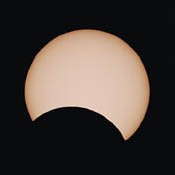
Solar eclipse is one the most interesting and fascinating natural phenomena to observe. An eclipse occurs when a celestial body is occulting or blocking another body or object. A solar eclipse or an eclipse of the sun is the result of the moon blocking off the sunlight. A solar eclipse can be partial, or annular or total depending upon which part of the shadow is involved. when the moon passes between the sun and the earth and if the moon does not cover the entire solar disk the solar eclipse is partial. For a total solar eclipse to occur, the umbral shadow of the moon must reach all the way to the earth. In annular solar eclipse, however, the umbral shadow falls short of the earth's surface, because the moon is too far away to obscure the sun entirely.
On 10/11th June 2002, the narrow track of the annular solar eclipse will begin at sunrise in east Sulawesi of Indonesia and will sweep across the central region of the Pacific ocean. The annular solar eclipse path will come to an end at sunset just south of Puerto Vallarta, in Mexico. [See the Eclipse Map]. However, the partial phase of the solar eclipse can be observed in many parts of the USA, most of the Australia & Eastern Asia including Brunei Darussalam.
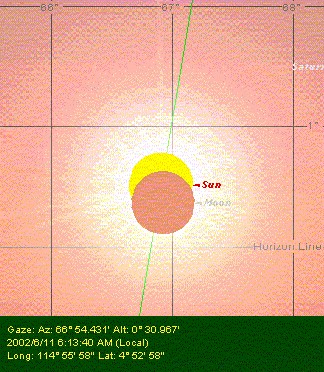
For Bandar Seri Begawan, Brunei, the partial solar eclipse will begin at sunrise at 06:07:40 am Local Time on 11th June 2002 when the sun is still below the horizon. At the same time the moon's disk will cover the solar disk at maximum in which 77% of the Sun's surface is obscured by the moon.
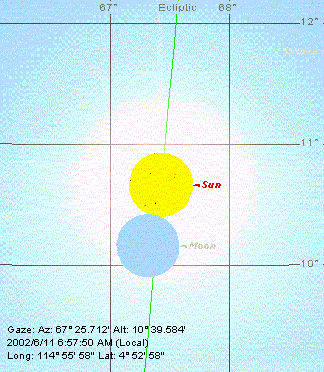
The phenomenon will last for 50 minutes where the last contact of the moon disk with the solar disk will occur at 06:57:50 am Local Time. See figure below. For simulation of the solar eclipse from Brunei click here.
Above: End of eclipse: The moon's disk (blue) leaves the solar disk (yellow) at 06:57:50 am Local Time. Graphic by Hazarry
The partial eclipse will be visible nearly above horizon about northeast of Brunei. The problem that might be facing us in viewing the event is the overcast sky. This is because the northern part of Brunei is coastal area where the sea-breeze contributes the formation of high pressure over the sea during the day. Because of the low-pressure area over the land, the air cools and moves towards the sea to form dense cool air or clouds over the sea. Let us hope for a clear sky! Amin!
In observance of the solar eclipse as the mighty creation of Allah, Muslims will perform (advisable but not obligatory) a special prayer and sermon. This service (prayer) should not be considered a form of "moon- or sun-worship" but in fact the Muslims seeks protection from Allah.
There will be a total of three eclipses visible in Brunei in 2002. Of which 2 are penumbral lunar eclipse which is less interesting to observe. People in Brunei will have to wait for about another 7 years to see the next solar eclipse as the next solar eclipse will be a partial solar on 26th January 2009 (16:42:00 LT). So make an effort to view this wonderful event.
Looking at the sun is harmful to your eyes at any time, partial eclipse or no. The result can be "eclipse blindness," a serious eye injury that can cause temporary or permanent blurred vision or blind spots at the center of your view. Fortunately, there are many easy ways to watch the show safely [How to Watch a Partial Solar Eclipse Safely By Alan MacRobert].
Any questions about the eclipse and comments, please join our online discussion group at http://www.communityzero.com/bruastronomy and post your questions there. We promise to get as soon as possible to answer your question.
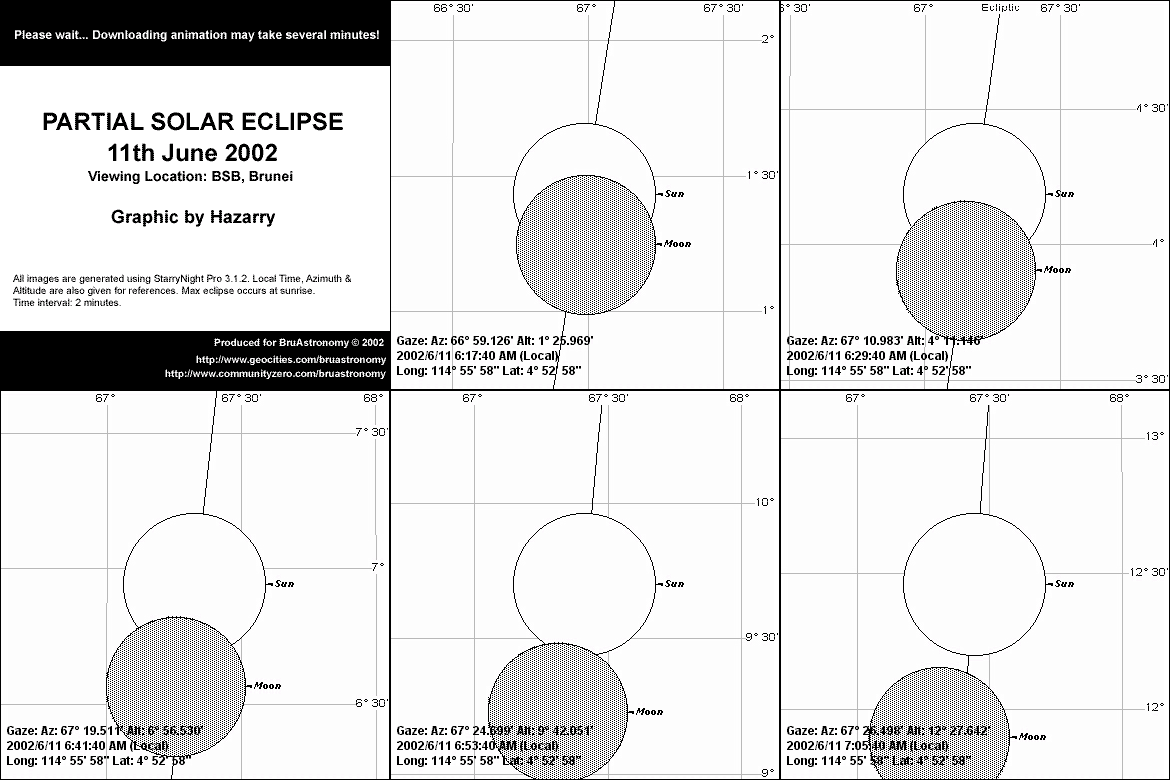
Please wait. Downloading the animated .gif image (280Kb)....
Above: An animated diagram on how the partial eclipse will appear as viewed from Bandar Seri Begawan. Note that the beginning of the eclipse starts right after the sunrise which is also the maximum phase.
|
|
||||||||||||||||||||||||

![June 2002 Annular Solar Eclipse [Click to Enlarge]](jun02se.gif)