
Mercury to make rare transit of sun












NOTE: Nothing is illegal on this page. While every care is taken in the compilation of these pages, I shall not be liable and shall be held harmless from any error of the calculation & information contained herein.
Copyright of BruAstronomy © 2000-2001
Created on 23rd Sept 2000
|
Article and graphics by Hazarry Haji Ali Ahmad
ABOVE:
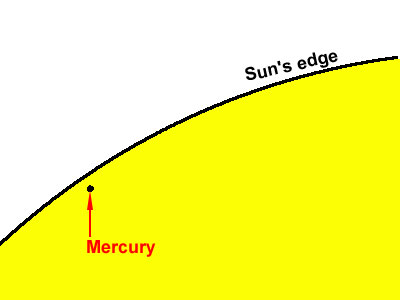
This
is how the transit will look like. As
seen from earth, Mercury will be quite small, a black spot less than
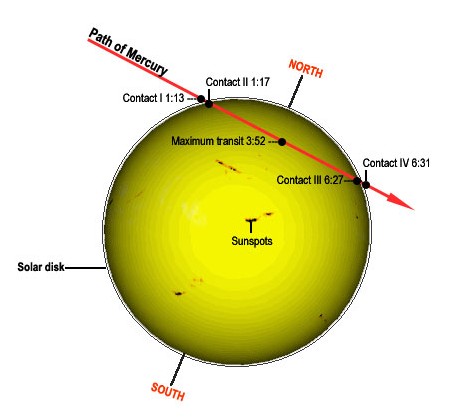
1/195 the diameter of the sun passing across the sun disk. On 7th May 2003, the planet Mercury will pass between the Earth and the sun to make a five hour-long journey across the solar disk. This astronomical event is a relatively rare occurrence of which on average, there are 13 transits of Mercury each century. The event will be visible from the eastern part of North America and South America, Europe, Africa, Australia and Asia including Brunei Darussalam. For Bandar Seri Begawan, Brunei Darussalam, the planet transit will begin at 1.13 pm local time on 7th May 2003 where the planet will appear as a silhouette grazing the sun’s northern edge. Just before contact II (at 1.17 pm), the so-called black drop effect can be seen. Shortly after contact II, the entire planetary body will be inside the sun’s disk. By then, Mercury will appear as a tiny black spot. At 3.52 pm the planet will be at it’s greatest transit where it is the instant when Mercury passes closest to the Sun's center. The phenomenon will end at 6.31 pm where the planet disk will make it’s last contact with the solar disk. However in Brunei, the last phase of the transit will occur after sunset at 6:25 pm.
ABOVE:
Path of mercury across the solar disk and the times of contact
during the transit on May 7. The
phenomenon is analogous to solar eclipse, though, Mercury
will appear quite small, a black spot less than 1/195 the diameter
of the sun since the planet is so distant. This makes it impossible
to view without the aid of telescopes. In
addition, public are warned not to look directly at the sun, or
through any telescopes and binoculars without proper equipments and
protection since the intense brightness of the sun is harmful to
your eyes. The result can be blindness, a serious eye injury that
can cause temporary or permanent blurred vision or even lost of
eyesight. Astronomy
enthusiasts in Brunei and interested public are welcome to the
transit watching activity at Serasa beach starting at 12.00 noon on
May 7 that will be organized by the Astronomy Unit of Brunei’s
Survey Department and the Astronomical Society of Negara Brunei
Darussalam. A powerful telescope will be setup equipped with solar
filters and a camera connected directly to a TV monitor for safer
viewing. So make an
effort to view this wonderful event and let us hope for a clear sky. Astronomically, transit occurs when the inner planets to earth passes across the Sun's disk. Therefore, other than Mercury, Venus is also possible to make the transit. All transits of Mercury fall within several days of May 08 and November 10. The next mercury transit will occur at sunrise of November 9, 2006. On 8th June 2004, people in Brunei will also be able to witness another planet transit of sun but this time it will involve Venus. Other interesting astronomical event will be in August 2003 whereby Mars will lies closest to Earth (55.76 million kilometers from Earth) making the red planet appears shining brighter at night.
|
|