













NOTE: Nothing is illegal on this page. While every care is taken in the compilation of these pages, I shall not be liable and shall be held harmless from any error of the calculation & information contained herein.
Copyright of BruAstronomy © 2000-2001
Created on 23rd Sept 2000
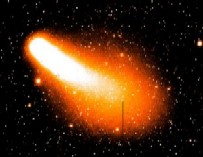
Comet LINEAR was first seen late last year — hence its name when it was out past Jupiter and still very faint. In the above picture from the Curtis Schmidt 0.6-meter Telescope in Chile, a 30-second exposure in red on December 4 captured detail in Comet LINEAR WM1's emerging dust tail. The W stands for the second last week of the year and the 1 means the first comet found in that time.
A comet bright enough to be seen with binoculars is swooping into southern skies. Comet C/2000 WM1 (LINEAR) continues to brighten and develop tails as it nears its closest approach of the Sun in late January 2002. Optimistic sky watchers hope that Comet LINEAR WM1 will undergo an even greater (and unexpected) brightening to the point where its coma and tails are easily discernable to the unaided eye. It is magnitude 5.8 in brightness — too faint for naked eye viewing in towns or cities. From now on you'll need dark skies (away from lights) and either a telescope or binoculars. The tail will increase in size throughout the month of December as it travels closer to the Sun, however it is moving away from the Earth during this time. Therefore the magnitude will remain steady at 5.7 until the new year.
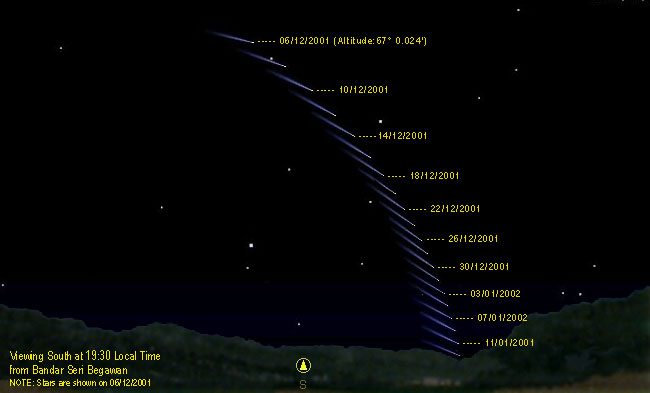
Comet C/2000 WM1 (LINEAR)'s closest approach to Earth was on 02 December 2001 with distance 0.316 AU. The diagram below shows where to look out for comet LINEAR from Brunei. The dates shown display the position of the comet on the given date at 19:30 Local Time. Note that the path of the comet is moving southwest direction.
Graphic by HazarryHAA
TIPS: To get the current position of the comet from your location, register (FREE) and go to http://www.heavens-above.com/
[Adapted from NASA] |
|||