












NOTE: Nothing is illegal on this page. While every care is taken in the compilation of these pages, I shall not be liable and shall be held harmless from any error of the calculation & information contained herein.
Copyright of BruAstronomy © 2000-2001
Created on 23rd Sept 2000
|
|
|||||||||
|
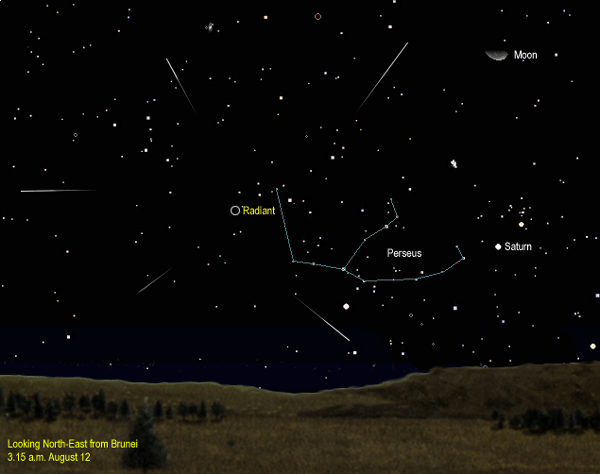
Above: Perseids meteor showers
radiant will be visible 30 degrees above horizon, north-east of
Brunei at 3.15 am on August 12. The prospects of viewing will be
fair since the moon is a waxing crescent. Observer will expect to
see 60 perseids per hour.
Graphics by Hazarry |
|||||||||
|
The Perseids are the Old Faithful of meteor showers. That's worth remembering, even if the last-quarter Moon will interfere somewhat on August 12th, when the height of this year's display is due. The shower actually lasts several weeks, but in the days leading up to the peak the shower will be largely wiped out by an even brighter Moon.
Our best bet in 2001 is to catch the Perseids on the morning of the 12th and on several mornings thereafter, when the waning crescent Moon will produce less glare. Activity increases sharply in the hours after midnight, because we are then looking more nearly face on into the direction of the Earth's motion as it orbits the Sun. The radiant, or point from which the Perseids appear to come, is also rising higher in the sky as dawn approaches for observers in midnorthern latitudes.
In a dark, moonless sky, when the radiant is 30 degrees or more above the horizon, observers often see 60 or more Perseids per hour at the shower's peak.
Adapted from Sky & Telescope |