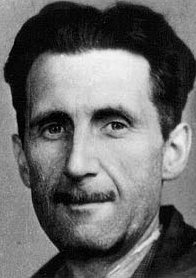
In his earlier schooling years, Orwell was a good student and he attended several schools on scholarship- including one of England�s finest schools, Eton. The imperial history of his family and his experiences as a school as a scholarship student were two important influences on Orwell�s intellectual development. They helped him define himself mostly in terms of what he did not wish for himself.
Cruel administrators ran the schools Orwell. These administrators were interested in tormenting the children that did not pay there own way. He eventually lost interest in his schooling at Eton, and his poor performance there reflected his interest in rejecting the traditional educational path that leads to either Oxford or Cambridge. Instead, Orwell went back to India to be a police officer for a number of years.
When Orwell returned to England in 1927 to fulfill his childhood dream to be a writer. In the next five years, Orwell was always on the edge of poverty . In Paris, he wrote and washed dishes in a hotel when the money ran out. Back in England, he lived in a series of cheap hotels in the East End. Of London and also traveling through the country side �tramping� and doing some agricultural labor. The documents about this experience became his first published work, Down and Out in Paris and London (1933). Because he did not know what ind of reaction the book would receive, he decided to publish it under a pen name. The man who had been a student at an exclusive school like Eton and who had served as an instrument of the British empire remade himself as George Orwell � a writer who ignored the barriers of class and wrote about poverty with insight and empathy.
In the years that followed he publication of his book, Orwell taught at schools, worked in bookstores and continued to write. He also continued his travels . In 1936, he lived in the industrial north of England in order to investigate the conditions of working class life and the effects of unemployment. In 1937he went to Spain to serve in a militia fight against the forces intent on establishing a fascist government in that country.
In the 1940s Orwell settled down a fair bit. He worked from 1941 to 1943 for the BBC, producing radio shows for broadcast in India ans southern Asia. From 1943 to 1946 he was the editor of a political left newspaper, the Tribune. In the spring of 1945, he served as a wartime correspondent from Paris.
In the late 40's, Orwell health began to decline seriously. He had always had respiratory problems, and developed tuberculosis seriously enough to request hospitalization in 1947, 1948 and again in1949. He revised his draft of 1984 after his release from the hospital in 1948. He was able to see the initial favorable response to both novels, but died from a hemorrhaged lung in early 1950, well before the impact of his writing would be fully evident.