Judaic Mythology of Knowledge.
Cultural historians distinguish between village-dwelling grain growing
cultures and migratory hearding cultures.
Many scholars see the Cain and Abel story as a myth in which the Hebrews
explained why God favored them over the agricultural and mother goddess
oriented societies. (source)
This also takes into account the Jewish myth of Lillith.
According to myth, Lillith was Adam's first wife, however, since she wanted
to be on top during sex, God turned her into a demon and gave Adam a more
passive woman, Eve. This myth is indicative of the fact that the Hebrews
did not get along with (in the sense of not sharing the same cultural biases)
the grain growing cultures that worshipped, along with others, goddesses
of nature. Ancient history is full of the stories of settled peoples of
the great river valleys and endless invasions by nomadic peoples. How has
the history of one small nomadic tribe, the Hebrews, come to us? The Hebrew
Bible, the Torah is our main source of information.
The Christian Bible can be divided into two parts, one being the part
that is shared with the Jewish Bible. The Jewish Bible can also be split
into two parts. Since we are trying to investigate the cultural memories
of "western" civilization, we can split the Jewish Bible into its pre-literate
and literate parts. The first 5 or 6 "books" of the Bible represent the
oral tradition of the Hebrews, as modified and put into written form by
later literate Hebrews. From about the seventh book of the bible on into
some point in Kings and Chronicles there is a transitional phase representative
of the time during which Hebrew speaking people were becoming literate.
This was a delicate transition of cultural interaction and assimilation.
Doubtlessly, some Israelites became literate and left the culture of Moses
behind. King David is an example of an Israelite who came close to leaving
the Moses culture, but was returned to it in the form of a powerful political
force that could be grafted onto the weaker Israelite Preistly Caste in
the time that it was becoming literate in the Hebrew language.
The story of David is a classical story of cultural assimilation. David
was essentially assimilated into the non-Hebrew culture of Judea from which
he was able to learn the secrets of modern warfare and city life. He was
a fighting man and a diplomat, a person able to to assemble a kingdom from
a jumble of tribes and cities.David provided the required political power
to assure the survival of the Moses tradition, a cultural tradition that
otherwise could easily have disappeared into time along with so many thousands
of others about which we know very little. Insted of disappearing, the
Israelites became one of the two major cultural pillars upon which Western
Civilization was formed.
First, the Torah text was established within an oral tradition. This
is usually attributed to Moses (~1300 BCE) passing the word of God on to
other nomadic Hebrews before the founding of the Kingdom of Israel. After
the decline of the Kingdom of Israel (~700 BCE), the stories of the 'Prophets'
were added to the original core of the Torah (what was considered to be
the stories of Moses). There may have been attempts to record the oral
Torah during these early times, if so, the early versions were lost and
newly edited versions produced at later dates. For example, the book of
Deuteronomy was apparently first written in the ancient Hebrew script,
examples of which are found on broken pieces of pottery, rings, and seals.
After the Jews had been exiled to Babylonia (586 BCE) by Nebuchadnezzar,
some 140 years later, under the reign of King Cyrus, there was a period
of religious toleration and some Jews returned to Israel. The book of Nehemia
relates the story of Ezra (the scribe) assembling all the people (like
Moses had done in Deuteronomy), and reading the Torah on Rosh Hashanah.
Legend has it that Ezra miraculously 'found' the book Moses had written
from the fountain of Siloam. Many scholars now feel that it was Ezra who
actually 'wrote' the first Torah. (source)
Ezra abandoned the ancient Hebrew script and adopted the Aramaic script.
This made the Torah more accessible to the community of Jews who had adopted
the Aramaic language. This may have been important for distancing the small
and weak Jewish community from the Samaritan community (coming from Samaria),
who were a group hostile to the Jews. These two people shared belief of
Torah, but the Samaritans continued to write in an ancient script (similar
- but no longer identical) to the ancient Hebrew. Their Torah is NOT identical-
it contains thousands of minor textual differences. Their text replaces
'Zion' or 'Jerusalem' with 'Mount Grizim' their holy mountain. They also
add the book of Joshua as a historical book, but do not include the later
prophets or writings as scripture.
Whether Ezra actually wrote the Torah or not, Ezra's followers, called
the Sofrim (scribes), continued the chain of tradition. These scholars
established the text of the Torah, and were responsible for explaining
it. Ultimately, they preserved the identities and unity of the Jewish communities
by preparing scrolls for them. Because of their work, the Torah became
the authority for regulating Jewish life and allowed them to withstand
to threat of Alexander the Great's conquest and Hellenism.
What did the Sofrim do? They introduced the five 'medial' forms. Five
Hebrew letters have a 'final' form, and contrary to popular supposition,
it was the final form that was the original letter. (Four of the five have
long tails that are 'bent' up to make it easier to write at the beginning
or middle of the word.) They also introduced the 'open' and 'closed' paragraphs
(called pericopes) that are often signified by a 'pey' or 'samech' in a
printed chumash. The Sofrim also made changes to spelling to aid in reading
the unvocalized Hebrew text by using the largely silent letters: aleph,
hey, yod and vuv. They instituted the substitution of 'Adonai' for God's
(ineffable) four letter name: YHVH.
After the second destruction of Israel, Rabbis of the second Century
updated the Hebrew Bible. They had discussions as to which stories of the
Hebrew people were to be included: a heated debate over the Song of Songs
for instance was won by Rabbi Akiva. Other books were not so fortunate:
Ben Sira, Judith, Tobith, and the books of I & II Maccabbees were not
included. (These books have been lost to us in the original Hebrew, and
exist in their Latin translations.) They are included in Christian Bibles
and are available as a separate collection called the 'Apocrypha'- the
'outside' books. The book of Esther was the last book to be included in
the canon and is the only book to have not had even a fragment found in
the Dead Sea Scrolls. The Christian Bible was also assembled and put into
Greek. From this point in history there has been little change in the Old
Testament, although some differences exist between the Jewish and Christian
versions.
A different tradition of scholars was responsible for the transmission
of the biblical text in the 9th and 10th centuries. In Tiberias, two academies
flourished. These scholars are known as the Masoretes. They devoted themselves
to a patient and careful study of the biblical text. They were responsible
for establishing how the Torah was to be written and read. They added (ie.
invented) vowels and cantillation (singing) marks that helped in the correct
reading of the text.
Of all the Masoretes, the most famous was Rabbi Aaron ben Moshe ben
Asher. He supervised the production of a manuscript called the 'Ben Asher
Crown.' This most famous 'codex' (hand written book - not scroll) was probably
used by Maimonides and became the standard that everyone relied on. He
relates that he found many scrolls at the time with errors. It is now known
as the Aleppo codex as it was housed in a synagogue in Syria for many years
before being smuggled to Israel. Another famous codex from Ben Asher (1008
CE) is known as the Leningrad Codex.
The Aleppo Codex (Keter), is one of the world's oldest existing
Hebrew Tanach (Old Testament, Greek translations produced after
Greek domination of the Israel region are known as Septuagint) manuscripts.
It was written 1000 years ago in Tiberias by a member of the Ben-Asher
family, and shows the final vocalization and punctuation of the Biblical
text. The first physical manifestation of the text of the Hebrew Bible
was on scrolls; the Torah scroll containing the first five books remains
in use for the weekly synagogue reading. Although the codex did not come
into general use by Jews untilthe ninth century, well after the rest of
the western world had adopted it, the use of the codex for non-ritual purposes
soon became standard. The oldest biblical manuscripts now extant date from
the end of the ninth century, and the first complete text that we have
dates from the beginning of the eleventh. (source)
The first printed Hebrew biblical text was an edition of the Psalms,
printed in Bologna in 1477. In 1482, the first complete Pentateuch was
printed in the same city along with the Aramaic translation.
In the 1500s the process of editing the Torah continued. When the first
printers attempted to find an authoritative text, they collected Masoretic
texts from all over. Jacob ben Hayim spent seven years collecting and scrutinizing
the manuscripts to determine the best reading. Until the modern period,
printed Bibles were based on ben Hayyim's edition. In 1937, two scholars,
Kittel and Kahle published an edition of the Bible based on the Leningrad
Codex. This is known as the Biblia Hebraica, and includes comparisons with
ancient translations and manuscripts noted at the bottom of each page.
(The details of this rather contorted history of the biblical text is only
one of many arguments as to why the "Bible Codes" recently popularized
is such a fallacy.)
Recognition of the imperfect nature of both personal and memetic memory
is one of the key insights into the nature of memory that we can strive
to see incorporated into our modern culture's Folk Wisdom.
Traditionally, we might say that God 'wrote' the Torah. That is to say,
God is the source. However, even among most Orthodox, it was a human (maybe
Moses) who actually penned the parchment. Many Rabbis had their doubts
about Moses being the sole author (like when the Torah writes, 'and Moses
died.') But it was in the seventeenth and eighteenth centuries (along with
all the other intellectual revolutions) that 'Mosaic/Divine' authorship
was seriously questioned. Today, we can interpret the Torah as a human
document, written over a period of time, by numerous authors. (This explains
the apparent contradictions, repetitions, etc.) The Torah is a product
of specific time periods, and the Torah (like a pot found at an archeological
site) is an article that allows us to peek into a window of how the ancient
Israelites lived and what they believed. Such is the source of our knowledge
of the oral, pre-historical world. Of course, we are only too happy to
find multiple sources of documentation for any aspect of ancient times.
 Although
Abraham personally came from the land of the Tigris and Euphrates (~2000
BCE), the cultural beliefs of the jewish people diverged from the core
cultural roots of that land. Of course, certain ancient and expected river
valley legends such as that of a great flood
remained as an integral pert of Jewish mythology. However, in Jewish tradition,
the telling of the Flood Myth became altered. Rather that starting as an
argument between gods as was the Mesopotamian tradition, the Flood bocomes
the result of human curruption. Is human existence an endless cycle of
repetition to be explained away by capricious gods (like serpent gods)
or can people take responsibility for thier own fate and rise above the
existence of a mere animal? What would be the means of such transcendence
if not our unique strengths in the production and utilization of cultural
knowledge?
Although
Abraham personally came from the land of the Tigris and Euphrates (~2000
BCE), the cultural beliefs of the jewish people diverged from the core
cultural roots of that land. Of course, certain ancient and expected river
valley legends such as that of a great flood
remained as an integral pert of Jewish mythology. However, in Jewish tradition,
the telling of the Flood Myth became altered. Rather that starting as an
argument between gods as was the Mesopotamian tradition, the Flood bocomes
the result of human curruption. Is human existence an endless cycle of
repetition to be explained away by capricious gods (like serpent gods)
or can people take responsibility for thier own fate and rise above the
existence of a mere animal? What would be the means of such transcendence
if not our unique strengths in the production and utilization of cultural
knowledge?
In addition to the question of how the Judeic Adam and Eve myth was
formulated, there is the issue of its impact on Western Society. The Judeao-Christian
ethic of human responsibility and struggle for domination over nature has
brought Western civilization to where it now is. Is the idea of progress
in the growth of human knowledge and betterment of human existence bogus
and wishful thinking as some pessimists have recently argued from within
our own culture? Has a 3000 year run of Judeo-Christian progress been enough
of a push to one side of the boat, is it now time for a shift back in the
opposite direction of cultural evolution? This
question will have to be part of our concern when we turn to our final
task of exploring what type of new myth needs to be created as we enter
into a new millenium.
But first, the origin of Eden; how does radical newness arise in the
world? In paticular, how does a new social contract get written by a group
of people? This is a question in memetic engineering, in memetic evolution.
For 150 years biologists have studied the importance of geographical isolation
and population bottlenecks in the evolution of biological species. Do these
ideas also apply to cultural evolution? I want to briefly mention three
other cultural revolutions that involved geographic isolation before getting
to the origins of Judaic thought. In addition to addressing the issue of
geographical isolation in social evolution, these three examples are used
to illustrate the idea of progress in human social evolution. Progress
is discussed from the perspective of evolutionary forces acting as a blind
watchmaker. But even a blindwatchmaker is guided by certain physical rules
of the universe that operate so as to produce orderly progressions of change
in certain directions, what we as humans naturally identify as at least
relative "progress".
When Christianity came to dominate the Roman Empire and its later fragments,
the political/religious combination of central beaurocracy and practiced
religious intolerance was a powerful combination for outward expansion.
This new social system provided a type of social and economic stability
over a large region that was a viable foundation for human progress, but
it was also a social system that was itself an enemy of progress.
How was this unique foundation to be built upon in order to move humanity
on to a radically new level of social existence? The unity and social stability
of the Roman Empire and its offspring, the Catholic Nation States, lead
to the gradual development of centers of learning, particularly Univerities.
But how were these centers of learning to be allowed to create new knowledge
that conflicted with features of the existing social system? At the Northern
geographical fringe where the grip of Catholicism was derivative and weakest,
the Protestant revolution was able to begin. In the relative isolation
of this geographical Fringe, a progressively radical chain of revolutionary
steps away from Catholicism could be nurtured by political and economic
forces that had more to gain by change than by sticking with the successful
strategy of the Catholic Core of Western culture.
The geographical isolation of the Island Nation of England allowed the
Protestant experiment in social and political evolution to progress to
certain logical extreams. The developing universities such as Oxford and
Cambridge were able to begin to nurture people like Newton and usher in
the new age of Modern Science. Political revolution could begin the process
of working towards universal personal freedoms of religion, political enfranchisement
(voting rites) and ecconomic freedom (property ownership rights, etc).
In Catholic Italy, Galileo was silenced. In England, Newton began a centuries
long tradition of scientific discovery.
When these trends in change jumped across the Atlantic to the even greater
geographical isolation of the American Colonies, the American Revolution
became the fertile ground the creation of a new Nation, one born free of
the old system, free to lead the world into a new future. All of this newness
was safely established as a new species of human social contract which
could now return from the geographical Fringe to invade the old Core.
 This
idea of the importance of spatial isolation in cultural evolution was depicted
in Issac Asimov's Foundation
stories. Roughly modeled on the Fall of the Roman Empire, Asimov's story
was transposed into the larger domain of the entire galaxy. Still, in his
story, the seeds of a new Second Empire were purposively planted in the
Galactic Fringe, in the geographical isolation of a single planet at the
outer edge of the galaxy. Asimov imagined a new science, a "Psychohistory"
that would one day allow us to understand why such spatial isolation was
an inevitable path to social change. Asimov died just as the new science
of memetics was getting established as our current embryonic version of
Asimov's envisioned Psychohistory. Interestingly, Asimov's story used a
1-2 punch of mechanisms for social change. The First Foundation relied
upon spatial isolation for its safety, but a Second Foundation provided
a mechanism of sympatric social evolution.
This
idea of the importance of spatial isolation in cultural evolution was depicted
in Issac Asimov's Foundation
stories. Roughly modeled on the Fall of the Roman Empire, Asimov's story
was transposed into the larger domain of the entire galaxy. Still, in his
story, the seeds of a new Second Empire were purposively planted in the
Galactic Fringe, in the geographical isolation of a single planet at the
outer edge of the galaxy. Asimov imagined a new science, a "Psychohistory"
that would one day allow us to understand why such spatial isolation was
an inevitable path to social change. Asimov died just as the new science
of memetics was getting established as our current embryonic version of
Asimov's envisioned Psychohistory. Interestingly, Asimov's story used a
1-2 punch of mechanisms for social change. The First Foundation relied
upon spatial isolation for its safety, but a Second Foundation provided
a mechanism of sympatric social evolution.
We can now focus on the origins and the source of the unique perspective
on knowledge portrayed in Judaic myhtolgy.
 Much
of what follows is derived from Heritage
: Civilization and the Jews by Abba Eban.
Much
of what follows is derived from Heritage
: Civilization and the Jews by Abba Eban.
By the time that the Biblical stories like that of
Adam and Eve were put into the written form that has been passed
to us, ancient symbols like serpent gods had taken on a special importance
for the Hebrew leaders. When the Hebrews emigrated from Egypt
during the XIX dynasty they took with them a caricature of the evil Egyption
serpent god named Set and gave him the
title Satan from the hieroglyphic Set-hen which was one of Set's formal
Egyption titles. (source)
Given Judea's central location between Egypt, Greece, and Mesopotamia,
the Jewish people were seldom free from outside influences. Genesis simply
says, "the serpent is the most crafty of creatures", a statement that would
have seemed second nature to people who were familiar with the various
serpentine gods, including those of knowledge. Of course, the authors of
the Bible do not want to even mention gods other than the One True God,
and in the Eden myth that survives today, there is no indication of the
devine origin of the serpent that talks to Eve.
Why does the Eden serpent have the god-like power of being able to talk?
The authors of the Hebrew Eden legend were striving mightly to sterilize
their text and remove all reliance on a pantheon. However, no religion
is vreated in a cultural vacuum. The account of the "fall of man" from
Eden was adapted by biblical writers
from pre-Judaic polytheistic traditions
in which a divine and omniscient serpent, representing the
female creative nature , was pitted against the created order of a
male oriented divinity. It is for this
reason that the serpent is stressed as demonic, in spite of the fact
that the Genesis authors are
compelled to harmonize their account with those of the surrounding
peoples, and therefore must write
that the serpent is a creature of God, and "more 'subtil' (sic) [ Genesis
3:1] than any beast of the field
which the Lord God has made." (source)
Every Hebrew would have been aware of the ubiquitous serpent of ancient
myths, for the authors of Genesis to feature a talking non-divine serpent
was an act of memetic engineering, a way of saying,
Okay, we (the authors) know that you (the audience) think you know
all about the snake god, but the key point is that the One True God dominates
over the snake "god", such "gods" are just bad influences on people and
if you let yourself be influenced you will be in a heap of trouble! This
is a general theme of the Bible, "the Party line" of the Hebrew religious
memetic engineers: if you let yourself be distracted from the true path
(God and his (our!) appointed prophets) by false gods or prophets, then
you are in deep doo doo. The finger of consciousness pointing down at Adam
and Eve from the dominant Sun god behind the cloud (A great visual shout:
"you really can't hide!") and the false serpent god (representative of
all false gods) is all encapsulated in the Eden Myth. Of course, any false
prophet will just be a speaking man, and, of course, false gods are depicted
as being able to speak. So the Eden myth HAD to point to the pantheon of
gods, but it had to do so in a way that did not glorify that pantheon,
but rather condemned it as a distraction from the true source of knowledge
and wisdom. This is a great metaphor for the entire world-shaking cultural
turn that came out of Sinai: let us rise above wallowing in ignorance and
the confusion of the old ways and find a new way to live in which we rely
on eachother (the Hebrew tribe) and our rationality to protect us and build
us into a strong nation. Let us mark ourselves (circumcision) so that we
can not be fooled into being led by outsiders who have not been indoctrinated
into our ways. Let us mark ourselves through a ritual of initiation, transformation,
and enlightenment that will always remind us who we are and what we are
striving for in the midst of the pagan swarm. THEY can continue to revel
in nature, but WE are a special Selected People, selected to leave that
pagan past behind and create a new way of relating to nature, a way that
makes us like gods in having the power to dominate over nature, not just
exist as an animal within nature. This would have been a quiet revolution
of a small and weak tribe, except for one strange twist of fate: the Roman
Empire eventually adopted this unusual religious idea, allowing it to spread
to Romanized, Christian Europe, and the eventual birth place of both the
Crusading/Missionary meme and modern science.
What accounts for the Jewish insistence on monotheiesm and their subsequent
cultural cohesion in the midst of polytheistic cultures? Abraham's cultural
roots can be traced to the Mesopotamian
cities of the 3rd millenium BCE, each of which had a temple and a local
god. These temples housed figurines that represented the gods, usually
depicted as human figures. In Mesopotamia, sacrifices of food were made
to these gods. Cain and Able make offerings of food to their god.
Within the Sumerian Empire, the individual cities were unified, bringing
together a collection of gods within a larger cultural arena. The first
writing began in this polytheistic cultural setting. Mesopotamian god-lists
contain as many as 3,000 names. Some of these gods were not local, but
arrived with various invaders who came to Mesopotamia. About 2350 BCE the
Semitic Akkadian Sargon arrived, uniting all the lands from the Meditteranean
to the Persian Gulf and allowing trade with distant lands like those of
the highly civilized Indus Valley. By about 2000 BCE the Akkadian Empire
was in fragments and cities like Ur were the dominant powers. By this time,
deities such as the horned bull dominated the pantheons of cities like
Ur. The great city of Ur fell to invaders, nomadic people from the West,
such as the Amorite tribe. These people were partially assimilated into
Mesopotamian culture, and they were Abraham's people. The biblical wanderings
of Abraham are those expected of nomadic pastoralists. Egyption descriptions
of Canaan from this time suggest a phase of transition of the Amorite tribe
from nomadism to a growing dependence on city life. There would have been
conflict between the traditional patriarchies of a nomadic people and the
more earth-goddess oriented river valley city culture. Part of this conflict
involved the natural austerity of mobil cultures compared to settled peoples,
with their huge endowment of indigenous and imported gods, many in animal
form by this time.
 Out of
this historical context comes Abraham, who is depicted as making a commitment
to a single god, the god of his nomadic family, in order to assure rights
to land between the great centers of civilization in Egypt and Mesopotamia.
However, the early biblical stories of Abraham's descendents are full of
evidence that the Hebrews did not make a clean break with an assortment
of idols and popular gods. Unfortunately, as would be expected for a small
and politically insignificant tribe, historical records of the Hebrews
in the following centuries are sparse. It had been suggested that asiatic
people including Semetics dominated Egypt and Palestine around 1600 BCE.
By 1550 BCE Egypt was recovering from that asiatic domination. This great
shift in the balance of power may have been the historical basis of the
legend of Moses. In the midst of this gradual change in the balance of
power (about 1400 BCE), the Egyptian rulers Akhenten and Nefertiti were
involved in a rebellion against the animal (including serpents and bulls)
worship which had come to be prominent in Egypt, disrupting the former
importance of local Egyption deities. Leading up to Rameses II in 1290
BCE, the local sun-god Re rose to prominance
in Egypt. It may be that the great building projects and use of Jewish
slaves by Rameses II was the historical setting for the Jewish exodus from
Egypt that became associated with the Moses Legend.
Out of
this historical context comes Abraham, who is depicted as making a commitment
to a single god, the god of his nomadic family, in order to assure rights
to land between the great centers of civilization in Egypt and Mesopotamia.
However, the early biblical stories of Abraham's descendents are full of
evidence that the Hebrews did not make a clean break with an assortment
of idols and popular gods. Unfortunately, as would be expected for a small
and politically insignificant tribe, historical records of the Hebrews
in the following centuries are sparse. It had been suggested that asiatic
people including Semetics dominated Egypt and Palestine around 1600 BCE.
By 1550 BCE Egypt was recovering from that asiatic domination. This great
shift in the balance of power may have been the historical basis of the
legend of Moses. In the midst of this gradual change in the balance of
power (about 1400 BCE), the Egyptian rulers Akhenten and Nefertiti were
involved in a rebellion against the animal (including serpents and bulls)
worship which had come to be prominent in Egypt, disrupting the former
importance of local Egyption deities. Leading up to Rameses II in 1290
BCE, the local sun-god Re rose to prominance
in Egypt. It may be that the great building projects and use of Jewish
slaves by Rameses II was the historical setting for the Jewish exodus from
Egypt that became associated with the Moses Legend.
The huge number of accomplishments that came to be associated with a
single individual, Moses, gives the Moses Legend the flavor of having been
constructed by accumulating a great many historical tales from an extended
period of history under a single convenient personage. The nomadic people
who formed the Jewish nation may have numbered only about 10,000, a group
small enough and isolated enough in the wilderness of Sinai to accomplish
the construction of a new religion and a new way of human interaction with
the world. Out of the mysterious couldron of Sinai rose a new nation of
Israel. The high point in terms of political power for the Jewish people
came from 1000-922 BCE when the Kingdom of Isreal was a reasonably powerful
force in the land between Egypt and Mesopotmaia. From 900-700 BCE the jewish
nation had declining political fortune. During this time the biblical myths
were perserved in the general form that we know them. The entire period
from 1290-700 BCE was one of continual struggle between a culture's
movement towards monotheism and away from various popular fertility and
other gods that would have been part of the lives of the Jewish people.
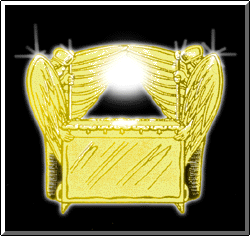
Even the Arc of the Covenant was gurded by two part-human, part-animal
cherubim. Dragon or cherub figures are mentioned at other point in the
Biblical legends. Moses is depicted as having to kill wayword Hebrews for
their failure to adhere to monotheistic restrictions. It was in this context
that the Jewish myths such as that of Adam and Eve were formulated in their
final forms.
After the destruction of Jeruselem, some Jewish people were taken into
captivity by Nebuchadnezzar (586 BCE) and forced to live in the heart of
grain-growing Mesopotemia, or in dispersal throughout much of the the Mediterranean.
One way to read the Biblical stories is as a tool that could be used in
an attempt to save a weak paternalistic culture from assimilation into
the dominant polytheistic cultures of the region. How was a single Angry
Sky God to compete with other popular gods such as the nurturing Mother
Earth? Moses was written larger than life as the great Law Giver and source
of "good" knowledge and wisdom (the ten commandments). The competition,
the serpent god of wisdom and the maternal earth figure, were condemned
as the source of "evil" knowledge and disobedience to the One True God.
In another sense favored by Jewish cultural historians like Abba Eban (Herritage:
Civilization and the Jews), Jewish tradition transcends the snake skin
shedding-like cycle of cultural birth and death. How were a people exiled
from their homeland to maintain any cultural cohesion? Why not enter into
memetic engineering and remove all use of the old symbols and idols, forcing
the people to concentrate on one God? This effort of cultural survival
was assisted by the religious diversity of the Persian Empire 550-330 BCE.
The satrapies of administrative subdivision of the Empire sometimes allowed
for autonomy of conquered people, as under the rule of Cyrus. A second
Temple was constructed by 515 BCE. Jewish people had to find a new way
to live within cities of the Persian Empire.
The widely-spread Persian Empire was also important for allowing Eastern
ideas to influence Jewish thought, such as the idea of a great struggle
between light and darkness in the world. After Alexander the Great destroyed
the Persian Empire, the task of translating the Bible into Greek was begun,
within a cultural environment including many new influences. By 64 BCE
the Roman Empire dominated the Eastern end of the Mediteranean and Jerusalem
was once more destroyed, Jewish thought was greatly fragmented into various
sects, and a second Jewish exile was decreed.
Out of this defeat came the origins of Christianity and the Talmudic
commentaries on the Bible. It was mainly through Christianity that Jewish
thought reached Europe, triggering centuries of cultural warfare with indiginous
pagan peoples. Christianity brought a new way of human interaction with
the world. Pagan traditions emphasized a unity between humans and the rest
of the natural world. Christianity was a faith built on man placed above
the mindless confusion of the beasts and natural forces. Rather that taking
a path of conciliation towards the chaotic forces of nature as embodied
in mythical god figures, Christianity taught that people should dominate
over nature and take fate into their own hands.....people have the power
to move away from evil and the endless cycles of nature toward what is
good for humans. An organized pursuit of knowledge, even natural theology,
was an inevitable outcome of such thinking. Early Christian thinkers were
greatly influenced by both their Jewish heritage and traditions of Greek
thought going back to Plato and Aristotle. After leaving this section dealing
with Judeaic mythology, a natural next topic is the history
of philosophy, starting with Plato and other Greeks.
 Adam,
Eve, and the Serpent
Adam,
Eve, and the Serpent
by Elaine Pagels
The well-known story of Adam and Eve is told in chapter 2 and 3 of Genesis.
Initially Adam and Eve live in a state of innocent bliss in the Garden.
God tells them that they can eat from any tree with the pointed exception
of the Tree of Knowledge of Good and Evil. The serpent suggests to Eve
that eating from this Tree will open her eyes and make her wise. After
she and Adam cast aside caution and eat, God appears and they hide. He
asks why are they wearing fig leaves and Eve confesses, blaming the serpent.
Then Adam confesses, blaming Eve, "the woman You gave me": in effect blaming
God. God responds with a threefold punishment:
Woman will experience pain during childbirth.
Man will no longer be pampered but must work by the sweat of his brow.
Both will become mortal, anticipating that life is finite.
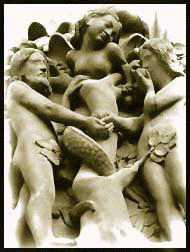 "Adam,
Eve & the serpent"
"Adam,
Eve & the serpent"
Notre Dame de Paris
Many words that are used to describe extreme religious fervor are also
used to describe great sex, such as passion, bliss, and ecstasy. There
were many orgies throughout the year as celebrations in the religion of
the Goddess. Many of these celebrations have been taken over by the Christians
who removed their sexual nature. The best known is undoubtedly Christmas
taken from the pagan festival of Saturnalia.
All of these ancient rituals, these orgia, involved group sex and nudity.
The hang ups and inhibitions that most people have about having sex in
groups or in front of other people are largely the result of Biblical attitudes.
Sex, was something to be done only in private behind locked doors, and
only for procreation. Those restrictive ideas come to us from the Bible,
in which nudity is condemned as soon as Adam and Eve ate the apple (or
technically, the Fruit of Knowledge of Good and Evil). (Source)
One has to wonder to what extent Freud's discovery of the unconscious
was derailed or at least side-tracked by Western bashfulness.
In the Orient there was a great interest in The Way of The Body, of
the unconscious wisdom that we are born with. In the West, all emphasis
was on initiation into an adulthood that takes you beyond the Body. It
is interesting that only by first turning our backs on the Body did we
in the West find a way to finally return to the Body with the tools that
are required to truly understand it. Of course, this reorientation is not
painless, our knowledge did come at a high cost.
It is not unusual for us to find that in later ages, especially
among Semitic and Indo-European
peoples, the dragon [ Greek drakon = serpent] or cosmic serpent is
seen as a symbol of chaos.
It is this chaos, or serpent which must be overcome to create order
and maintain life in any
meaningful way. (source)
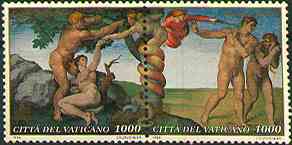 Source
To a people living in the cultural melting pot that was the Middle East,
the many meanings associated with the figure of a snake would have been
well know. To a nomadic people living before the age of cities, a people
exiled from the great river valleys, snakes could easily have had a mostly
negative connotation. Snakes bite people. Snake bites open up holes. Blood
comes out of bitten bodies.
Holes, and the power to open and close them, are fundamental elements
and concerns of human thought. Holes are sources and sinks. For a whole
society, wells can be metaphorical sources of cultural knowledge. For an
individual, a hole can be a source of death (the bite of the Achilles heal)
or sources of knowledge (a bite between the eyes opens a new eye of inner
vision). The serpent is an excellent symbol of change (shedding skin),
rebirth, initiation into the new, transcendence of the old. (See Joseph
Campbell
on Myth)
Human life starts in a state of dependency. Children are dependent on
the mother for life, dependent on society for cultural knowledge and wisdom.
Sexual maturation marks the end of dependence and the entry into adulthood.
All humans must be initiated into an adult state of teaching from an infantile
state of learning. This is the human survival strategy. Snakes are common
symbols for initiation rites, for opening up the infant to the knowledge
of the adult human.
Similarly, all of human kind must have graduated from the simple ways
of Beasts to the complex termoils of human knowledge. It makes sense to
apply the symbology of the snake to the human initiation into a world of
knowledge.
How does the Tree of Knowledge fit into the Eden myth? For primates,
there has probably always been something special about Great Old Trees.
The largest tree of one's experience is likely to be the oldest living
thing in one's world, the Cosmic Tree. Most cultures looked to natural
features of the landscape as the metaphorical sources of human cultural
knowledge; old mountains, deep springs, old trees. A snake in a tree can
open your mind to the world of knowledge. Why a talking snake? Surely it
is human language that makes it possible for us to share our cultural knowledge
more efficiently than is possible for non-speaking primates like chimps.
Myths involving talking trees are also known from various cultures.
The following is from: Mystical World Wide Web MYSTICAL
TREES :
Tree of Knowledge and Tree of Life
Both trees are said to stood in the Garden of Eden. The forbidden fruit
of the 'Tree of Knowledge' is said to have
brought the creation of man into being and that the 'Tree of Life'
enabled man's redemption, the latter providing
shelter and shade for the former. According to Christian philosophy,
the Tree of Life has also been called the 'Tree of
Adam' and the 'Tree of the Cross'. The tree is believed to have dense
green foliage and to have provided Adam and
Eve with shelter from God's watchful eye. (Some believe it may have
been a Fig or Banyan tree). Brought naked into
the world the tree is thought to have provided the two with leaves
for clothing.
According to one of the legends attached to the Tree of Knowledge, it
is said by some that Eve concealed a branch of the
tree when leaving the garden which she later planted. Some believe
that this was not the case, and that the Archangel
Gabriel in fact gave Eve three leaves on a small branch from the Tree
of Knowledge and told her to plant it on Adam's
grave. This she did and the branch grew into a tree. The tree was later
removed and replaced by an ornamental tree,
planted by King Solomon. The tree was then submerged in the water of
the pool of Bethesda.
The Tree of knowledge comes right out of the mythology of Mesopotamia.
People of the Great River Valley know the river as the source of life,
the source of ALL. The source of the river is easily seen as the source
of cultural knowledge. In the forests of the rainy head-waters, there must
stand the Tree of Knowledge. Of course, the serventine path of the river
goes right to the Tree of Knowledge. When the Sun shines unmercifully,
the rains do not come, the river is dry, the snake dies. Why is the Sun
hot and burning? In anger over the humans who have turned to the river
goddess and her tricks rather than remembering the true god of the powerful
Sun. Knowledge and the human place in nature all come together in the Eden
myth in a fundamental way. This is the knowledge myth that set the Western
world on the path to modern science and technology.
A modern Eve and Serpent.
 Image
Source.
Image
Source.
After a 2000 year diversion of Platonic Realism and the discovery of
Modern Science, the Western world rediscovers the body and the unconscious.
Judaic Water Myths.
Some cultures explicitly use wells and springs
as symbols of knowledge. The Eden myth begins at the Head Waters of the
Great Rivers. The importance of the waters of rivers is fundamental to
the great civilizations of Egypt, Mesopotamia, the Indus Valley. It is
no surprise that the Hebrew legend puts the Tree of Knowledge at the source
of the Great Rivers. For a nomadic people who were developing their culture
in an arid environment while they participated in deforestration and desertification,
it is no surprise that they would prize old tales of origins in a lush
forested garden.
Part of Judaic mythology is tied up with the battle between the Sun
and the rains. The whole Moses legen is set up by Joseph and his ability
to foresee a period of drought. Joseph is personally baptised; dumped into
a well and then pulled out. While in Egypt the Hebrews learned to equate
their tribal god with the Sun god (Re). Of course, it was a masterful piece
of memetic engineering to strip all of Hebrew mythology of its idols and
gods, leaving a single mysterious God that endlessly and cyclically burns
its wrath into the people or lets flow the good times.
When Christianity was constructed, incorporating
more pagonism than is allowed in Judaism, practices like imersion in the
Great River (Baptism) could be incorporated.
The close association between water and knowledge is firmly rooted in
the Great River Valley civilivations. The rivers became sources of everything,
and one had to get into the water to get to the source, or actually go
to the head waters to get even closer to "the source". I find it interesting
that the Eden myth is located on the surface of Earth for us by means of
relating it to the convergence of four rivers. In the way that Issac Asimov
discusses the Biblical description of these rivers,we might be led to imagine
that the mythical source of knowledge was some where in the lower Euphrates
river valley where the Tigris and Euphrates converge on their destination,
the ocean. I suspect that a some point during the past 1,000 years the
Garden of Eden has been located at just about every possible spot on the
globe. In my case, I take "the Garden of Eden" to be a cultural remembrance
by the Babylonians of about 600 BC thet relates directly to their cultural
memory of where their culture originated. The authors of the Bible faced
a tricky bit of surgery; how to graft the traditional lineage of Abraham
onto the Mesopotamian Eden and Flood myths. An explanation of the origin
of "man" as in the people of Babylon had to, at some point, be linked into
a specific human family lineage. Lineage was so important that the authors
of the final version of Genesis decided to go right to the very start and
make Adam a creation of God,and the start of the Hebrew blood line. However,
it cannot be ignored that even the original Hebrew versions of the creation
story were less personal than the final version. And certainly we know
ipendent of Bible sories that there was a whole world full of people into
which the Hebrew blood line must be integrated, even if the authors of
Genesis did not want to talk about that,uld not intelligently discuss it
because they did not know how to. They also took some pains to indicate
a location for this origin. Why bother? Two linked reasons; if you claim
to know the names of all of your relatives back to the creation, you must
know something about where they came from and because Babylon still had
such a memory of its source. I fe need to suggest an "opposite" alternative
to that taken by Asimov, so rather
than looking to the mouth of the great Mesopotamian rivers, wat happens
if we look to the source of those rivers? I make no claim about the correctness
of this reading of the Eden myth, but suggest it as one way to explore
the memory that a culture has for its roots. It is a good example of how
cultural knowledge can be both fragile yet persistent. Perhapse most importantly,
it illustrates how memories can be wrong, yet also be accepted by the rememberer.
If the memory "works", why worry about the question of it being "true"
in the absolute sense. Memories often need only be true for the rememberer.
Go here for an example
of the "headwaters approach" to the location of the Hebrew knowledge origin
myth, is the source of the following map which
shows a possible location for Eden in the Ararat mountains.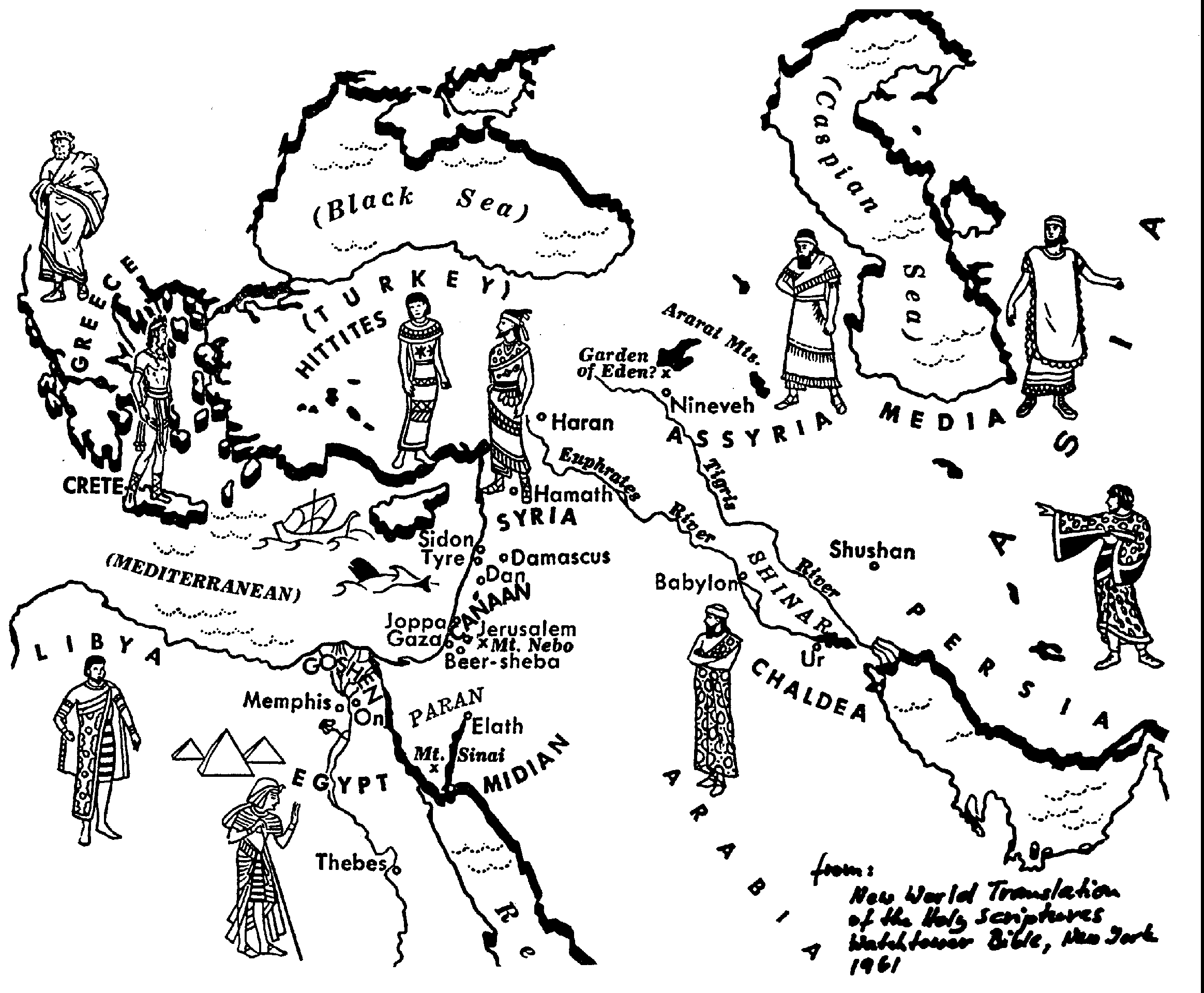
When the Eden myth of Genesis was constructed in the form we now know
it (by Hebrew scholars working to "pick up the pieces" after the Babylonian
Exile), they knew that the Hebrews were a people rooted in the culture
of Mesopotamia. This is not to say that the Hebrew entanglements with Egypt
were unimportant, but we know that the ancient creation myth of the Hebrews
is of Mesopotamian origin, not Egyption. The idea that Eden is in Africa
might appeal to modern "out of Africa" thinking, but I do not buy it. Go
here for an African
Garden argument.
Eden near a garden containing the Tree of Knowledge and the Tree
of Life.
I'll assume that "Eden" meant the great plain through which the Tigris
and Euphrates flow.
"A river flowed through the Garden"
So for the "garden" we want a place, relatively small, that one river
could pass through. However, if there were such a river still flowing in
the time of Mesopotamian culture that influenced the authors of Genesis,
then it would have been named, unless t were some problem, such as tiver
of the garden being so tiny that nobody would have known the name except
a local inhabitant of the garden region. Another possibility is that a
geological or climatic change might have eliminated such a small river.
Such a change might have been the real reason why people would have moved
down from the mountains into the great river valleys. We probably need
not look for a "natural" source of such change. Humans have a solid history
of destroying arid and forested mountain ecosystems through over-grazing
and utilization of the trees for building material and fire wood.
From Genesis we also have the idea that there is an entry path to the
location of the Tree of Life that can be guarded by a sword. To me, this
sounds like a narrow valley or canyon that existed in the headwaters above
the plain, Eden.
There is one more thing, the bible mentions that it is a flaming sword.
Is this just a mis-shaped reference to a volcano, perhapse concocted by
and for people who had left a mountainous region that contained volcanoes,
a people who forgot what a volcano is?
The Eden story says of the river of the Garden, "afterwards the river
divided into four branches." What does this MEAN? If the river of
the Garden (that points towards the land Eden, the plains below) is now
dry, then (metaphorically at least) we can say that where that river once
ran, there are now four rl, flowing rivers. Now I take two of these to
be the Tigris and the Euphrates. What about the other two? I suggest that
they are rivers draining into the Caspian. The convergence of these four
is on the head-lands, where the Trees are, in a mountain valley.
The mountains above the plain of the lower Tigris and Euphrates river
valleys has high peaks and deep valleys. The barren hills would have been
covered by forests in ancient times before being denuded by pasturalism.
There were once cedar forests and these are the forests that you read about
in the epic literature of the Sumerians, e.g. in the Gilgamesh epics. These
are the cedar forests of the mountains. And these mountains play a crucial
role in the mythology and religion of Sumer. (source)
The people who came down from those mountains
had their own Sumerian gods who were associated with the tops of mountains.
When these gods were brought down from the mountains the Sumerians built
zigurats, i.e. towers to recreate the mountain abode of the gods in the
lowlands. That is the fonction of the zigurats.
Now, the map shown above is a good representation
of how most Westerners think about the Holy Land, but it is misleading.
It only shows the three main rivers of the Fertile Crescent. If we are
following the course of the Tigris and Euphrates rivers to their sources,
this map does a poor job, because the Euphrates turns west into the same
mountains that the most northerly tributaries of the Tigris originate in.
Here is a better view, also from this
source.
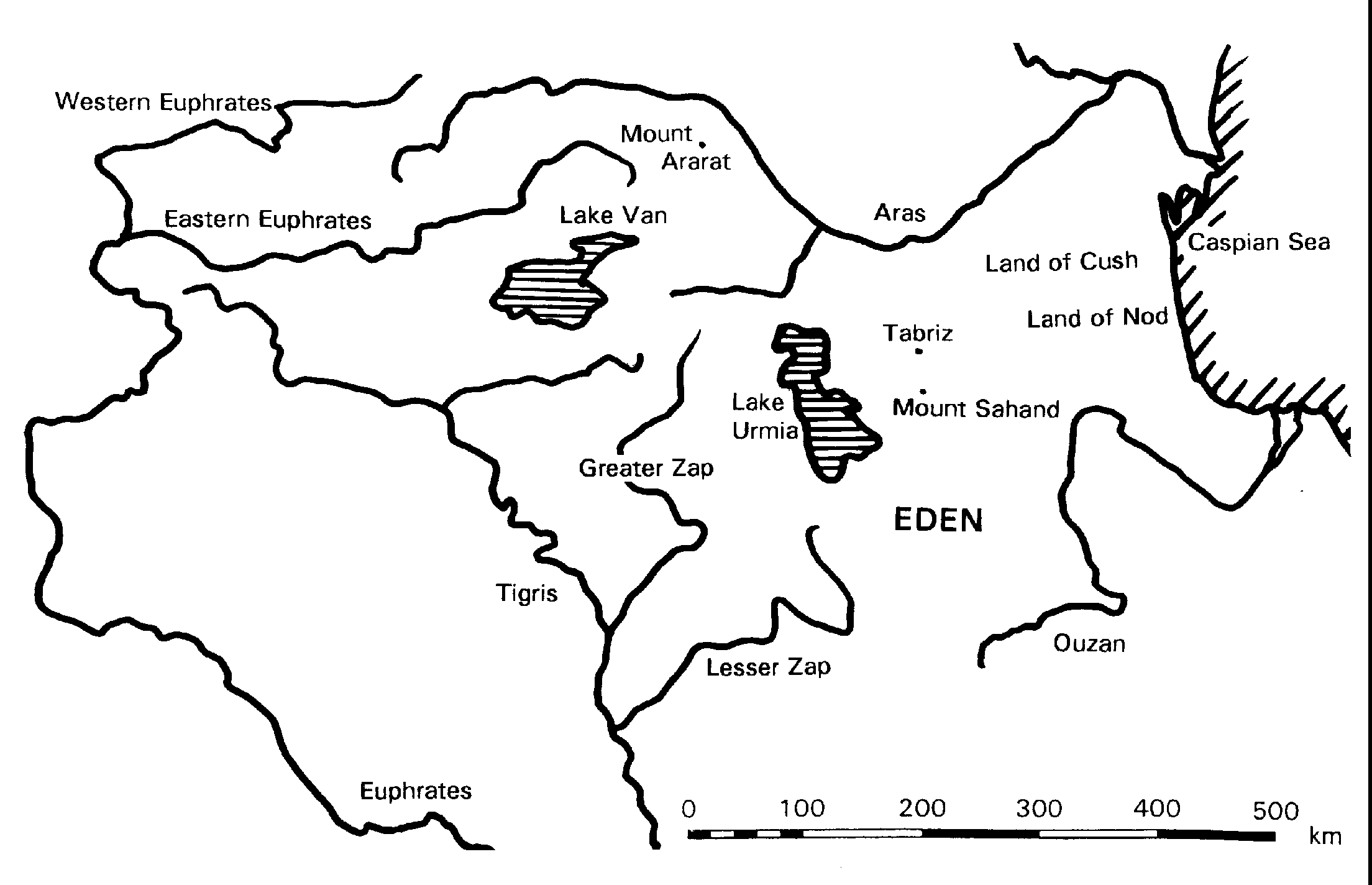
Besides the Tigris and the Euphrates, there is another major river
that comes out of the Lake Van area. This third river flows into the Caspian
Sea. The modern name of this river is Aras (in Greek: Araxis). But if you
check on this sort of things, the thing you do is to go back to local topper
names from different periods and you try to find out what the names where
as well in ancient times. And if you go back to the Islamic invasion of
this region, the Islamic historians called this river something quite different.
They called it the Gaihun. And in fact in older commentaries on the Bible,
like last century ones, you'll see it called the Gaihun Aras or the Gaihon
Araxis which, of course, is the biblical Gihon (notwithstanding the fact
that near Jerusalem there is also a river called Gihon which, incidently,
may also have had another name in ancient time). So we've got three rivers
out of four. (source)
The fourth river empties into the southern end of the Caspian Sea. The
modern name of this is the Uwzon or Uizon. Now that doesn't sound like
Pishon until you realise that there is a linguistic problem which is that
the letter "U" can become the letter "P". Here is an example: there is
a site down here in the Zagros Mountains which is called Pishdeli today.
When they made archeological excavations there, they found tablets naming
the place as Uishdeli, i.e. transfer from "U" to "P" and "P" to "U". So
there is extra-biblical archeological support for substituting the Uizon's
"U" with a "P", with the result that you come reasonably close to the biblical
Pishon (or Pison). The Zagros Mountains form a great chain, a great barrier,
that separates paradise from the mundane. (source)
Now, i we assume that we are trying to find a "garden" that the authors
of Genesis tried to locate in terms of the source of these four rivers,n
where do we look? Lake Urmia is a large lake, it's got a volcanic island
like that and it's a dead lake. It's a dead lake for with its high salt
content it supports no life in it. The Lake Urmia region contains volcanic
mountains
such as the huge volcano called Mount Sahand, a natural cone.
Now volcanos have always been a part of human history. It is thought
that humans evolved in the part of Africa near the great Rift Valley, a
place where there is a rip in the crust of the planet and volcanic debris
have been important for preserving allowing the dating of human fossils,
and even the preservation of human foot prints from millions of years ago.
I also thought that a climatic shift in East Africa was important for human
evolution, basically forcing humans to evolve to utilize dryer lands, to
move out of the lush jungles that are still the home of the West African
apes. Carl Sagan suggested that the serpent of the
Eden myth might have deep unconscious relevance to us because of the dangers
that our human ancestors faced from large predatory reptiles. I wonder
if the struggle against desertification is also built into our genes and
minds? In an arid climate, mountains like volcanos stick up into the moist
air and collect rain. Think of the environment of the mountain gorrila.
The history of the human race is probably intimately tied up with movements
between mountains and valleys.
Near Lake Urmia there is still a lush valley with a river that flows
into the lifeless Lake. At its mouth there is a large swamp and salty estuary.
And then beyond that estuary here is a very beautiful section of the river
valley which today is full of orchards, every kind of trees. The waters
of this river flow from the mountains and one source in particular flows
down from the volcano Mount Sahand. This is the valley of Tabriz, the city
of Tabriz is located at the heart of this lush
valley. Tabriz is at the end of the silk road from China, so it is
very important in different parts of history. The river in this valley
has a Persian name: Medan. In Persian, Medan-el-sha means the Royal Garden
of the King, or the public square as it's become today. The river is named
the Garden.
There is a pass which leads from Tabriz over the mountain range to the
North and down into the valley of the Gihon river. A tall mountain in that
range is called Cushedag, the Mountain of Cush. The Bible says that the
Gihon flows in the Land of Cush. Descend the valley, the road rises up,
out of the valley and goes through a pass and as it drops down the other
side it goes to the town of Ardabil where all the earth quakes are. All
over this region there are villages called Nod. In fact they are called
Nod-i (belonging to Nod), like pakistani (belonging to Pakistan), inglesi
(belonging to England): "i" of a belonging. The villages are all called
of Nod. This is the Land of Nod of the Bible where Cain is exiled.
Wen the Bible says Eden, it might also sometimes mean the low lands
of the Urmia basin. Iuld be that "eden" originally meant the bottom of
the Urmia basin, w later it was a term applied to the larger plain of Mosopotamia.
A river went out of the basin, up into the mountain valley where it watered
the garden, the father of Seth ate fruit and got in trouble because of
it. The river was parted by a ring of mountains, the mountain "divide"
that forms the edges of the basin. Outside of the basin the waters flow
the other way (outward from the basin), and there are four great rivers
surounding the basin.
The occupations attributed Cain and Able are interesting. Human civilization
must have arisen amongst a basic conflict between hearders and farmers.
As the mountain pastures were slowly destroyed by over-grazing, farming
of the watered valleys would have been increasingly important. The Bible
depicts the farmer as being a murderer of the hearder; what must have been
a common fear for the early Hebrew nomadic hearders. The story of Cain
and Able as told in Genesis should remove from everyone's mind the idea
that Adam was the first man. Cain goes "east of Eden", marries a
local girl there, and founds a city. The authors of Genesis take pains
to label both cattle hearders and makers of bronze and iron the spawn
of Cain; not surprising for hearders of sheep and goats who were harried
for centuries by well armed invaders.
So, the mountain valleys are the kind of place that the Hebrews could
have remembered as their origin. One particular valley could have been
the first place that the tribe began to tend fruit trees, their first step
towards agriculture. How do you tend you heards, moving through the mountains
to the best pastures, while also protecting you favorite vinyards? Somehow
you have to mark your fruit and keep others away from it. Apes are good
at this, there is always some monkey that has to be chased away, so the
tribe has to patrol the borders and defend the good fruit. If someone tries
to take your fruit you scream and hollar and scare the invader away. And
what happens if YOU eat the fruit that is not yours, that you have been
warned not to eat? YOU are chased away. But a funny thing happens when
you graze mountains. The land changes slowly over the course of generations.
Eventually there are too many people and not enough resources. Conflicts
over resources increase, but the people are not even aware that it is their
own activity that caused the problem. Who do they blame? A rather harsh
God?
Of all the trees, why such a fuss over a Tree of Knowledge? And why
a specific type of knowledge? Knowledge of the Conscience, of Good and
Bad. Why is leaving the original Hebrew home valley associated with knowledge
of Eve's naked body? The Bible is full of a struggle against the raw powers
of human nature. Who does the struggling? Somehow, he has no name.We have
retropectively attached the general word for "man" to this mythical charaacter,
"adam", but I will call him "the father of Seth". In the Eden story, the
father of Seth learns what "bad" is: bad is taking someone else's fruit,
bad is having sex with this woman who also ate the fruit. Is this just
all placing the blame for the consequences of the natural course of over-grazing
on some target you dislike? And what is this target? The fertilty goddess
and the serpent god that compete with the True God for the people's attention?
Eating fruit was the path to experiencing the "bad", movement away from
pastoral existence. The way the human brain works, sensations of good and
bad (pain and pleasure) are the source of our sense of what is "right and
wrong". There is cultural knowledge that is forced upon us that is "wrong"
for us. If we are true to God and resist he bad knowledge, then we will
stay out of trouble.
So much for the Tree of Knowledge, what about the Tree of Life? Why
are people who know the evil of the serpent and the fertility goddess never
to be allowed to return to eternal life?
The Serpentine staff of Moses
After the Eden myth the start of Genesis, we next meet the serpent
in Exodus 4:3,4 and Exodus 7: 10-12. In these passages the snake, presumably
the Egyptian asp, is connected to a rod. Aaron's rod. When Moses doubts
that he is really
hearing the voice of Yahweh, he is asked what he is holding in his
hand and when he replies that he is holding a rod, he is commanded to throw
the rod down on the ground. When he does this, the rod becomes a serpent
[ Exodus 7:1-16]. When he picks it up it becomes a rod again. This association
between serpent and rod is a very ancient one. Later when Aaron throws
his rod down before Pharaoh, it becomes a snakes. Pharaoh recognizes this
magical association, as do the Egyptian
priests, who also change their rods into serpents. However, to demonstrate
the superiority of the Jewish god, Aaron's snake ate the Egyptian snakes.
(source)
Again, when Moses sets the plagues upon Egypt, he does so by stretching
forth this serpent/rod.
When Moses parts the sea for the passage of his people, he again does
so with the assistance of this
powerful rod/serpent. In the wilderness Moses strikes the rock with
this same rod to create water.
This object becomes so "sacred" that it is one of the objects for which
room is made in the Ark of the
Covenant.
Before we examine some more ominous aspects of the serpent in Jewish
scripture we will have to look
at Numbers 21:9. Moses, who had thrown a fit when Aaron made a golden
image of the Egyptian
goddess of mercy and miners, Hathor [ Exodus 32: 19-20] claming that
God condemned such terrible
action, himself makes and puts on a pole a copper, or brass serpent,
claiming that God had ordered
him to make and display this image to cure the people from snake bites.
Here we see not only the
divine power of the serpent, but also the connection with healing which
pervades this part of the
world. This action by Moses might show his Midianite heritage or the
universal recognition of the
divinity of the serpent, but it certainly shows a different Moses.
One might ask how can a 'jealous
God' condemn the golden calf and approve the 'brazen serpent '? What
is it about the snake that
commands such loyalty?
Perhaps we can find a hint as to the position of power in Judaism when
we discover that one of the
most powerful of the heavenly creatures may have serpentine connections.
We find in Isaiah 14:29 a description of the highest of all of God's
angeliccreatures, the Seraphim.
The word 'seraph' [of which Seraphim is the plural] can be translated
" fiery serpent". There are other
Hebrew words for serpents : "zacha" can be translated as dragon; "pethen"
is the asp; "epheh" is the
viper and " nachash" is the generic word for serpent. Therefore there
must be significance that the
word used for serpent inIsaiah 14:29, Isaiah 30:6 and in the Numbers
21:8 description of a serpent, is
the word "seraph" Could it be that these "fiery serpents" stood highest
in the hierarchy of angelic
beings? There is no doubt that the Hebrew 'shrpm' refers to serpents.
Leviathan
Perhaps the best citation would be Isaiah 27. In this passage Leviathan
is described as the 'elusive
serpent' and 'Dragon of the sea'. This latter description can be translated
[ and we find it so in the
Tanakh] "The monster which the Lord vanquished of old; the embodiment
of chaos, or perhaps the
forces of evil in the present world. (source)
Link to Hobbes
Any relation to the Lillith legend?
When Moses brought the Hebrew god from mount Sini up to Canaan, the
entire area was influenced by a near Eastern Serpent Goddess Anat, who
was depicted as the sister and consort to Baal (Baal is found in the Bible
and some of the earliest alphabetic inscriptions), God of Storms and Rain
and Lightning (similar to Zeus and the Hebrew god). Every tribe had their
own version of Baal who was thought to reside on a local mountain. It is
easy to see how the Hebrews would have taken pains to put their mountain
god in domination over all others. The turn to monotheism probably had
its roots in Egyptian influences.
In addition to the Tree of Knowledge, the Eden myth mentions a Tree
of Immortality. There is evidence that in the arid and hilly lands where
the nomadic Hebrews formed their Kingdom, a common practice was to construct
channels in the hills to collect what little rain fell into small areas
where hardy vines and trees could obtain enough water to produce fruit.
In such a culture, trees might have taken on the role of being sources
of knowledge and life that other cultures inhaibiting better watered terrain
would have associated with wells and springs.
The myth of dominance over the serpent isn’t just in the Judaic tradition,
but iseen in many other cultures.
Excerpt out of "The
Two Babylons" by Rev. Alexander Hislop:
The Greeks represented their great god Apollo as slaying the serpent Pytho,
and Hercules as strangling
serpents while yet in his cradle. In Egypt, in India, in Scandinavia, in
Mexico, we find clear allusions
to the same great truth. "The evil genius," says Wilkinson, "of the adversaries
of the Egyptian god
Horus is frequently figured under the form of a snake, whose head he is
seen piercing with a spear.
The same fable occurs in the religion of India, where the malignant serpent
Calyia is slain by Vishnu,
in his avatar of Crishna...; and the Scandinavian deity Thor was said to
have bruised the head of the
great serpent with his mace."...In reference to a similar belief among
the Mexicans, we find Humboldt
saying, that "The serpent crushed by the great spirit Teotl, when he takes
the form of one of the
subaltern deities, is the genius of evil- a real Kakodemon."
more memory myths:
Egypt
Africa
China
Celtic
India
Norse
Greek
Mesoamerican
return to main Memory Mythology page.