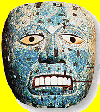
 Image source.
Image source.
Quetzalcoatl was a god of knowledge. One of the gifts of knowledge allegedly delivered by Quetzalcoatl was the method of making tortillas. Quetzalcoatl was also credited as being the first teacher of medical knowledge.
Quetzalcoatl, God of wisdom, and knowledge was called the father of the Toltecs, who was driven from his homeland by Tezcatlipoca, which began the end of the Toltec civilization. However, he had promised to return one day and reclaim his kingdom. It was said that he would return on the gulf coast, from which he left on a raft of serpents. It was he who the Aztecs assumed Cortez was, as Quetzalcoatl was said to have fair skin. His name meaning “the feathered serpent”, he is also seen as a god of the air. (source)
The main pyramid in the Mayan/Toltec ruins of Chichen Itza is "El Castle", the pyramid of Kulkulcan. This pyramid is often mistakenly called the pyramid of the sun because of its astronomical orientation, but it is clearly dedicated to Kulkulcan, the feathered serpent, the Mayan precursor to Quetzalcoatl. The astronomical detail built into the pyramid is interesting, showing the connection of the Great Serpent and the cosmos, in the same way other cultures often places a serpent across the stars. (source)
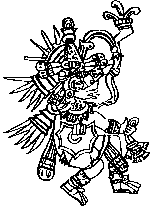 -- Myth
has it that Quetzalcoatl did the following for humanity:
-- Myth
has it that Quetzalcoatl did the following for humanity:
Named all of the landmarks of the
Earth (mountains, seas, etc.)
Discovered maize
Created fire (in the guise of
Mixcoatl)
Established the maguey culture
--
octli brewing and ceremonial drunkenness
Gave instruction of music and
dance
Cured eye ailments, blindness,
coughs, skin afflictions
gave the priests the practice
of curandero,
the diagnostic casting of lots
( a sort of medical divination )
Helped with fertility problems
Sired royal lineages
Established the priesthood
gave proper instruction of sacrifice
and created the Tonalmatal
(Book of the Destiny Days)
Domesticated animals. (source)
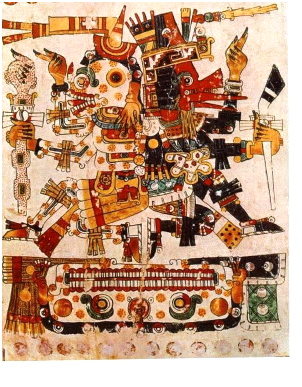
The Tultecs and Aztecs of Mexico called him Quetzalcoatl, the Incas
called him Viracocha. To the Maya he was Kukulcan, who brought them all
their laws, also their script, and was worshipped like a god by the entire
people.
"They could do practically anything, nothing seemed to difficult for them; they cut the greenstone, they melted gold, and all this came from Quetzalcoatl - arts and knowledge." - Fray Bernandino Sahagun.
The numerous legends of the great White God say that he brought the Indians all their sciences, knowledge of engineering, laws, and their higher level of civilisation. (source)
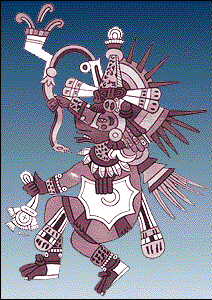
The serpent god Quetzalcoatl (see illustration above) brought knowledge
to the Toltecs in the same way that the serpent in the Garden of Eden brought
knowledge to Eve (see Judaic Myths).
 Who
was Quetzalcoatl? (source)
Who
was Quetzalcoatl? (source)
According to Mayan legend Kulkulkan, the Plumed Serpant, (called Quetzalcoatl
by the Toltecs and later the Aztecs) arrived in Central America in a boat
from across the sea. The Mayans regarded him as the great organizer who
founded cities, formulated laws and invented the Mayan calendar. The Aztecs
revered him as a god of light. He was a bearded white man. Other Central
American deities were Votan, a great civilizer who was white and bearded
and Itzamana a pale skinned, bearded Mayan God of medicine. The Central
American Indians did not have beards.