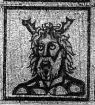
 Cernunnos
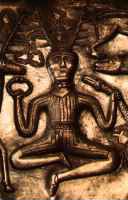 Cernunnos
was worshipped by the iron age Celts all across Europe as late as the first
century AD, and his worship must have begun centuries before that. (source)
Cernunnos
was worshipped by the iron age Celts all across Europe as late as the first
century AD, and his worship must have begun centuries before that. (source)
The Celts had no written language of their own, and although some druids
could write in Latin and Greek they were
forbidden to write down any of their knowledge. The classical writers
themselves never mentioned this particular Celtic divinity, and so we have
nothing in writing about him at all. Everything we know about him can only
be guessed at from the iconography: the images of him created by the Celts
themselves.
Known to all Celtic areas in one form or another. The Horned God; God
of Nature; god of the Underworld and the
Astral Plane; Great Father; "the Horned One". The Druids knew him as
Hu Gadarn, the Horned God of fertility. He
was portrayed sitting in a lotus position with horns or antlers on
his head, long curling hair, a beard, naked except for
a neck torque, and sometimes holding a spear and shield. His symbols
were the stag, ram, bull, and horned serpent.
Sometimes called Belatucadros and Vitiris. Virility, fertility, animals,
physical love, Nature, woodlands, reincarnation,
crossroads, wealth, commerce, warriors.
Saint Cornely of horned beasts? The town of Carnac ? Cernunnos the horned god of the hunt ?
The old pagan deity has been picked up, cleaned up, dressed up, de-horned
and canonised.
Brigit - Brid - Brig - Brigid - Brighid (source)
Ireland, Wales, Spain, France. "Power"; "Renown"; "Fiery Arrow or Power"
(Breo-saighead). Daughter of Dagda;
called the poetess. Often called The Triple Brigids, Three Blessed
Ladies of Britain, The Three Mothers. Another
aspect of Danu; associated with Imbolc. She had an exclusive female
priesthood at Kildare and an ever-burning sacred
fire. The number of her priestesses was nineteen, representing the
nineteen-year cycle of the Celtic "Great Year". Her
kelles were sacred prostitutes and her soldiers brigands. Goddess of
fire, fertility, the hearth, all feminine arts and
crafts, and martial arts. Healing, physicians, agriculture, inspiration,
learning, poetry, divination, prophecy,
smithcraft, animal husbandry, love witchcraft, occult knowledge.
Morgan, a witch goddess, ruled over Avalon, the Isle of Apples, where
fruit and other vegetation grew without
cultivation. On Avalon, there was no sickness, and everyone remained
young forever. Moreover, eternal peace reigned.
There were no criminals, and the weather was always perfect. Morgan
told Arthur that he would regain his health
through her if he stayed on the island, and he accepted her offer.
Avalon is essentially life inside the womb of the
Mother.
Avalon became the Celtic word for "apple" and corresponds to the word
"ablach" in the Otherworld island Emain
Ablach, to which Bran sailed. In Celtic thought, as well as many other
Indo-European traditions, the apple symbolizes
fertility and immortality. (source)
It is the unconscious mind that provides the experiences and landscape
of the Otherworld, but the truths that are
imparted to the shaman come from a higher plane. The journey unleashes
both our fears and our untamed nature, as
well as psychic phenomena so different from our ordinary way of "seeing"
that the journey may become treacherous.
The unconscious is a storehouse of instinctual psychic knowledge that
began before the first humans ever evolved from
life in the primal sea, and we must become reconciled with it in order
to become completely whole.
The Unconscious--itself likened to the sea--recognizes a link between
woman-water-sex-birth-death. We see only the
surface, but the depths are dark, mysterious and seemingly endless.
The women in these Celtic myths are aspects of
the Goddess who is in every man and woman.