The word Naga is rooted in Sanskrit and means "Serpent". In the East Indian pantheon it is connected with the Serpent Spirit and the Dragon Spirit. It has an quivalency to the Burmese Nats, or god-serpents. Naga is associated with initiation rituals, as are snakes in Western cultures. In India and Egypt, and even in Central and South America, the snake figure stands for one who is wise.
Nagarjuna of India, for example, is shown with
an aura, or halo, of seven serpents which is an
indication of a very high degree of Initiation. The symbolism of the
seven serpents, usually cobras,
are also on Masonic aprons of certain systems in the Buddhistic ruins
of Cambodia (Ankhor) and
Ceylon. The avenue leading to the Temple is lined with the seven-headed
Naga. And
even in Mexico, we find the "Naga" which becomes
"Nagal." In China, the Naga is given the form
of the Dragon and has a direct association with the Emperor and is
known as the "Son of
Heaven"...while in Egypt the same association is termed "King-Initiate".
The Chinese are even said
to have originated with the Serpent demi-gods and even to speak their
language, Naga-Krita. For a
place that has no serpents, Tibet, they are still known in a symbolic
sense and are called "Lu!"
(Naga). Nagarjuna called in Tibetan, Lu-trub.
In the Western traditions we find the sae ubiquity
for the Naga, or Serpent. One simple
example is the Ancient Greek Goddess, Athena. She is known as a warrior
Goddess as well as the
Goddess of Wisdom; her symbol being the Serpent as displayed on her
personal shield. Of course,
in Genesis the Serpent is a Naga who instructs the new infant (humanity)
in what is called the
Knowledge of Good and Evil. The Christian church has, unfortunately
transformed the
Initiate-Teacher into a tempting and negative demon-character. An apocryphal
tradition says that
Apollonius of Tyana, while on a visit to India, was taught by the "Nagas"
of Kashmir. (See The
Life of Apollonius, by Philostratos.) It is felt by many scholars
of the Western Tradition that the
life of Apollonius was taken from the New Testament, or that the narratives
of the New Testament
have been taken from the life of Apollonius. This is felt because of
! the undisputed and clear
similarities of construction fo that particular narrative.
Naga is one of a handful of rare words surviving
the loss of the first universal language. In
Buddhism, Wisdom has always been ties, symbollically, to the figure
of the Serpent. In the
Western Tradition it can be found as used by the Christ in the Gospel
of Saint Matthew (x.16), "Be
ye therefore as serpents, and harmless as doves."
In all mythological language the snake is also
an emblem of immortality. Its endless
representation with its tail in its mouth (Ouroboros), and the constant
renewal of its skin and
vigor, enliven teh symbols of continued youth and eternity.
The Serpent's reputation for positive medicinal
and/or life-preserving qualities have also
contributed to the honors of the Serpent as STILL seen by the employment
of the Caduceus. To
this very day, the Hindus are taught that the end of every Universal
Manifestation (Kalpa) all
things are re-absorbed into Deity and the the interval between "creations."
He reposes upon the
Serpant Sesha (Duration) who is called Ananta, or, Endlessness. (See
Ophiolatreiaby Hargrave
Jennings)
. . . . . . . . . . . . . . . . . . . . . . . . . . . . . . . . . .
. . . . . . . . . . . . . . . . . . . .. . . . . . . . . . . . . . . .
. .
Naga
This race of half human, half snake appears in Indian mythology as
both good and evil. They are thought to have emerged from Shiva, the god
of creation and destruction. Even today, people in India worships gods
with serpent attributes, and some cults even have ceremonies that praises
the snake (cobra) with maidens' kisses. (source)
Even in the extremely ascetic off-shoot from Hinduism, the Jains have a serpent tradition. The founder of Jainism, Nataputta Vardhamana earned his honorific title Mahavira [or "Great Man"] by overcoming a great serpent who guarded the ford which Mahavira saw as " The Way". (source)
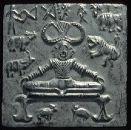 Pashupati
A half serpent (mermaid like) being has been claimed as the legendary ancestor of the Scythians. There similar stories among other Ural-Altaic legends. The serpent like mother of the Scythians, was called Naga who in India, by the local Scythian incomers. To a lesser extent the root word is part of most Ural-Altaic and Sumerian languages. Several of the local Scythian tribes use this word for chief/ruler "Naick". Similarly the Ugrians Nay=queen, Nayer=king. Hungarian Nyek tribe. (Scythian NAICK-erde tribe next to the Aral Sea.)
Relationship of horns to serpent figures.
BOR-isten
The term Bori, Buri, Pur is an ancient term referring to a totemic
ancestor of many Ural-Altaic nations. Seen on the pertoglyps of the Altai
and Sayan. Now due to its animal - totemic nature, the animal may be different
even though its totemic name is the same, for it represents the "ancestor
spirit". Among some, the *"horned" deer is the ancestor for Hungarians
and some Scythians.
Many of the Hun and Turkic tribes had the wolf and various dog breeds as the totem animals and in Turkic languages bo"ru" refers to wolf. Herodotus also mentions the Scythian NEURI, who "turn into wolves once per year...as a ceremony no doubt. This tribal name is much like the Hurrian NAIRI tribal name. The royal tribes of the Huns had the dragon (LIU-ente dynasty) as their totem like the Medes and royal Scythians. It would only be natural for the royal Scythians to have the half serpent half woman being to be their ancestress with the type of legend Herodotus related about the mating of Zeus with such a mythical "mermaid", which Herodotus calles the daughter of Bor-isten(es).
The Hindus are taught that the end of every Universal Manifestation
(Kalpa) all things are re-absorbed into Deity and the the interval between
"creations." He reposes upon the Serpant Sesha (Duration) who is called
Ananta, or, Endlessness. (source)
World Tree of Buddha
Buddhists view the 'Pippala' or 'Acvattha' trees as being the actual
Cosmogonic tree, although some say it may have been a Palm tree. The tree
is believed to be the 'Tree of Ambrosia', the 'Tree of the Wise',
the 'Tree of Perfection', the 'Tree of Holiness' and as a 'Cloud Tree'..
Seen mythologically as a glowing tree of the rarest divine flowers which
glistened. The centre of the Buddhist belief focuses on how and when Buddha
was born. At this time a great flash of light was seen to travel around
the world. After this a branch of the Acvattha grew at the centre of the
universe. Buddha is said to have sat under a tree for six years meditating
in isolation. Many negative forces approached him. The negative forces
took the form of demons that hurled rain, hurricanes, burning darts and
darkness at him. Buddha retained control of the tree and sent the demons
away. Saving the tree ensured that wisdom and knowledge would survive.
It is said that the leaves of the tree are always moving which is believed
to signify that the meditations of Buddha continue. The tree is thought
to be a 'Pippala' (Fiscus religiosa), a sacred tree.
The 'Kadamba' tree is also been believed to be the 'Tree of Buddha'.
With brightly coloured orange flowers the Kadamba tree is thought to return
lovers.
The 'Man'g'ushaka' tree is covered in precious stones which produced
the earth and water. Believed to grow in the Buddhist Paradise and sprinkled
with water from the 'Anavatapta' the tree is a place for meditation.
(Source: Mystical World Wide Web MYSTICAL
TREES )
Review by
Alan Fox of the book `In
the Mirror of Memory: Reflections on Mindfulness and Remembrance in
Indian and Tibetan Buddhism,' edited by Janet Gyatso
"Memory is a problematic notion for traditional Buddhist thought, since
it
has often been associated with both unwholesome and wholesome states
of
mind. In addition, the fact of memory creates problems for
non-substantialist theories of selfhood (e.g., Buddhism), since so
many
substantialist systems use memory as evidence of inhering substance.
Memory
also contributes to the illusion of selfhood, since it contributes
to the
belief that I am the same person from moment to moment or lifetime
to
lifetime. On the positive side, there are aspects of remembering that
are
referred to as smrti, which are associated with meditation and mindfulness
and which in fact are deeply embedded in the mythological story of
the
Buddha's own enlightenment. This is evident at least in the fact that
the
first phase of the Buddha's accomplishment of bodhi entailed the
remembrance or awareness of past lives (anusmrti).
And yet, even though memory is important and controversial, for the
most
part it is only minimally treated in the traditional literature, a
fact
that is both noted and variously explained by a number of the essays
in
this volume. That makes this volume especially unique."
The Buddhist-Humean parallels: Postmortem L. Stafford Betty
A comparison of Merleau-Ponty and Dogen BY Carl Olson
Antiquity of Tantricism By Chintaharan Chakravarti
Two types of saving knowledge in the Paali suttas By Donald K. Swearer
THE PROBLEM OF KNOWLEDGE AND THE FOUR SCHOOLS OF LATER BUDDHISM BY DURGACHARAN CHATTERJI, M. A
Oriental battle of experience vs. knowledge.
Review by Chris Arthur of The Awakening of the West: The Encounter of Buddhism and Western Culture by Stephen Batchelor
more memory myths:
Norse
Mesoamerican
Judaic
return to main Memory Mythology page.