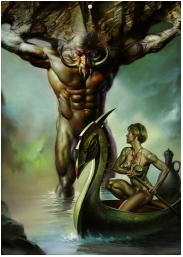
 A
modern image (to left) inspired by the mythical Mimir of Norse mythology,
source.
A
modern image (to left) inspired by the mythical Mimir of Norse mythology,
source.
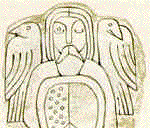
Norse Mythology. This image (left) shows Odin with his two ravens, Memory and Thought. Notice that Odin is depicted as having only one eye. Norse mythology held that Oden sacrificed one eye for wisdom (see Mimir, below).
Most information about Scandinavian mythology is preserved in the Old Norse literature (Icelandic, Swedish, and Norwegian Literature), in the Eddas and later sagas; other material appears in commentaries by the Danish historian Saxo Grammaticus and the German writer Adam of Bremen (flourished about 1075). Fragments of legends are sometimes preserved in old inscriptions and in later folklore. The Aesir family of Gods were the chief gods of Norse Mythology. Odin, king of the gods had two black ravens, Huginn (Thought) and Muninn (Memory), who flew forth daily to gather tidings of events all over the world. (Source)
In Norse mythology, Munin was a raven of memory which sat on Odin's shoulder and along with Hunin brought Odin news each day of what was occuring in the world. (source)
We can wonder why memory and thought are depicted as ravens. One possibility is tht ravens are very vocal and can sometimes mimic human speech.
Mimir
A
modern image (to left) inspired by the mythical Mimir of Norse mythology,
source.
Mimir was a giant of superhuman strength who stood half-immersed in the Waters of Ultimate Wisdom, supporting the Kjolen Mountains on his powerful shoulders. He was said to have been at his post since the world came into being and to have become part of the mountain itself. Oracles in ancient times would bring vessels and retrieve water from the pool in order to learn the secrets of the earth. Mimir was sometimes depicted as perhaps being the brother of Odin's etin-mother Bestla and keeper of the Well (or spring) of Mimir, in which all wisdom lies - the spring where Odin gave up his eye to drink. (source)
Try to recall your first day at school. Your consciousness should have slipped away from awareness of your current surroundings and you should have been "lost in the past", parhapse seeing mental images of your first day of school. In some sense, conscious access of memories of past events always involves a sacrifice, we must shift our awareness away from current perceptual experience of the external world to our inner faculty for recall of memory. By making use of memory to store wisdom, Odin gave up one eye.
Mimir was sent to the Vanir as a hostage with Hoenir, but when Hoenir's slowness of speech was discovered, the Vanir became angry. Unwilling to harm Odin's brother, they lopped off Mimir's head instead and sent it back. Odin preserved it with herbs and spells, and gains much wisdom from talking with the head. According to the Eddic poem Sigrdrífumál, Odin learned the runes from Mimir's head. (source)
It is an interesting question: how and when did people learn that the brain is the location of memories? It has been common for people to assume that certain memories are in the body, say one's legs, if you are talking about the memory for a dance step that your body seems to be able to perform automatically, while you chat with your dance partner. These kinds of memory are usually called "habit" and the story of how they were shown to be the result of unconscious brain activity is a late twist in the history of memory. What was traditionally thought of as memory was explicit, conscious memory. It is not uncommon for blows to the head to cause loss of a temporal block of memory. We now know that memory storage requires a series of active processes in the brain during the minutes and hours following an experience. Disruption of brain activity by a blow to the head which induces unconsciousness can scramble memory storage. More rare would have been cases permanent head injury that resulted in loss of memory. Another possibility is that cervical spinal injuries would have left some people mostly paralysed below the neck, yet still able to control the muscles of the head. Thus, it is possible that ancient people could have recognized a relationship between the head and memory. A more gruesome possibility is that following decapitation, mouth movements are still possible. If a detatched head can still try to talk, then the head must be the seat of the soul.
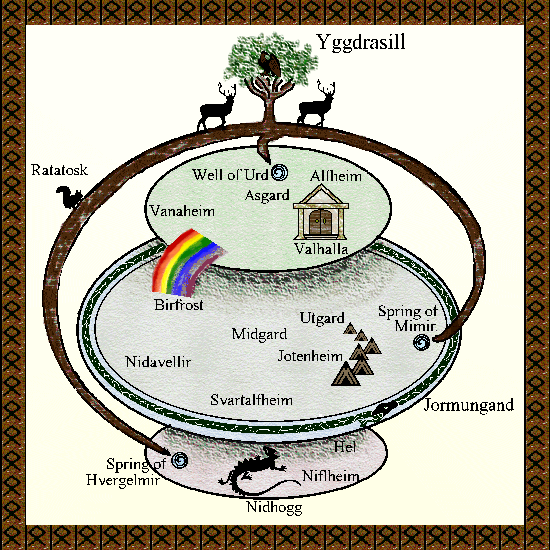 Norse
World of Myth (source)
Norse
World of Myth (source)
Mimir was supposed to have been the wisest of the Aesir tribe of gods, and thus a god of wisdom and knowledge. He was sent to live with the Vanir after the war between the gods. There, unfortunate being, he had his head cut off and sent back to the Aesir. Odin smeared the head with magic herbs so that it would never rot, and recited a magic charm over it that restored its power of speech; all this so he could have Mimir's wise counsel as needed. Mimir dwelt by the ash-tree Yggdrasil, guarding the "Well of Wisdom". Here he allowed Odin to drink for the price of one of his eyes; that is why Odin is usually depicted as having but one eye.
Mimir (Scandinavian): The well of wisdom that lies beneath a root of Yggdrasil, the world tree. This is the fountain from which Odin, sacrificing an eye to do so, drank to gain wisdom. It is also the name of the guardian of the well.
For pre-literate cultures, much of the store of human knowledge is passed from generation to generation. We do not know who the first person was who built a sail boat even if we do know how our parents built one. Much human knowledge just seems to exist within one's social group. How do we explain the origin of such knowledge? It is common for people to devise legends that depict such knowledge as issuing forth from the earth, from streams, from clouds or from other natural sources; it seems as old as the world.
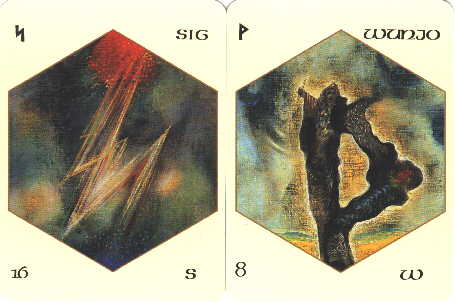 Rune
cards (source)
Rune
cards (source)
Mimir's Head (Scandinavian): When Mimir (the guardian of the Well of Wisdom) was killed, Odin refused to do without his wise council and had the head re-animated. It had a limited precognitive ability, though. (source)
The fact that Mimir's Head did not retain its full faculties of thought is interesting. Can wisdom have both its rational thinking part and a separate spontaneous part that works like an unconscious automaton? Within personal conscious experience, memories do come in two forms: those that arrive in consciousness "from out of no where" and those that we actively search up by means of conscious effort of recollection and sustained application of reasoning.
In Norse mythology, Mimir was a god of wisdom and knowledge. He dwelt by the ash-tree Yggdrasil. (source)
World Tree
Known amongst Scandinavian nations traditionally as the 'Ash Yggdrasil'.
Having three main branches and roots the
tree was believed to have sprung from the beginning of time out of
primordial slime and ashes.
The roots represent time, past, present, and future, and all spread
to reach wells or fountains at different points. The
first root was next to a fountain or well called 'Hvergelmir' in 'Niflheim'.
The second root was by inhabited by
'Mimir' in 'Jotunheim'. The third root was found by 'Vurdh' or 'Urdar'.
This was in heaven and a sacred place
were the gods would hold their meetings.
The central first branch reached out over the whole universe and ran
through the centre of the earth holding it up.
'Asgard' was a mountain and home of the gods and rose up out of where
the root pierced the earth. The leaves on this
branch represented the clouds whilst the fruit were the stars.
The second branch came up by a place of a fountain with holy water and
guarded by the three 'Fates' or 'Norns'
(Vurdh, Verhandi and Skuld). The Fates represented the past, present
and future respectively. The water fed the tree,
and in the fountain one could see two swans which represented the sun
and the moon.
'Hunangsfall' is like honey and is believed to have fallen from the
tree. Scampering amongst the branches and nibbling
the top shoots were four male deer. At the top sits an eagle which
represents the atmosphere with a hawk ('Veorfolnir')
representing the ether. 'Nidhoggr' is a serpent that represents the
inner torment that is in every person and is coiled
up at the bottom of the tree with other snakes, continually attacking
the roots. The serpent waits to take over the earth.
A squirrel, 'Ratatosk', runs up and down the main stem between the
eagle and the serpent endeavouring to engage the
two in a process of salvation. It represents the snow and the rain.
(See Mystical-WWW Animals and Birds : Squirrel,
Eagle)
'Mimir' is seen as a wise man, or in some cases a giant, that dwells
in the second fountain providing a source of
wisdom for man. The water here too provides the source for all streams.
The 'Frost-Giants', or 'Hrim-thyrs' also
live in Jotunheim. When the last judgement or final conflict occurs
a horn called 'Giallr' will be sounded by
'Heimdallr'. He is the warder of the gods who live on the mountain.
When everything in the world is about to end
including time itself the gods and men will be raised for the final
fight, known at the 'doom' or 'twilight'.
The following poem tells us what will happen after the final conflict.
The tree will grow once again and the gods will
meet on 'Idafield' beneath it. A new host of people will inhabit the
earth. They have been hidden during the conflict
in 'Hoddmimir's Grove (the World Ash), Their parents are 'Lif' which
means 'Life' and 'Lifthrasir' which
means 'Desire of Life' (who could be equated to Adam and Eve).
'Woluspa' or 'Lay of Wala'
taken from 'The Edda'
'The sons of Mimir tremble, the tree in the middle takes fire
At the startling sounds of the noisy horn;
Heimdal, horn in air, loudly sounds the alarm;
Odin consults the head of Mimir.
Then the Ash raised from Yggdrasil,
That old tree, shivers; the Jotun breaks his chains;
The shades shudder upon the roads to the lower region,
Until the ardour of Surtur has consumed the tree.'
Also known traditionally as 'Irminsul' in Germanic culture. The name
refers to the trunk of the tree as it represents
the structures which hold up the universe. The roots of the tree are
similar to the 'Yggdrasil'. Wooden sculptures of
the Gods were placed on wooden pillars called 'Irminsul'.
'Upon an yrmensul
Stood an idol huge,
Him they called their merchant.'
The "World Ash, Yggdrasil" had at its base a great cosmic serpent that gnawed at its roots while guarding it. See the Norse Mythical World Map shown above. In this depiction, it is more like a lizzard han a snake, but many cultures categorized many reptiles as serpents, including the Egyptian crocodiles.
There is an old Norse tale which tells of Thor combating a great serpent,
called the Midgard
Serpent. Thor went out of Asgard and enlisted the help of the giant
Hymir. The two went fishing,
and when Hymir would not share his bait with Thor. Thor killed Hymir's
largest ox and cut off its
head. Thor took the ox head as bait, made a very strong line and a
large hook. The Midgard serpent
took the bait and Thor drew it to the boat. The serpent glared at Thor
and belched poison. Hymir,
frightened cut Thor's line and let the serpent loose. As the serpent
sank back into the sea, Thor threw
his hammer after it. Some versions of the legend say that the hammer
struck and killed the serpent,
other versions say that the Midgard serpent is still alive and lying
in the depths.

